DURING the recent midterm electoral campaign for Republican candidates in the United States, President Donald Trump once again intensified his anti-Islamic rhetoric and efforts to fuel Islamophobia. Sharing an inflammatory cartoon on his social media platform, depicting a Muslim holding a torch and setting America on fire, and openly mocking the popularity of notions sacred to Muslims, were highly condemnable acts. Although the Council on American-Islamic Relations (CAIR), an American Muslim advocacy organisation, condemned these remarks as a reflection of political desperation, the questions being raised at the international level are far deeper and more serious.
Trump’s anti-Islamic rhetoric is not a new phenomenon. It has long been part of his political strategy. He has referred to a so-called ‘Muslim problem’, and has advocated a ‘Muslim ban’ to restrict their entry into the United States. Whenever his popularity declines, Muslims become convenient targets for mobilising extremist right-wing groups. This rhetoric has direct consequences for ordinary Muslims living in Western societies, often contributing to discrimination, hostility and even violence against them.
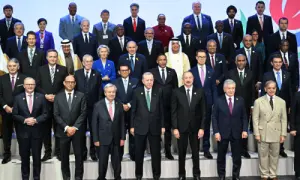
One highly regrettable and thought- provoking aspect of this situation is that London Mayor Sadiq Khan and New York Mayor Zohran Mamdani have the courage to stand up firmly against Trump’s insulting remarks about Islam and Muslims, while the leadership of more than 50 Muslim- majority countries and the Organisation of Islamic Cooperation (OIC) remains shamefully silent in the face of this open hostility.
The United Nations General Assembly has already adopted a historic resolution designating March 15 as the International Day to Combat Islamophobia. Yet, Muslim leaders have not even made an effort to introduce a formal resolution at the international forum in condemnation of Trump’s continued offensive statements.
If these powerful rulers cannot take any meaningful action, then, at the very least, one of them could present Trump with a copy of the famous book by an American author, Michael H. Hart, The 100: A Ranking of the Most Influential Persons in History. After conducting what he considered an objective historical assess-ment, Hart placed Prophet Muhammad (peace be upon him) at the very top of his list. The book, written by an American scholar, has sold millions of copies world-wide. Instead of constantly following Trump, flattering him, and offering him political suggestions, Muslim rulers should consider presenting him with a book written by a scholar from his own country.
Perhaps this would help him understand the respect and admiration that an American intellectual has expressed for the Prophet of Islam. Other scholarly works include The Humanity of Muhammad: A Christian View, penned by Craig Considine, which demonstrate that serious academic circles in the West have always recognised and appreciated Islam’s message of peace, compassion and humanity.
Muslim rulers must abandon their illusion and stop expecting positive outcomes from prejudiced political leaders. It is the foremost responsibility of Muslim leader-ship to break its diplomatic silence, firmly challenge insulting propaganda at inter-national forums, and present the true teachings of Islam to the world through credible scholarly work and historical facts.
Muhammad Faizan Ali
Karachi
Published in Dawn, November 14th, 2026