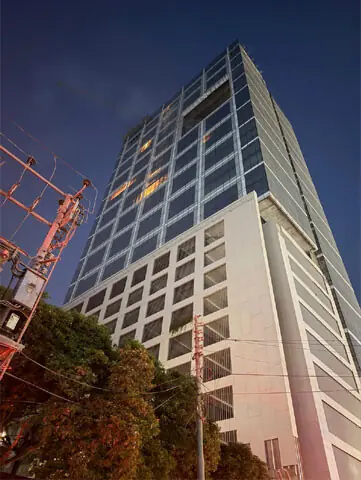
KARACHI: Residents of Clifton on Sunday stood united against the ongoing construction of a “46-storey” high-rise building in the residential area of Block-5, saying they already face water shortages, a faulty drainage system and unpaved streets, and that the construction would further worsen the situation.
Men, women and elderly residents of Clifton gathered near Do Talwar roundabout and marched towards the site of the under-construction high-rise building.
Holding placards with messages such as “Say no to any commercial activity in Block-5 Clifton” and “Our residential streets are not for high-rises”, the residents also displayed a banner reading, “Where will the water come from?”
They claimed that the status of a residential plot had been converted for commercial use, and that it could be the first step toward allowing high-rise buildings in the residential area.
Describing the transformation of the area from the “best” to the “worst”, businesswoman Sabera Tapal said it was sad to see the neighbourhood deteriorate. She added that residents were already facing water shortages, sewerage problems and unpaved streets, and now a 46-storey building was being constructed in the area.
She demanded that there should be “no commercialisation” of Block-5 or any other residential area in Clifton.
Ms Tapal also said that residents had filed complaints with the Cantonment Board Clifton (CBC), the Karachi Metropolitan Corporation (KMC) and the Karachi Water and Sewerage Corporation (KWSC), but none of the authorities had paid heed to their concerns.
Another resident, Shumaila Dawood, told Dawn that the area was once considered a premium locality, with several foreign consulates situated there. She claimed that the area now lacked basic infrastructure, yet the authorities allowed the construction of multi-storey buildings.
Actor Tipu Sharif, who joined other protesters marching towards the under-construction high-rise building, said that the Sindh Building Control Authority (SBCA) had earlier imposed restrictions on the construction of buildings above a certain number of storeys in the area, but now a 46-storey building was being constructed.
He questioned who would manage garbage collection and provide basic infrastructure to meet the requirements of commercial high-rise buildings when the area “was already lacking such facilities”.
Pointing to the ongoing construction work, he said the building was being constructed on a narrow street, making it difficult for residents of neighbouring three-storey buildings to live peacefully. He said their peace had been disturbed by the construction.
He alleged that such commercialisation had been taking place in the area for the past three years.
Sharing details of a complaint filed with the SBCA, Advocate Hafeez Jagirani told Dawn that he had approached the building authority director general, seeking a halt to the construction and removal of an “illegal and unlawful high-rise commercial building” being constructed on an alleged residential plot.
In his complaint, the advocate, on behalf of the residents, demanded immediate action against the builder, alleging that construction was being carried out “in violation of laws and rules based on fake, forged, bogus, manipulated and managed documents”.
He said he had also filed a right-to-information application with the Sindh Master Plan Authority to obtain details about the alleged conversion of the residential plot for commercial use. He further claimed that the relevant authorities had not conducted a geological survey or soil testing. He added that he would also approach the court against the construction of the 46-storey building.
In a press statement, the residents collectively urged the authorities concerned to review the proposed 46-storey building’s development and all high-rise construction on inner residential roads.
They also called for the “strict enforcement of zoning regulations and building bylaws” and demanded the disclosure of planning approvals, environmental assessments and infrastructure-capacity studies.
The residents also reiterated their demand for the protection of Nehr-i-Khayyam against alleged encroachment, narrowing and commercialisation.
Published in Dawn, November 9th, 2026