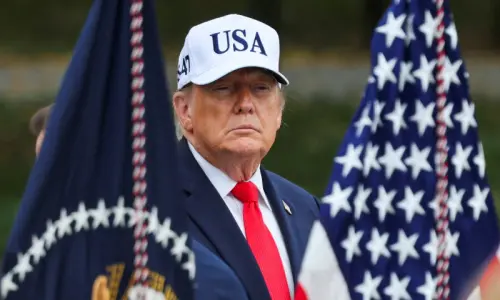
THE resounding defeat of the Republican Party in the US midterm election this week has triggered celebratory chatter around the world. Many see it as the beginning of the end for Donald Trump; the vibe was very similar when Trump was defeated by Joe Biden in the 2020 US presidential election. Yet four years later, Trumpism proved to be alive and very well.
Trump cannot stand in the 2028 presidential election. For that reason alone, his political career is reaching its end. But that does not mean that Trumpism — both the ideology and the social base to which it speaks — will disappear alongside the man himself.
Here I offer some suggestions what this latest election signals about the future of democracy in the US, and, by extension, around the world.
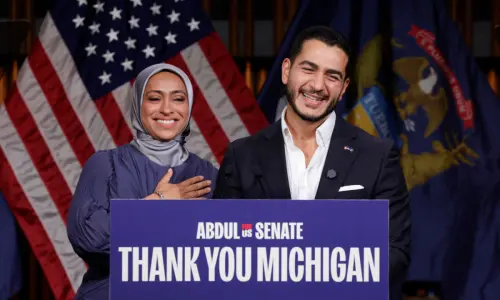
- We should harbour no illusions about the power of big money in American politics, or the Democratic Party’s historical commitment to US empire — the Biden administration’s diabolical warmongering after Oct 7, 2023, in Gaza, after all, set the stage for Trump’s 2024 win. Given this backdrop, the victory of candidates like Abdul el-Sayed who oppose imperialist wars abroad and are fronting progressive economic policies at home — just like Zohran Mamdani did during his successful campaign to become New York mayor — confirms that societal attitudes are changing. A growing number of young Americans now view socialism favourably and want unconditional support for Israel to be discontinued. It is another matter entirely whether an increasingly influential left-wing of the Democratic Party can win the inner-party struggle and then the presidency.
The contemporary state is whittling away democratic freedoms.
-
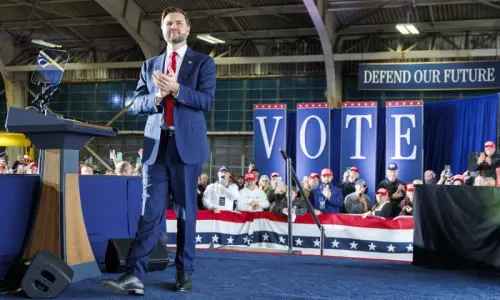
While progressive ideology has gained a foothold in American society, the Trumpist right maintains its powerful, and mobilised MAGA base, sustained in part by Christian evangelicals. Before his win in 2024, Trump vowed to stop fighting wars abroad, and bring back industrial jobs and prosperity. His base has been antagonised by the disastrous and prolonged war on Iran, and the inflationary spiral it has triggered. Vice-President J.D. Vance has already acknowledged this, and even added that Washington’s ‘special relationship’ with Israel must change. Trumpism will not die out because of a midterm defeat. Long-term economic stagnation will give it social mooring, while its major ideological enemies — immigration, the left, and outsourcing — remain easy sells.
-
A useful analogy is that of Brazil, where Luiz Inácio Lula da Silva recently staved off the most recent articulation of Bolsanarismo — the parallel ideology to Trumpism — to win his fourth term as president. Brazil’s left has far greater social roots than the emergent Democratic left in the US, hence its ability to mobilise the last-minute votes necessary to re-elect Lula. But the far right under the leadership of the Bolsanaro family also has a mobilised social base, which will rebound from the election loss. Lula is 81, and his Workers Party will have to deepen the social struggle to keep Bolsanarismo at bay in the years to come.
-
Zooming out further, the right wing is ascendant across much of the world, while the contemporary state is whittling away democratic freedoms and paving the way for capital to carry on with business as usual. Electoral victories for left-of-centre candidates in the US, Brazil or wherever else they may come to pass will not produce structural change in isolation. Does going to the ballot allow ordinary people an opportunity to exercise political choice? Yes. But this is not the same as working-class majorities being organised for progressive social transformation. The latter is required both to ensure more significant electoral success and then to turn such victories into substantive change.
-
Of course, we in Pakistan do not even get to enjoy the unfettered right to vote. The military-bureaucratic oligarchy that has ruled over us from soon after 1947 did not even allow a general election until 1970, and then chose military action rather than handing over power to the winning party afterwards. More recently, the electoral mandate in the 2024 general election was stolen blatantly, culminating in the imposition of emergency in KP. There is something to be said for at least the temporary waves of hope that are generated by electoral victories, even if one should at the same time be conscious of the highly delimited nature of democracy under the rule of contemporary capital. Progressives in Pakistan have to fight an epic battle against tyranny to even retain the pretence that democracy means rule of the people. And then we have to come up with a shared project for how to run a country ravaged by violence, repression and a deep crisis of identity.
The writer teaches at Quaid-i-Azam University, Islamabad.
Published in Dawn, November 6th, 2026