The Antalya test
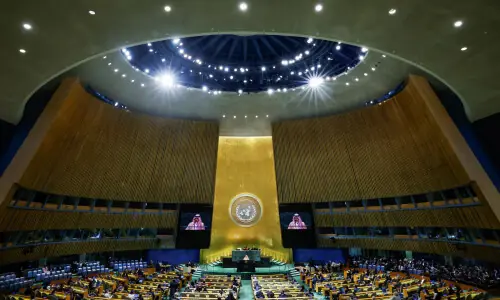
THIS year’s climate summit, to be held in Antalya next month, comes at a critical juncture. COP31 will be shadowed by UN reports that the Paris Accord target of keeping world temperatures below 1.5 degrees Celsius will be missed. Geopolitical tensions have compelled countries to divert attention and resources from combating climate change. With greenhouse gas (GHG) emissions on the rise, 2026 will go down as the hottest year on record. An extraordinary El Niño could worsen matters.
For the first time in the history of the climate convention, two states, Türkiye and Australia, will share roles and responsibilities. Türkiye will have the presidency of COP and Australia has the new role of ‘president of negotiations’. Both co-hosts have been active in preparing the ground for making Antalya a success. Australia hosted a pre- COP summit in Fiji recently, with participation of leaders from the Pacific Island nations — a region most vulnerable to climate change and now also threatened by a menacing El Niño.
Türkiye has linked COP31 priorities to cities, waste and a just energy transition — three critical areas for realising Nationally Determined Contributions (NDCs) in developing countries and accelerating climate action. Cities account for roughly 70 per cent of global energy-related Co2 emissions. Waste, particularly food waste and landfill methane, is the third-largest source of human-caused GHG emissions globally. Yet waste management has been treated as a footnote in climate talks. Antalya has the potential to correct that, embedding circular economy principles and urban climate planning into formal UNFCCC processes. The Just Transition agenda is equally central and considered a political requisite for phasing out fossil fuels to protect households and livelihoods.
The world requires a framework for adequate and timely climate funds.
Branded as the ‘COP of implementation’, the Turkish presidency wants it to be a meeting where actions take precedence over promises, raising hopes of a breakthrough on climate finance — the main stumbling block. The previous two COP meetings took important decisions on climate finance that beg implementation. COP30 agreed to a triple adaptation fund, and decided to raise $1.3 trillion by 2035 for overall climate action. If achieved, it will be the largest fund-raiser in history for a single purpose. Unfortunately, the prospects of achieving these targets by the stipulated timeline appear bleak. The financing gap for adaptation keeps rising and is now touching $365 billion a year as per United Nations Environment Programme reports based on extrapolated needs expressed by developing countries in their NDCs and National Adaptation Plans. More worrying is the decline in international public adaptation finance flows to $26bn in 2023 from $28bn the previous year. This, according to UNEP, creates a massive funding deficit where actual adaptation needs are 12 to 14 times greater than available financial flows.
Pakistan requires huge amounts of funds for implementing its climate policies. Its NDC 3.0 submitted last year puts its total climate investment needs for 2025-2035 at $565.7bn and adaptation needs at $235.2bn, a daunting challenge for one of the world’s most climate-vulnerable countries, with a minimal per capita footprint of 3.2 tons. The predicament of other climate-vulnerable countries is no different. Mobilising such large funds will be impossible for the cash-strapped economies of the Global South given the complicated and lengthy processes of global financial instruments.
The world needs a robust framework that unlocks adequate, timely, and accessible funds for effective climate action in vulnerable countries. Expectations from Antalya include est-
ablishing the implementation structure for three significant outcomes of COP30’s Belem package. First, the two-year work programme to follow up the implementation of financial pledges of $1.3tr and mobilisation of $300bn by developed countries for adaptation; second, the Global Climate Finance Accountability Framework to bring coherence to fragmented pledges and ensure transparency in financial disbursement; and third, the Just Transition Mechanism to support workers and communities dependent on brown industry. The Loss and Damage Fund, though operationalised, faces its first real test of replenishment at Antalya. Currently, the fund has mobilised less than $1bn — a small fraction of what is needed in this area.
While COP31 will not negotiate any new global deal, it offers an opportunity for Pakistan and other developing countries to explore options for collaboration with development partners. International support will only be effective when complemented by credible national adaptation frameworks, and a pipeline of bankable projects.
The writer is a career diplomat, a climate expert and a former director at UNEP.
Published in Dawn, November 4th, 2026