Production at the Reko Diq copper-gold project could be delayed by two years to 2030, pending improved security in Balochistan and de-escalation in the Middle East crisis, according to government sources and industry insiders.
War in the neighbouring Iran alongside persistent security challenges in Balochistan have reportedly pushed investors to adjust the original 2028 timeline. Canadian mining titan Barrick Mining (formerly Gold) Corporation is expected to resume full-scale development by mid-2027 following an ongoing internal project review. While the company has yet to issue an official announcement, its local officials express optimism that the multibillion-dollar venture remains on track.
Despite the operational slowdown, the project management has retained all 700 permanent and roughly 2,000 contractual workers at the site, though some third-party service contracts were allowed to expire.
Barrick, as well as senior federal and Balochistan provincial government officials, did not immediately respond to requests for their comment.
Iran situation alongside persistent security challenges in Balochistan has reportedly pushed investors to adjust the 2028 timeline
Despite recent timeline concerns, the company sources maintain that daily operations on the ground remain active.
“Research, administrative work, and community development projects are progressing normally,” said a company employee speaking on condition of anonymity.
“Speculation about the project’s future is baseless and fuelled by ill-informed or irresponsible elements.”
Another official echoed this confidence, pointing out that nearly $1 billion has already been invested in the venture. “The project is technically viable and holds immense promise for all stakeholders. External factors may delay it, but the stakes are too high for any shareholder — whether the miner or the government — to walk away now.”
Adding momentum to upcoming industry talks, Barrick Mining Chairman John L. Thornton is expected to visit Pakistan later this month to attend the Pakistan Minerals Investment Forum 2026 in Islamabad.
However, industry experts remain divided over the financial fallout of potential delays. A private-sector source involved in another Balochistan mining venture warned of severe cost overruns, advocating for a consortium of local companies to acquire a minority stake.
“Even if work resumes within a year, project costs could rise by $8bn to $10bn. Further security deterioration or delays exceeding two years could render it prohibitively expensive,” he cautioned.
Conversely, an industry insider with business ties to the Reko Diq Mining Company (RDMC) dismissed the $10bn cost escalation estimate as “bordering on absurdity.” “Delays might raise costs by 10 per cent at most — roughly $450 million to $900m,” he estimated, adding that sentiment surrounding the project had improved sharply in recent weeks. “A month ago, I would
have been uncertain. Today, I am confident that work on Reko Diq will resume sooner than expected.”
He also expressed regret that the operator reportedly plans to process only 30pc to 35pc of the copper-gold output in Pakistan — potentially routing the remainder to its Australian facility — rather than maximising domestic value addition.
In February this year, Barrick Mining initiated a formal review of Reko Diq, announcing a slowdown in development and extending its assessment period through early 2027.
Speaking at the Mining Forum Americas last month, the Barrick CEO offered no revised construction timelines, noting: “We are revisiting it because we need some sort of security improvement before we would embark on a full construction schedule.”
Canada’s Barrick Mining holds a 50pc stake in the project, with the remaining half split equally between the Balochistan provincial government and three Pakistani state-owned entities: Pakistan Petroleum, Oil and Gas Development Company, and Government Holdings Private.
As one of Pakistan’s most ambitious infrastructure endeavours, Reko Diq’s estimated Phase 1 investment has escalated from $4bn to $5.6bn. Phase 2 is projected to require another $3.5bn, pushing total capital expenditure to roughly $9.1bn, up from earlier estimates of around $7bn.
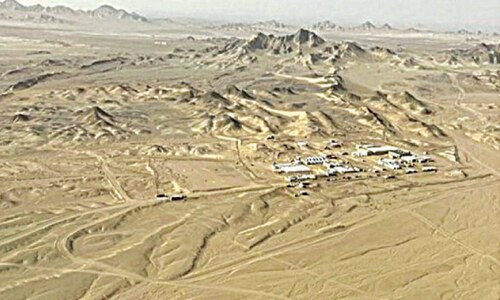
Designed as a conventional open-pit mining and processing operation, the site will yield high-grade copper-gold concentrate. Initial capacity is set at 45m tonnes of ore annually, which is expected to double to 90m tonnes upon Phase 2 completion. While the mine was originally slated for a 40-year operational lifecycle, an updated feasibility study revised that figure to 37 years to account for higher throughput. However, ongoing exploration and resource development could potentially extend the mine’s lifespan up to 80 years.
Beyond its export and revenue potential, Reko Diq is expected to generate 7,500 jobs during peak construction and sustain around 4,000 permanent positions once operational. Based on long-term commodity price assumptions, projected free cash flow over 37 years is estimated at $74bn.
Published in Dawn, The Business and Finance Weekly, November 2nd, 2026