Fading wheat cultivation ritual leaves Chitral residents deeply nostalgic

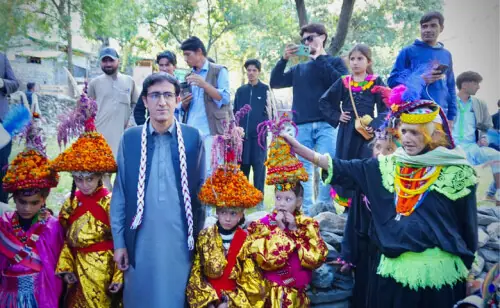
CHITRAL: Chitral residents have expressed deep nostalgia over the gradual fading of ‘bi-nisik’, a centuries-old socio-agricultural custom that once filled the region with vibrant autumn festivities.
The traditional practice, which marked the formal commencement of the wheat cultivation season, served as a cornerstone of social cohesion, unity, and mutual respect among the mountainous communities of northern Pakistan.
For generations, bi-nisik topped the list of cultural celebrations in Chitral. Elders and cultural activists now regret that the younger generation has almost entirely given up on the custom. This shift, they argue, has weakened the communal bonds that historically brought villagers together during the laborious sowing season in the early autumn.
Under the traditional practice, the entire village would assemble in designated irrigated fields to kick-start the wheat cultivation with great fanfare. The ritual began with the village elders formally throwing the first seeds into the soil, followed by the synchronous ploughing of the land using pairs of bulls.
The event was as much a culinary and musical festival as it was an agricultural necessity. Households owning the fields would cook special traditional foods for collective daytime feasts, ensuring that every participant was well-fed. As night fell, the celebrations shifted into high gear with lively musical concerts, where traditional Khowar music and folk dances kept the community entertained for weeks.
Haji Hussain Shah, a farmer from Upper Chitral in his 70s, recalled the profound impact the custom had on local life before the advent of modern technology.
“It was not merely a tradition or custom,” Shah explained. “It affected collective farming in the days when agriculture was not mechanised, and the use of tractors was not in vogue. Ploughing large tracts of land by individuals was a tedious job. The villagers fully sided with each other throughout the sowing season, and as such, the villages wore a festive look.”
He noted that in the past, farming was the primary source of sustenance for the vast majority of households, with very few individuals opting for government service or private business. Without machinery, the cultivation process was a lengthy affair, often continuing for four to six weeks across the valley.
“Now, it takes minutes to plough a field for a wheat crop, which took days previously when bulls were used instead of tractors,” Shah remarked. He identified rapid mechanisation and a modern lifestyle with limited free time as the primary reasons behind the cessation of the tradition.
The historical and cultural significance of bi-nisik is well-documented. Prof Israruddin, the former chairman of the geography department at the University of Peshawar, highlighted that the custom caught the attention of colonial observers over a century ago.
According to him, John Biddulph, a British military officer and administrator, specifically detailed the tradition and its associated rituals in his seminal book, Tribes of the Hindoo Koosh, published in 1880.
As per the book, the tradition of bi-nisik was practised in the Yasin Valley of Gilgit-Baltistan as well, apart from Chitral.
Prof Israruddin emphasised how deeply embedded the practice was in the local psyche, noting that an entire month in the traditional Khowar (Chitrali) calendar was named ‘Bi-nisik’ to honour the sowing season.
Currently, the custom is in its dying stages, surviving only in a few of the remotest, high-altitude villages of Upper Chitral and the Lot Koh Valley.
Cultural experts and local elders have urged the culture department to take immediate measures to preserve this unique heritage before it vanishes entirely from the collective memory of the region.
Published in Dawn, November 2nd, 2026