Basking in the blazing July sun, she hurried to the sun-baked door of Bilqees Manzil and rang the doorbell.
Buuaa opened the door, and she went straight to Dadi Jan, who was sitting on her charpoy, reading Ibn-i-Insha’s Urdu Ki Akhri Kitab. On seeing her, Dadi put the book aside and made her sit. Buuaa brought her a glass of water. Izza took it with unsteady hands and gulped it down.
Izza took a few deep breaths, and they waited patiently. After exhaling a chunk of anxiety along with carbon dioxide, she blurted out, “Dadi Jan, I noticed something terribly frightening today. I felt as if the town were regressing to the Dark Ages, with reading, storytelling, art and learning all in decline. Books and storytelling had become scarcer than hen’s teeth. Libraries, bookshops, bus stations and parks seemed to be missing the smell of books and the tranquillity they brought. Books miss the human connection they once had. Now, that connection is totally lost.”
Gasping for breath, she paused before continuing, “I’ve seen it, Dadi Jan. Ibn-i-Battuta Kutab Khana was empty; there wasn’t a single soul in Pitras and Tadrees, and the spacious corridors of Adab Library had become an enchanting residence for ghosts. We have to restore that connection and revive reading and storytelling.”
Listening like a doctor patiently hearing out a worried patient, Buuaa and Dadi consoled her and promised to do their best. Dadi asked her to rest and return at tea time with a fresh mind to discuss the matter.
“Dadi, the town won’t turn into another Qisa Khwani Bazaar, completely deserted of books, will it?”
“It won’t, dear!” Dadi replied. “Don’t worry. The town will experience the magic and charm of storytelling and reading. It’ll become a great hub of books and stories, like the old Qisa Khwani Bazaar.”
Dadi’s reassuring words brought solace to Izza’s aching heart, and she went to her room to rest. To Izza, stories were her whole world, and she couldn’t imagine life without them. They had always been with her. The first sound she remembered was Dadi’s voice reciting Tarzan ki Wapsi. The first syllable she uttered was the name of her favourite character, and the first thing she held was a page from a book.
Unlike Izza, Buuaa and Dadi did not find the issue shocking. They were aware of the growing disinterest in reading and storytelling. While arranging literary programmes and events, they had seen how difficult it was to persuade people to attend. People preferred trendy and cool activities, and such events were considered neither.
That evening, the three sat in the courtyard to devise a plan. Dadi suggested contacting good storytellers and seeking their help in reviving the tradition. Izza picked up a pen and scribbled down their names and whatever details they had. Their next task was to contact the storytellers for advice.
The next day, Izza called everyone on the list, invited them to a meeting and briefly explained what they would discuss.
At the appointed time, they gathered in the courtyard of Bilqees Manzil. Dadi took her seat on the charpoy and invited everyone to sit on the chairs arranged around it.
After a lengthy discussion, they decided to open a trendy café combining books and storytelling sessions to revive people’s interest in both.
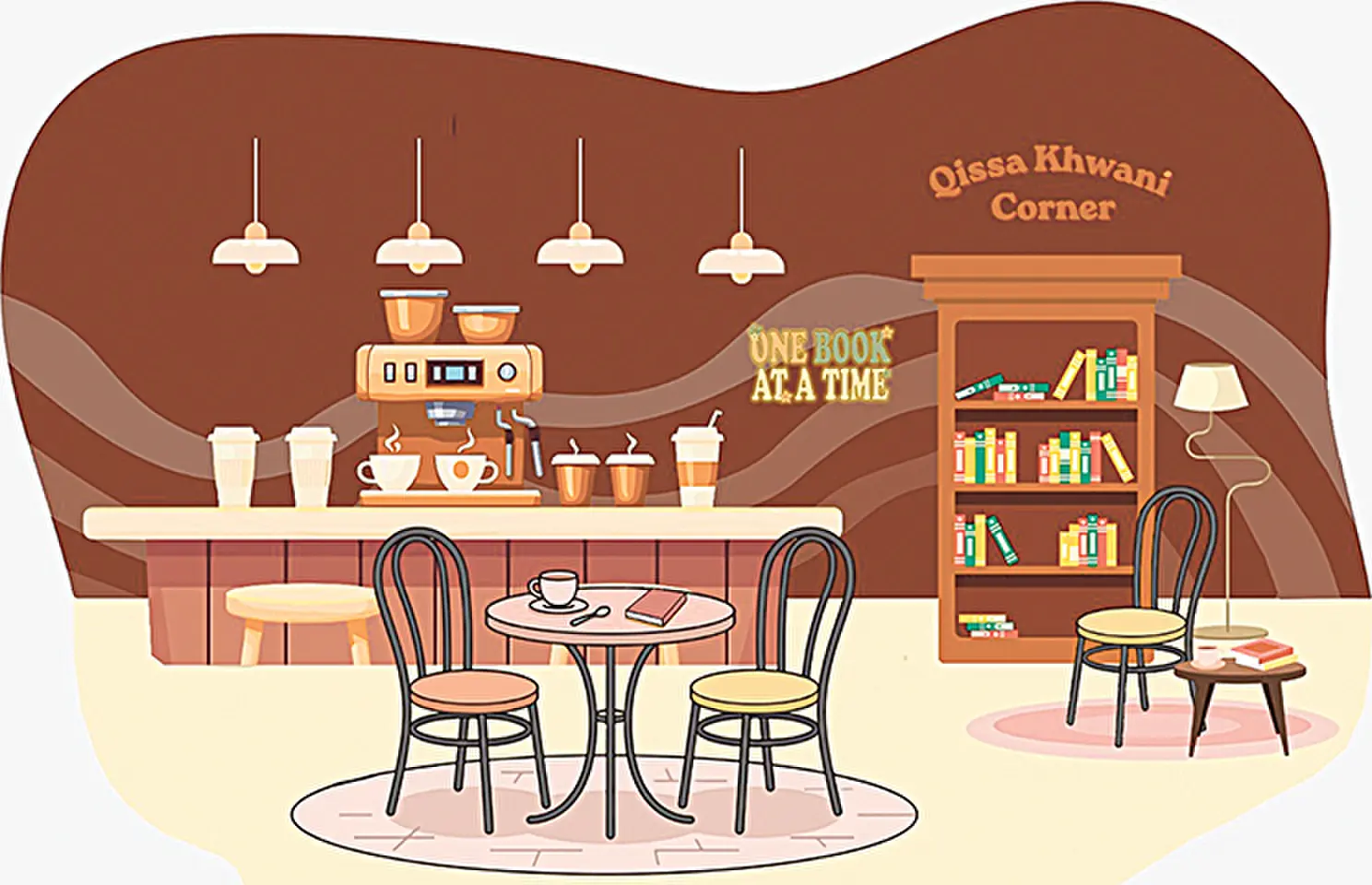
Everyone was assigned their duties, and work began. Within days, they rented a place on a busy street and transformed it into an attractive café with the help of expert architects. The walls were painted ivory, brown, beige and taupe, and decorated with abstract paintings and pictures featuring poems. Vintage wooden bookshelves and furniture added elegance and charm.
In a nook, a minimalist chair was placed for the storyteller to cast his spell on the audience. The wall behind it was adorned with The Road Not Taken and excerpts from Nineteen Eighty-Four, Raja Gidh, Wuthering Heights, Zawiya and Khushboo. The nook was named “Qisa Khawani Corner”.
A huge collection of classical and contemporary literature filled the bookshelves. The books were carefully chosen to cater to people’s diverse interests, as varied as Pakistani culture itself.
A highly sought-after barista was recruited. The only thing delaying the café’s launch was its name. Everyone scratched their heads, suggesting names that were promptly discarded.
After hours of deliberation, Dadi proposed “Thoughtful Sips”, and everyone agreed. The name was carved onto a black signboard and hung above the café’s door.
Thoughtful Sips had a grand inauguration ceremony. Hundreds of people were invited, and the event was covered by television channels, magazines, newspapers and online media portals.
Drawn by the hype, crowds flocked to the café. They enjoyed their coffee while the books sat on the shelves, watching people come and go. Some books made their way to the tables, while others got the chance to introduce themselves to curious readers.
Being surrounded by so many books seemed strange to many. Some felt suffocated, thinking the books took up space and blocked the air. Others barely glanced at them, while only a few spent time with them.
The first storytelling session went reasonably well. Some tried to follow it, while others wished they could skip it like an unwanted advertisement. The day ended without too much disappointment. Good things took time, and they were ready to invest theirs.
As the days passed, people’s interest grew. After a year or so, Thoughtful Sips had become the talk of the town. People loved its vast collection of books and storytelling sessions. They came to read and listen to stories, no longer wanting to miss a session and even demanding that it be extended.
Inspired by the café’s success, other cafés began keeping books on their shelves. Vendors sold heaps of books from their carts, and restaurants followed suit. The city seemed to be transforming into a library, with streets resembling the old Qisa Khwani Bazaar and storytellers in every nook.
Izza was overwhelmed by the change. She remembered how little interest people had shown in books on the café’s opening day. Now, books were one of the main reasons they came. People had discovered the magic of books and storytelling. They discussed how true it was that reading maketh a full man and that those who read live a thousand lives.
Voices rose from different tables. Some recited their favourite lines, others appreciated the style and subject matter of literary works, while still others praised their favourite writers.
From a corner, a man whispered to himself, “It is a far, far better thing that I do, than I have ever done; it is a far, far better rest that I go to than I have ever known.”
Published in Dawn, Young World, October 24th, 2026