ISLAMABAD: Pakistan’s debt crisis is not merely a budget problem, it is a human-rights issue and an imperialist trap that squeezes the working class while shielding the elite, speakers warned at a seminar, demanding a public audit of debt, land reforms, tax justice and a broad campaign for national sovereignty.
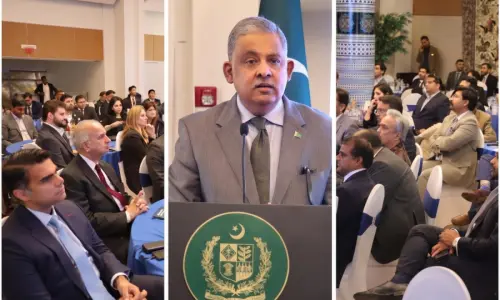
This was stated by speakers at a seminar, titled: “Pakistan’s Debt Crisis: Who Pays the Price”, organised jointly by the Islamabad Bar Association, the Democratic Lawyers’ Association, the Legal Support Foundation and Fight Inequality Alliance Pakistan at Shuhada Hall, District Courts Complex on Thursday.
Speakers stressed on structural changes in economic and governance systems to free the working people from an imperialist debt trap and elite capture.
Dr Aasim Sajjad Akhtar, associate professor of political economy at Quaid-i-Azam University and deputy secretary-general of the Awami Workers Party (Marxist), said “debt sovereignty meant sovereignty of the people”.
He argued that the IMF and World Bank have created a debt trap in which countries are bent to their will while ordinary people bear the burden. He asked why the IMF prescribes various kinds of taxes and levies on petroleum, electricity, gas and other essentials but never makes taxing large landowners, feudal lords, real-estate tycoons or non-productive expenditure a condition.
Akhtar said public welfare budgets had been cut for decades, unemployment was far higher than the official claim of 7pc, and the elite received an annual hidden subsidy of $17 billion. He added that the government was quick to raze the makeshift shelters and confiscate pushcarts of the working class but remained a silent spectator on land grabbing by the real-estate mafia.
He urged lawyers, teachers, social and political activists to wage a common struggle against what he called an imperialist exploitative financial system.
Syed Abdul Khaliq Shah, a debt justice campaigner, discussed the debt crisis in historical perspective and said Pakistan joined the IMF programme in 1954 and noted that it is now in its 25th programme.
“The country is among 54 debt-stressed countries”, Shah said. He said austerity cuts hit the common man, not the elite. He argued that the United States has two levers to control the Global South: military arms and lending institutions.
Shah advocated the formation of a parliamentary commission to audit foreign debt and declared that “debt is a human rights issue.”
Nisar Shah, convener of Fight Inequality Alliance Pakistan, said a small elite controls the world’s resources and policies through financial institutions. He said the richest 1% captured nearly two-thirds (63%) of all new global wealth since 2020, about $42 trillion, almost twice the entire bottom 99%.
He criticised WTO rules for favouring developed nations and multinational corporations and said Pakistan’s privatisation agenda is tied to a $7 billion IMF loan programme. He argued that economic improvement is impossible without comprehensive land reforms and wealth taxes.
Senior lawyers Javed Iqbal Bandey and Syed Ahmed Hassan Shah echoed these concerns, highlighting the rising burden of debt on the people, regressive taxation, inflation and unemployment.
They said only about 1% of the population pays direct taxes, while salaried workers contributed Rs605.953 billion in income tax at source in 2024-25, an increase of 54.7%.
They said over 48% of the population has fallen below the poverty line and real wages fell by 3.4%. They called for a cut in the tax rate, a broadening of the tax base and the formation of a commission led by lawyers to fight Pakistan’s debt case and inequality.
According to reports cited at the seminar, Pakistan has budgeted Rs8.2 trillion in interest payments for FY2025-26—46.7% of the entire federal budget. The $7 billion Extended Fund Facility requires about 174 legislative amendments covering taxation, energy, privatisation and austerity. IMF-linked reforms led to the elimination of over 54,000 government positions by the end of 2025.
Speakers said sovereign debt service, IMF conditionality, regressive taxation and inflation are designed to protect creditors.
They called for arranging such educational discourses to inform ordinary people about their rights and to resist the imperialist financial trap and elite capture.
Published in Dawn, October 23rd, 2026