Addressing transnational terrorism requires international partnerships beyond bilateral frameworks
Pakistan’s counter-terrorism challenge has entered a new and more complex phase. The groups are evolving, as are their methods, their financing and their recruitment. So must the response.
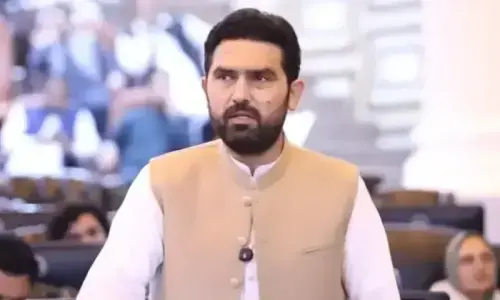
That was the central message of this week’s International Seminar on Pakistan’s Evolving Counter-Terrorism Landscape, organised by the Institute of Strategic Studies Islamabad (ISSI), which brought together policymakers, besides national and international experts to examine a threat no longer confined to any single border or battlefield.
Transnational terror network
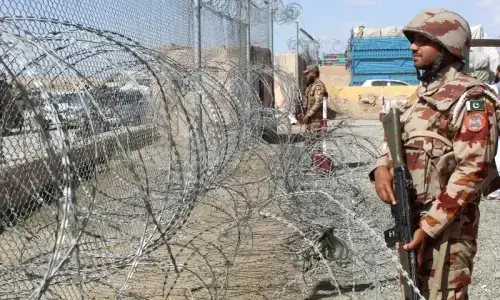
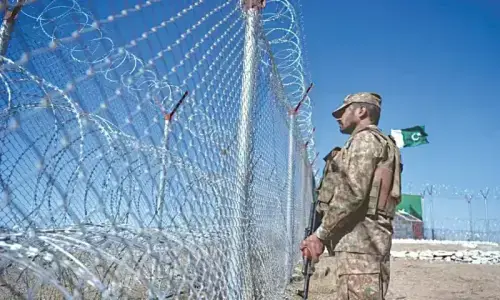
Deputy Prime Minister and Foreign Minister Ishaq Dar used the platform to deliver a message Pakistan has repeated for years but which now carries a sharper edge: Afghan authorities must take “concrete, verifiable and irreversible action” against the Tehreek-i-Taliban (TTP) and other terror outfits operating from Afghan soil.
Information Minister Attaullah Tarar, addressing the same conference, cited UN assessments of over 6,000 TTP fighters in Afghanistan and a total militant presence exceeding 20,000. Both reflected a government that has grown increasingly frustrated by the Taliban regime’s enablement of the TTP terrorism.
Dar also highlighted Indian sponsorship of terrorist groups operating against Pakistan, including from Afghan soil, describing it as a serious threat to regional peace. In recent years, Pakistan has shared dossiers with the United Nations and international partners documenting India’s support for the TTP and the terror gorup, Balochistan Liberation Army (BLA), in pursuit of its reckless escalation dominance strategy against Pakistan, a fellow nuclear power.
The urgency of that conversation has been underscored by events on the ground.
Asif Durrani, former Special Representative of Pakistan for Afghanistan, has stated that the intensifying clashes have brought relations between the Taliban and Islamabad to a dangerously high level, reinforcing the perception that the Taliban regime is aligned with the anti-Pakistan agenda of the TTP. Recent TTP-perpetrated attacks in Pakistan further undermined any diplomatic efforts facilitated by friendly countries, such as Turkey, whose intelligence chief Ibrahim Kalin recently visited Kabul, Kandahar and Islamabad.
This is not a situation that can be managed through bilateral engagement alone. Giorgio Cafiero’s, the CEO and founder of the Washington-based Gulf State Analytics, a geopolitical risk consultancy, emphasized that the militant ecosystem spanning the Pakistan-Afghanistan frontier — TTP networks, BLA cells and a range of lesser-known groups — “affects wider regional and global security”. He added that international partnerships could help Islamabad to address threats posed by the TTP and BLA.
Such partnerships require intelligence-sharing arrangements that include Western and Gulf partners, technological cooperation on IED detection and border surveillance, and sustained international engagement on the question of Afghan territory being used against its neighbours.
The real threat is digital
Perhaps the most underrated dimension of the threat is digital. Both the TTP and the BLA have moved onto social media platforms to recruit, radicalise and raise funds. They are targeting young people, and increasingly, women. Maj Gen (retd) R Zahid Mehmood made a point at the seminar that deserves repeating in every school staffroom and parent-teacher meeting: countering online radicalisation is not a job for the state alone.
The scale of the challenge is considerable. Platforms like YouTube and X host a large volume of content produced by hostile actors, algorithms amplify what provokes, and young Pakistanis with phones and internet connections are being fed narratives designed to turn grievance into violence.
The state cannot police this alone. What it can do is build digital literacy from an early age — embedding critical media education in school curricula, helping families understand what their children consume online, and creating spaces in universities for open discussion where doubts can be aired rather than suppressed.
The recruitment of women by the BLA, discussed by Dr Shabana Fayaz, exposes a dimension of the conflict that Pakistan has been slow to confront. The narratives drawing women into militancy are not primarily religious; they are woven from nationalism, historical grievance and the language of sacrifice and resistance. This makes them more sophisticated than the crude propaganda of the past and harder to counter with messages that speak only in the state’s idiom
Dr Fayaz’s caution against treating individual cases as evidence of a province-wide movement is important. But so is her central argument: countering recruitment requires more than security operations. It demands intelligence personnel and peace builders trained to engage in sensitive areas, to listen as well as to investigate, to build dialogue rather than simply close networks.
Governance, rule of law and public trust
The seminar’s emphasis on governance, rule of law, and public trust, as highlighted by the former United Kingdom Deputy High Commissioner in Pakistan James Watt, is not a softer add-on to kinetic operations; it is the foundation on which they rest. Militant groups do not operate in vacuums. They exploit marginalisation, perceived injustice and state weakness. Accordingly, every successful counter-insurgency campaign in history has combined military pressure with political and economic investment in the areas it sought to clear.
If there is one key takeaway from the seminar, it is the re-affirmation of Pakistan’s legitimate right to demand that Afghan territory not be used against it. That involves preventing cross-border movement of the militants and arms, extraditing wanted terrorists, disrupting financing networks, curbing propaganda and recruitment efforts, both online and offline.
But legitimacy alone does not create leverage. Leverage in this context comes from strengthening internal resilience and building coalitions of international partners who share concerns over trans-national terrorism and extremism.
The ISSI-organised seminar, with international experts, diplomats and media in attendance, was a timely public diplomacy initiative that articulated Islamabad’s views coherently. What it also made clear is that the threat has outgrown the old playbook. To succeed, Pakistan’s — and international community’s — response needs to keep pace accordingly.