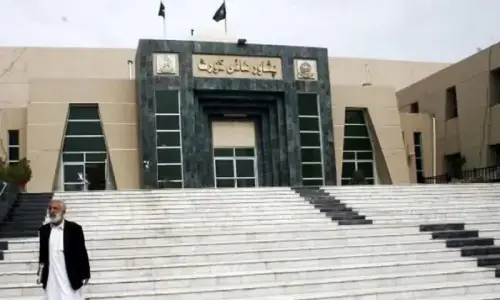
PHC issues notices in petitions challenging governor’s rule, emergency in KP; hearing adjourned till Nov 10

PESHAWAR: The Peshawar High Court (PHC) on Tuesday issued notices to the federal and provincial governments in several petitions challenging the imposition of emergency and governor’s rule in Khyber Pakhtunkhwa on October 11.
PTI Chairman Barrister Gohar Ali Khan moved the PHC on Oct 14 against the measures, requesting the court to declare them unconstitutional. The move to impose emergency and governor’s rule followed heightened tensions between the PML-N-led federal government and the PTI-led KP government.
A two-member bench comprising Justices Ijaz Anwar and Muhammad Faheem Wali adjourned the hearing till November 10 after hearing preliminary arguments.
The court said an order would be issued afterwards, adding that notices would also be issued to the attorney general for Pakistan and the KP advocate general.
The bench took up several petitions today, including one filed by PTI Chairman Barrister Gohar Ali. PTI leader Shandana Gulzar, the KP Bar Council and leaders of the Tehreek-i-Tahafuz-Ayin-i-Pakistan (TTAP) have also filed petitions.
Barrister Sameer Khosa and Salman Akram Raja appeared on behalf of Barrister Gohar.
Barrister Sameer said the petition challenged the imposition of governor’s rule and the state of emergency in KP, arguing that a resolution passed by the provincial assembly was mandatory for such a move.
“No approval was obtained from the provincial assembly,” he told the court.
He added that the National Assembly and the Senate had approved the action later. “We have also challenged this in the miscellaneous application,” he added.
“The proviso to Article 232(1) states that approval from the provincial assembly is necessary. The word ‘shall’ is used, which means this condition is mandatory,” the petitioner’s lawyer said.
He reiterated that the measures had been taken without the provincial assembly’s approval and were therefore illegal. The counsel contended that the situation in KP was not beyond the provincial government’s control.
Sameer further argued that the chief minister, Sohail Afridi, and the speaker of the provincial assembly were currently “missing”.
The bench then asked whether the petition included a request for the leaders to be presented before the court or recovered.
“Yes, we have made that request in this application,” the counsel replied.
He referred to a Supreme Court judgment in the case of former chief minister Pir Sabir Shah, in which the SC had established that the chief minister and the cabinet would continue to function if an emergency were imposed.
“In the current case, the chief minister, the cabinet and the advocate general have been stopped from working and rendered inactive,” Sameer said.
“Our plea is that the assembly be restored and the chief minister and speaker be released,” he added.
Raja also argued that governor’s rule and the state of emergency had been imposed without “fulfilling legal requirements”, calling for the measures to be revoked and the provincial assembly restored.
The petitioner, Barrister Gohar, also addressed the bench, arguing that the PTI-led government in KP had always supported the Centre in the fight against terrorism.
He went on to claim that 12 MNAs and 14 MPAs affiliated with the PTI had been “picked up”.
“Raids are being conducted on the homes of our members; they are being harassed,” he added. “We say that Pakistan comes first, we say that we are one, this country is ours,” Gohar said.
Gohar further contended that on October 11, deputy commissioners and district police officers had been replaced, as had officers posted at the advocate general’s office.
Appearing on behalf of Gulzar, advocate Muazzam Butt argued that the provincial assembly’s approval had not been obtained before the imposition of governor’s rule and the state of emergency.
He said that an apex committee had been formed under the National Action Plan (NAP), arguing that it was the committee’s responsibility to assess the security situation in the province.
He further argued that responsibility for terrorism could not be placed on the provincial government given the existence of the apex committee.
Representing the KP Bar Council, advocate Babar Khan Yousafzai appeared before the court and adopted the arguments advanced in Barrister Gohar’s case.
Another petitioner, advocate Qaiser Shah, supported the imposition of the state of emergency but opposed the proclamation insofar as it imposed governor’s rule.