FO condemns Indian minister’s ‘provocative’ remarks threatening aggression against Pakistan
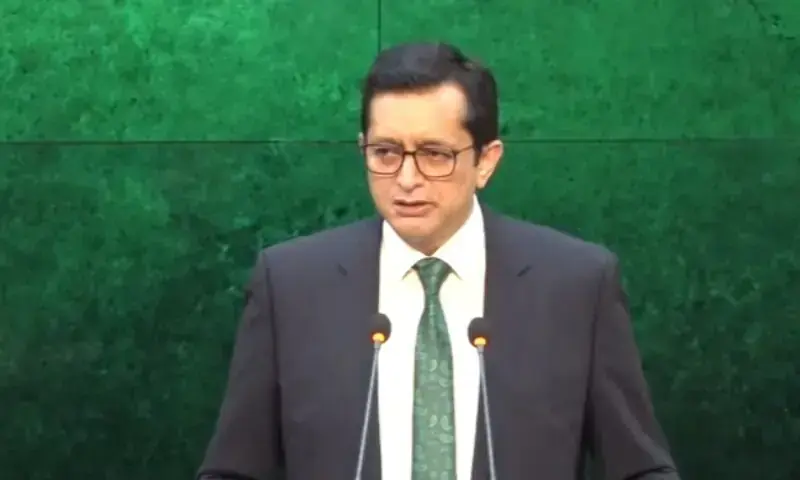
The Foreign Office (FO) on Friday condemned Indian Defence Minister Rajnath Singh’s “provocative remarks” threatening aggression against Pakistan, saying such statements highlighting the neighbouring country’s “hegemonistic mindset”.
Singh on Thursday had warned Pakistan that any “fresh terrorist activity from across the border would invite a strike even bigger than the last time”, according to Indian news agency ANI.
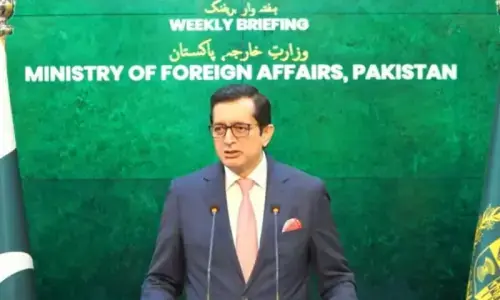
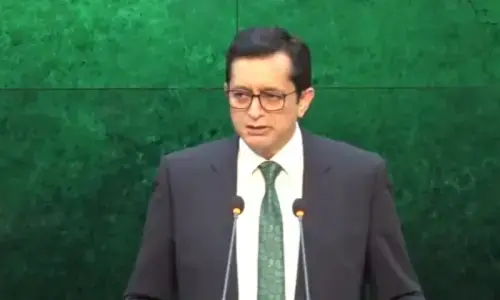
On Friday, FO spokesperson Sajjad Haider Khan was asked about the comments during his weekly press briefing.
“Pakistan rejects and condemns the Indian defence minister’s provocative remarks entailing a threat of Indian aggression against Pakistan. Such reckless statements reflect India’s hegemonistic mindset and the risk its belligerent posture poses to regional peace and stability in South Asia,” he said.
“We wish to remind India of the consequences of its military aggression in May last year, when Pakistan demonstrated both its capability and resolve to defend its sovereignty and territorial integrity and gave a befitting response and reply to Indian aggression,” he said, referring to the brief military conflict between the two countries.
He said that there should be “no ambiguity” that Pakistan remained fully prepared to safeguard its “sovereignty and territorial integrity” against any “ill-advised aggression”.
Haider said Pakistan’s “restraint and commitment to peace” should not be mistaken for weakness, warning that any aggression would be met with a “forceful response”.
“India should draw an appropriate lesson from last year’s experience and abandon its belligerent posture and dangerous rhetoric and act with responsibility for lasting peace in the region,” he said.
During the briefing, the FO spokesperson was also asked about China’s comments regarding India’s move to recognise and standardise the names of 28 geographical features in Ladakh, a disputed territory claimed by India. China had opposed the move, terming it “illegal”.
The spokesperson was asked about the development in the context of the Jammu and Kashmir dispute.
Khan said that said India’s actions on Aug 5, 2019, which revoked the special autonomy of occupied Kashmir, were “illegal and void”.
He added that the move could not alter the fact that Jammu and Kashmir was an internationally recognised disputed territory whose final status must be determined in accordance with relevant UN Security Council resolutions and the wishes of the Kashmiri people.
Digitisation of attestation services
During the press briefing, the FO spokesperson was also asked about the reforms introduced to the ministry’s attestation and apostille services.
Last month, the Federal Investigation Agency’s Anti-Corruption Circle Islamabad had busted a network allegedly involved in the preparation and use of fake apostille stickers in connivance with officials from the foreign ministry.
Khan said on Friday that the foreign ministry was progressively digitising and automating apostille services to make them faster, more transparent and accessible.
He said that e-attestation had been launched through the ministry’s portal, while the transition to e-apostille services was under way.
He added that eligible applicants could be exempted from “physical appearances, subject to prescribed safeguards”, a move that would particularly facilitate overseas Pakistanis.
“This is a massive leap forward,” he said, adding that the process was ongoing and Deputy Prime Minister and Foreign Minister Ishaq Dar had personally steered the initiative.
He said that an inquiry into irregularities regarding the services was underway and the results would be announced when it was completed.