HEALTHCARE in Karachi has its own geography. Private hospitals glow along Sharea Faisal. Consultants’ clinics fill the upper floors of Clifton plazas. A few kilometres away, in the narrow lanes of a katchi abadi, a mother weighs a child’s fever against the price of a rickshaw ride. Everyone treats this as normal: the illness passes or it doesn’t, and life goes on. What rarely gets named is that much of this suffering is not caused by a lack of medicine. It is caused by distance, transport and travel: measured in hours of work and lost wages.
I first saw it while shadowing a neurosurgeon. Some patients declined surgery they clearly needed because they could not afford it. Others had travelled a full day from their villages, only to be turned back by the consultation fee.
Public health researchers have a name for this pattern. In 1994, Sereen Thaddeus and Deborah Maine proposed the “three delays” model — care can fail at the decision to seek it, the journey to reach it, or the wait to receive it. Karachi’s poor face the first two before they ever see a doctor. Households pay close to half of Pakistan’s total health spending out of their own pockets, so the decision to seek care is really a budget decision. And for the half or more of Karachiites estimated to live in informal settlements, reaching a clinic means paying a fare, losing a day’s income and leaving children behind.
I started ‘Rickshaw Hospital’ to remove both delays at once. If families could not come to care, care would go to them.
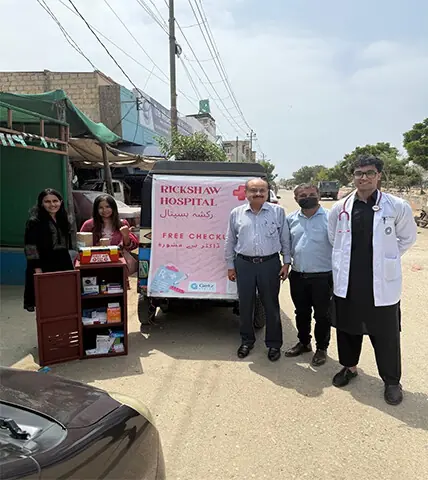
In April 2025, two volunteer doctors, two medical students and I parked a rickshaw outside a small school in Azam Basti. We had painted “free check-ups” on its side in English and Urdu and filled a cabinet with the most basic medicines we could buy. Our plan was modest. Everything would be free: the consultation, the diagnostic check and the medicine, handed over on the spot. We expected a trickle of patients. About a hundred came.
What they brought with them was not a rare disease. It was neglect. Children scratched at scabies that had spread through entire households, the kind of itching that keeps a child awake at night and out of class by day. Mothers described stomach pain that had lasted for months. Our doctors found worms, again and again. Thin arms and tired eyes pointed to malnutrition. There were fevers, coughs and colds that had lingered far longer than they should have. None of it was complicated. All of it was treatable. Yet much of it had gone untreated for weeks or months.
One mother told us her son had lived with stomach pain for months. She had never brought him to a doctor, because a check-up meant choosing between the appointment and that week’s groceries. He had stomach worms. The cure was a few tablets.
By the end of that first day, our cabinet was nearly empty. We had run out of scabies medicine. Our Softin for the itching was gone. So was our Augmentin, a common antibiotic. These are not expensive or specialised drugs. They sit on the shelf of almost every pharmacy in Karachi. What we learned that day was simple and unsettling: the people in front of us were not missing advanced healthcare. They were missing the most ordinary medicines in the city, because even those were beyond their budget.
At our camp in Shireen Jinnah Colony, the picture shifted. Worms were still common among the children. But when we began screening adults, reading after reading of blood pressure and blood sugar came back high. Many of these patients had never had either checked. Neither condition hurts. High blood pressure announces itself as a stroke, diabetes as failing kidneys or a wound that will not heal. For these adults, a five-minute check outside a school may be the only warning they get.
We noticed something else across our camps. Far more women came to us than men. Many of them were the ones holding their households together. They brought their children first, then their husbands and mentioned their own pain almost as an afterthought, if at all. For some of them, our camp was the first place anyone had asked how they were feeling. We began making space for women to speak first. Our next step is bringing a gynaecologist to our camps, and raising awareness about the health of post-menopausal women, whose needs are almost never discussed.
After six camps, we have treated more than 500 patients. What strikes me most is not how much care they needed, but how little. Most of it could be handed over in a few minutes, from a cabinet on the back of a three-wheeler.
The state has not been idle. The Sehat Sahulat card shields poor families from catastrophic hospital bills, but it pays only once a patient is admitted. Lady Health Workers have saved countless newborns, but they reached less than half of Sindh’s population in 2024, and they are not doctors. Mobile health units exist, but they go to districts with no hospitals, or run for a single campaign and then disappear. None of them reached the children with scabies in Azam Basti.
None of this means volunteer camps can fix a structural problem. A mother who decides groceries matter more than a check-up is not being careless. Given what she can afford, she is choosing correctly. The fault lies in a system that forces the choice. That is exactly why the solution cannot rest on students and weekend volunteers. Standing, regularly scheduled mobile clinics, run by the Sindh Health Department and linked to Lady Health Workers and the Sehat card, could do at scale what one rickshaw does on a Sunday morning.
Karachi’s health inequalities will not close on their own timeline. Pretending a rickshaw can replace a functioning primary care system oversells what we do. But a boy who lived with a treatable infection for months, and was cured in an afternoon for less than the price of a meal, is proof that the distance can be crossed. The only question is whether the state will choose to cross it.
Published in Dawn, October 16th, 2026