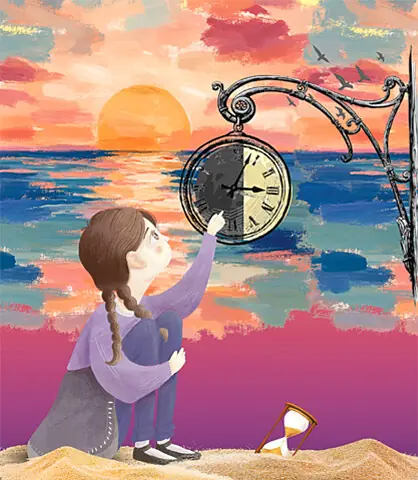
Our day starts with an alarm ringing or our parents calling out to tell us it is time to wake up. If it is an alarm clock, we turn it off. If it is a phone, we hit snooze and close our eyes again.
But if our parents are calling, we keep saying, “Yes, yes, five more minutes!” or “Just one more minute!” until we finally get out of bed.
Once we are ready to start our day, we have tasks to complete within a specific time. School starts at 8 am, and if we arrive even five minutes late, we might get marked late or receive a scolding. So we hurry, keeping an eye on the clock to make sure we reach there on time.
Schools, colleges, universities and workplaces all follow schedules, with set times for classes, breaks, meetings and even getting back home. Even when we are out with friends, we keep one eye on the clock, especially if we have to be home by a certain time.
We check the clock, race against time and wish for five more minutes in bed. But have you ever wondered who decided that an hour should have 60 minutes and a day should have 24 hours? For this, we have to go back in time…
And that often leads to a familiar call from Mum: “You said you would be home by 7 pm! Look at the time. We are waiting for you for dinner!”
Our lives run on schedules and timetables, and no doubt, having set times makes things easier. But have you ever wondered how people lived before clocks were introduced, or how we settled on 24 hours in a day, 60 minutes in an hour and 60 seconds in a minute?
People simply watched the sun rise and set and observed the arrival of night. These natural changes helped them keep track of time, knowing when to work in daylight and rest in darkness.
60 minutes
If you were designing a clock today, would you choose 60 minutes for an hour? Think about it. Some of you might say a 20-minute hour would be amazing, especially during maths or history class. Others might vote for a 120-minute art or music period. And some would even divide the day into ten hours instead of 24.
But jokes aside, who decided that a day should have 24 hours in the first place? Why 60 minutes in an hour and 60 seconds in a minute?
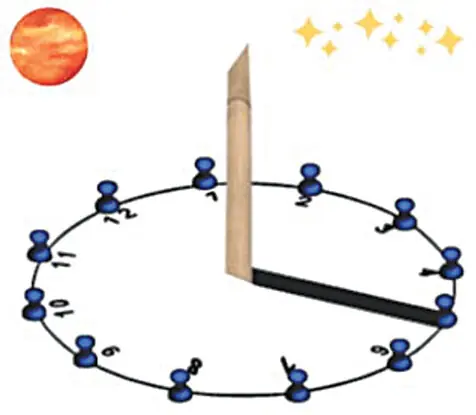
So, going back to the time when the sun and the moon helped track time, people started making things easier for themselves and came up with the sundial.
A sundial is a dial plate marked with hour lines, with a raised stick, pin or angled plate (called a gnomon) set into it. As the sun moves across the sky, the shadow moves to point to the correct hour. In the Northern Hemisphere, it must point to the fixed north and match the local latitude. People could mark its position and use it to divide the day into parts.
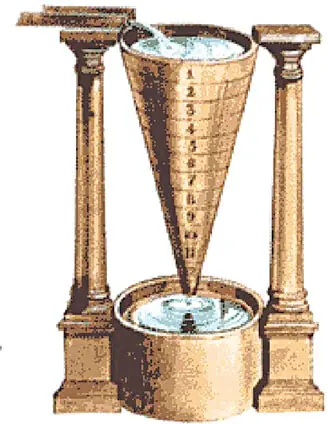
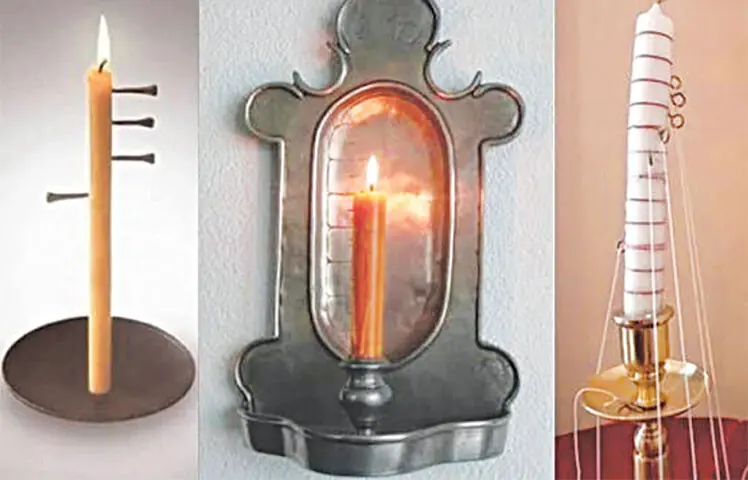
But the sundial was of no use at night and in cloudy weather. Therefore, to measure time, people tried other methods, including water clocks, candles and hourglasses. But still, they didn’t work the way people wanted, and this brings us to the numbers we use today.
Why 60?
The Babylonians (Iraqis) lived in Mesopotamia (Iraq) and used a number system based on 60 rather than the 10-digit system we commonly use today. Why they settled on 60 is not completely clear, but one suggested explanation involves finger counting.
The finger counting trick
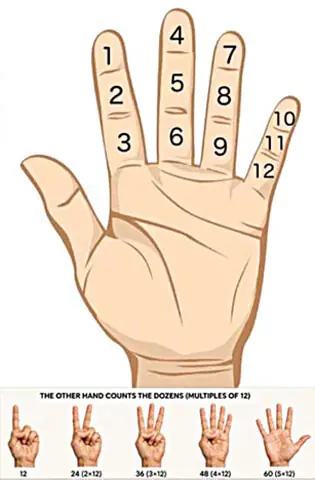
Use your thumb to touch the three joints on each of the four fingers of the same hand. That gives you 12. Then use the five fingers on your other hand to count five groups of 12, giving you 60. Historians have suggested that methods like this may have helped people count, although we cannot say for sure that this is how the Babylonians developed their system.
Interestingly, sixty can be divided evenly into many different groups, making calculations easier. You can split 60 evenly by 2, 3, 4, 5, 6, 10, 12, 15, 20 and 30. The Babylonians also used a system based on 60 when working with angles, and their mathematical ideas influenced later Greek astronomers. Over time, this way of dividing quantities helped shape the system of 60 minutes in an hour and 60 seconds in a minute.
The words minute and second have an interesting history, too. They come from Latin terms meaning a first small division and a second small division. That is why a minute can mean both a unit of time and something very small.
Why 24 hours?
Our modern clock with minutes and seconds explains how we measure time, but it leaves one major question unanswered: why is a single day split into 24 hours in the first place? Why not 10 or 20?
Again, the answer takes us back thousands of years to ancient Egypt. The Egyptians were among the first to divide the full cycle of day and night into 24 distinct periods.
12 hours of daylight: They used shadow clocks and sundials and split daytime into 10 main units, plus two additional twilight hours — one for dawn and one for dusk — making a 12-hour day.
12 hours of darkness: Because sundials could not work at night, Egyptian astronomers looked up at the skies. They tracked a group of 36 special stars called decans. As the Earth rotated, 12 of these star groups rose above the horizon during the night, each marking the passage of one night-time hour.
By combining 12 hours of sunlight with 12 hours of starlight, the 24-hour day was born!
However, these ancient hours weren’t fixed at 60 minutes like today. Because summer days are longer than winter days, the length of an hour changed with the seasons. Knowing how to divide the day was only part of the story — people still needed a reliable way to keep track of these hours as technology evolved.

When clocks began to ring
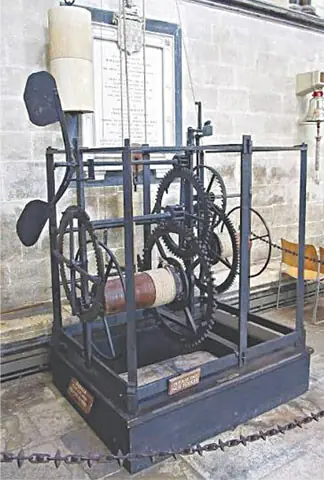
Mechanical clocks showed up in Europe around the late 1200s. They ran on gears and a heavy weight that slowly dropped, and most of them didn’t even have a dial. They just rang a bell. You heard the time instead of seeing it. Monasteries used them first. The monks had to wake up and pray at fixed times, even in the middle of the night, so they needed something loud that would wake them up.
These clocks also changed how long an hour was. Before, an hour in summer was longer than an hour in winter, because people just cut the daylight into 12 parts and the daylight changes. A machine can’t do that. A gear has no idea what season it is. So the hour became the same length all year round, and that’s the one we still use.
A major improvement came in 1656, when Dutch scientist Christiaan Huygens developed the pendulum clock. Its regular swinging motion helped clocks keep time more accurately than before. But it took another two centuries for a new invention to change the way people used time.
How trains entered the time scene and messed up!
In the 1800s, steam trains became common and the railway companies needed proper timetables. The problem was that every town kept its own time, set by where the sun was in the sky. Even a few minutes of difference made a mess.
So the railways fixed it themselves. In 1840, the Great Western Railway in Britain started using London time at all its stations. In 1883, railway companies in North America divided the continent into four time zones. A year later, a group of countries met and agreed to use Greenwich, in London, as the starting point for measuring the world.
Railways didn’t invent the 24-hour day or the 60-minute hour. They just got whole regions to follow one clock.
We still live like this. In Lahore, the sun is at its highest about half an hour before it is in Karachi, because Lahore is further east. But both cities use the same time so that business, television and train schedules run smoothly.
The clock inside you
There’s one more clock, and it’s inside all of us. The proper name is circadian rhythm, but “body clock” is easier. It runs on a 24-hour cycle, and it’s the reason you get sleepy at night and wake up in the morning. It follows light. When the sun comes up, your body knows it’s morning. When it gets dark, your body starts getting ready for sleep.
Today, our clocks are so clever that your phone can tell you the time in Dubai, London or New York without you doing anything. We have figured out how to keep time for the whole world, and yet, getting out of bed on time is a big struggle.
If only someone could invent a clock that wakes you up, gets you ready and makes sure you reach school on time. Now that would be an invention worth waiting for!
Until then, tomorrow morning will probably be the same story. The alarm rings, you open one eye, look at the time and think, “Just five more minutes.” And before you know it, those five minutes have disappeared, and you’re late again.
Weird time facts
• The word clock comes from the Medieval Latin word ‘clocca’, meaning “bell”. This word is also related to the French word cloche, meaning “bell”. In the old days, clocks used bells to announce the time, which is why the word became associated with time.
• China spans roughly five geographical time zones but officially uses just one time zone: Beijing time. In western Xinjiang, the sun rises much later according to the official clock. Some local communities use an unofficial time known as Xinjiang Time, which is two hours behind Beijing time. Russia is the opposite. It has 11 time zones.
• In 2011, the country of Samoa skipped a whole day. It moved to the other side of the International Date Line so it would be on the same day as Australia and New Zealand, with which it does a lot of business. So Thursday, 29 December went straight to Saturday, 31 December. Anyone with a birthday on the 30th missed it that year.
• Pakistan tried daylight saving in 2008 and 2009. Clocks went one hour forward in summer; the idea was to save electricity. We stopped after those two years.
• France once had a ten-hour day. Right after its revolution in the 1790s, it introduced a system with 10 hours in a day, 100 minutes in an hour and 100 seconds in a minute. It was much easier on paper. It didn’t last long because people didn’t want to throw away their old clocks and learn a new system.
• Clock hands go clockwise because of sundials. Most people think this is the reason, anyway. In the Northern Hemisphere, where most early clockmakers lived, a sundial’s shadow moves in that direction, so clocks copied it. If clocks had been invented in the Southern Hemisphere, we’d probably be reading them the other way round.
• A watch advert almost always shows 10:10 on the dial. The hands sit on either side of the brand name and look a bit like a smile; companies do this on purpose.
Time zones: how are they divided?
The Earth takes about 24 hours to spin all the way around, and a full circle is 360 degrees. Divide 360 by 24 and you get 15. So every hour, the Earth turns 15 degrees. This is the basic idea behind time zones. The world can be divided into sections, each about 15 degrees wide, like the slices of an orange.
The starting line is called the Prime Meridian. It’s an imaginary line that goes from the North Pole to the South Pole and passes through Greenwich in London. Go east from there, and the clock is ahead. Go west, and it’s behind. Pakistan is five hours ahead of UTC, which is roughly equivalent to Greenwich time.
Why do we need time zones?
Time zones keep our clocks close to where the sun is in the sky. Around noon, the sun is usually at its highest. If there were no zones, 12 o’clock could mean bright daylight in one country and the middle of the night in another.
Time zone lines on a map are not straight. Governments bend them around national borders so that people living in the same country can share the exact same time on their clocks. — S.A.
Published in Dawn, Young World, October 17th, 2026