The attic above the second floor was a place full of abandoned things. It contained old, mostly damaged furniture, stacks of yellow newspapers covered in thick layers of dust, cardboard boxes, broken electrical appliances such as keyboards, and metal trunks bound with rusting iron.
Twelve-year-old Fatima had been asked by her mother to find some old kitchen utensils and boxes to be discarded.
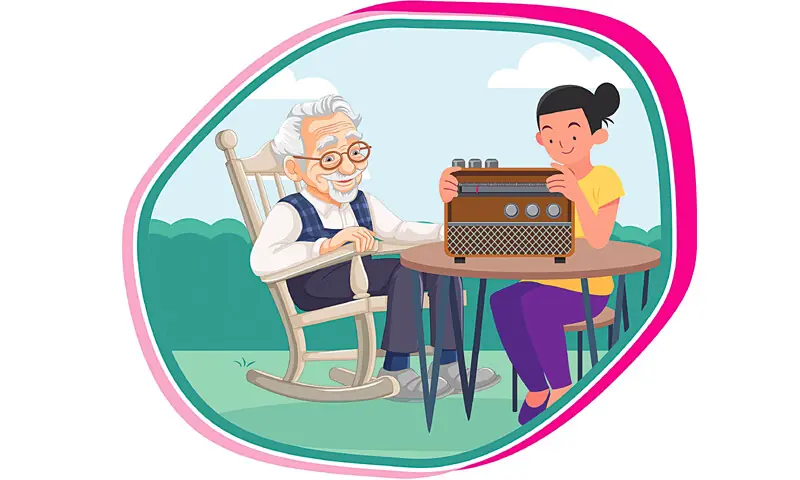
At the back, behind a metal trunk, stood a heavy, square-shaped wooden box covered in dust. Woven fabric covered the large speaker, while two brass knobs, dull with age, sat on the right side to adjust the sound and change channels. Above them was a long glass window with city names such as Lahore, Dhaka and Delhi written in faded white letters beside the channel numbers. A long, thin metal antenna lay folded flat along its top edge.
“Dada Abbu!” Fatima called down the stairs, examining the object with curiosity. “What is this?”
Her grandfather came up the stairs, his wooden cane clanking against the steps. When he saw the wooden case in his granddaughter’s hands, his face softened. He ran a hand over the metal dials and murmured, “Ahh! It’s the old National Panasonic radio I bought in 1974 with my first salary.”
Fatima turned one of the metal dials. It resisted her hand. “Does it still work?”
“Not for 20 years,” her grandfather sighed, taking a seat on a chest. “It’s been lying here in the attic, forgotten as televisions made radios seem obsolete and old-fashioned.”
Fatima noticed the sadness and nostalgia in his eyes.
“Can we take it downstairs and try to make it work?” she asked excitedly.
“Of course we can,” he replied, rising from his seat with a new spark in his eyes, as if hoping to relive his past.
They carried the radio down to the sitting room and began trying to get it working again. Fatima wiped it with a damp cloth, revealing a rich reddish-brown colour beneath the dust, while her grandfather pointed out its little details, including the power switch, worn fabric, tuning dials and attached leather strap.
Once it was clean, Fatima ran to the kitchen drawer and fetched four long D-cell batteries. She unscrewed the back panel, slid the batteries into the casing and pushed the small power switch until it clicked.
For a moment, nothing happened. Fatima felt a wave of disappointment.
“Hold on,” her grandfather murmured, bending closer. “The tubes must heat up.”
She switched it on again, and a faint orange light glimmered to life behind the glass screen. A loud, harsh burst of static crackled through the quiet sitting room. Following her grandfather’s instructions, Fatima took hold of the brass tuning knob and began turning it gently.
The needle moved slowly across the printed gauge. Static crackled from the speaker like dry autumn leaves. As the needle passed a mark labelled Medium Wave, a soft, wavering tune emerged, featuring the warm, distinctive sound of a wooden flute accompanied by the steady pulse of a tabla.
Fatima adjusted the fine-tuning knob. The static faded and a clear voice emerged, announcing the hourly transmission of Radio Pakistan.
Her grandfather leaned against the wall, a slow, distant smile spreading across his face. He closed his eyes for a moment, listening to the chime that signalled the beginning of the hour.
“That exact tone,” he said softly, “used to be the clock by which our entire neighbourhood lived. Every evening at seven, the courtyard of our village home would fill up. Neighbours would bring their own wooden stools and drink tea while this very speaker played.”
He gestured towards the glass window. “We didn’t have instant alerts or notifications, mobile screens or 24-hour news channels. We had this single radio.
“During summer heatwaves, when the electricity went out across the city, the whole street sat in the dark under the night sky, staring at that small amber light. When a cricket match was played abroad, 30 people would hold their breath together in silence between balls, waiting for the commentator’s voice to break through the static.”
Fatima looked down at the glowing dial. In her mind, the quiet, empty courtyard seemed to come alive with the sounds of clinking teacups, murmuring neighbours and the shared excitement of a community brought together by a single radio. She realised that modern phones gave her instant access to everything, yet she had never experienced a moment when an entire street shared the same feeling.
Fatima placed the radio in the centre of the table and tuned it to a classical music station. Soft sitar melodies drifted through the open arches, mingling with the cool evening air.
Published in Dawn, Young World, October 17th, 2026