Sindh CM seeks Chinese cooperation on K-IV, Sukkur Barrage rehabilitation
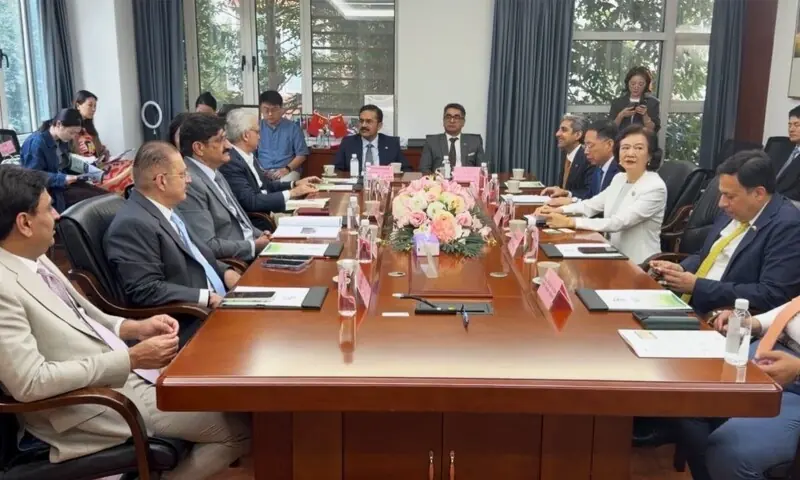
KARACHI: Sindh Chief Minister Syed Murad Ali Shah has invited Chinese companies to invest in the province’s water, agriculture, and infrastructure sectors, seeking cooperation on building a 100-kilometre K-IV pipeline for Karachi, rehabilitating the Sukkur Barrage, and developing climate-resilient crop varieties.
According to a CM House press statement issued on Tuesday, during a visit to HBSZ company in Wuhan’s Hanyang district, China, the chief minister discussed the K-IV pipeline project and inspected gates being manufactured for the rehabilitation and modernisation of Sukkur Barrage.
Officials said HBSZ had expressed its willingness to construct the 100km pipeline, while Mr Shah directed that work on the project begin as soon as possible.
The chief minister was briefed on progress under the Sukkur Barrage Improvement Project, being implemented by a joint venture of China Road and Bridge Corporation and HBSZ. Of the barrage’s 54 river gates, 44 and their operating systems have been replaced and made functional, while civil repair work at the sites has also been completed.
HBSZ expresses willingness to construct 100km K-IV pipeline
The remaining 10 gates have been prepared and will soon be transported from China to Pakistan. Each of the large gates weighs more than 50 tonnes, the statement said.
HBSZ is also fabricating 110 canal gates for Sukkur Barrage. During the 2026 closure period, civil works and repairs to the internal components of 27 canal gates were completed, while six gauge wells were constructed and handed over to the relevant authorities.
Dredging and excavation work has been completed in all areas except the tail channel, where work will be carried out during the next working season. The gate fabrication workshop building has also been completed.
“Sukkur Barrage is extremely important to me. It is the economic lifeline of Sindh,” Mr Shah said, adding that its formal rehabilitation after 90 years had significantly improved water flows.
Launched on Feb 24, 2023, the Sukkur Barrage project is scheduled for completion by June 30, 2027. It is being financed by the World Bank, the federal government and the Sindh government. Rehabilitation work at Guddu Barrage is also under way as part of the Sindh Barrages Improvement Project.
Also, Mr Shah has sought Chinese cooperation in smart governance, artificial intelligence and pharmaceutical manufacturing, proposing partnerships with Huawei and Humanwell Healthcare Group to strengthen urban management, healthcare production and technological development in the province.
The chief minister made the proposals during visits to Huawei’s Global Model Site for Digital-Driven Urban Governance, the Wuhan Artificial Intelligence Computing Centre and the headquarters of Humanwell Healthcare Group, also known as Renfu Pharmaceutical Group, in Wuhan.
Leading a high-level delegation during his official visit to China, Mr Shah said Sindh wanted to benefit from China’s experience in using data, artificial intelligence and digital platforms to improve public services, manage growing cities and expand industrial capacity.
CM proposes joint research facilities in Sindh
The chief minister also held a meeting with Qingfa Hesheng Agriculture Development Co. Ltd, a Wuhan-based high-tech seed company. He invited the company to expand cooperation with Sindh in developing high-yield and climate-resilient crop varieties, strengthening local seed production and transferring modern agricultural technology.
During the meeting with the company’s Chairman Wang Shicai and senior representatives, Mr Shah discussed joint research, technology transfer, farmer training and the development of modern seed-production systems suited to Sindh’s agricultural conditions.
The chief minister said Sindh had significant potential to increase agricultural productivity through improved seed varieties, modern technology and scientific farming practices. He proposed cooperation in developing crops adapted to the province’s challenges, including extreme heat, water shortages, floods and changing weather patterns.
The company briefed him on its expertise in the research, production and international trade of hybrid crop and vegetable seeds, including rice, rapeseed, maize, cotton, watermelon, radish, pepper and pak-choi. Its hybrid rice varieties have reportedly achieved yield increases of between 20 and 30pc in relevant trials.
Qingfa Hesheng, an ISO9001-certified high-tech seed company, collaborates on research cooperation with the Chinese Academy of Agricultural Sciences and operates seed-testing laboratories and demonstration farms.
The chief minister proposed establishing joint research facilities in Sindh to develop and test seed varieties before their wider multiplication and distribution among farmers. He also stressed the importance of developing local seed multiplication and production through public-private partnerships to reduce dependence on imported varieties.
During the visit, he also met Pakistani agricultural scientist Dr Ahmad Ali, who holds a PhD in seed development and is currently working with Qingfa Hesheng.
The chief minister honoured him with a Sindhi cap and appreciated his achievement in working with an internationally recognised company.
Mr Shah was accompanied by provincial ministers Sharjeel Memon and Jam Khan Shoro, Special Assistant to CM Syed Qasim Naveed, PSC Agha Wasif, Planning and Development Chairman Najam Shah, Investment Secretary Raja Khuram Shahzad, Transport Secretary Asad Zamin and Agriculture Secretary Zaman Narejo.
Published in Dawn, October 14th, 2026