Govt says people of KP ‘welcomed’ governor's rule as it gave them ‘hope’
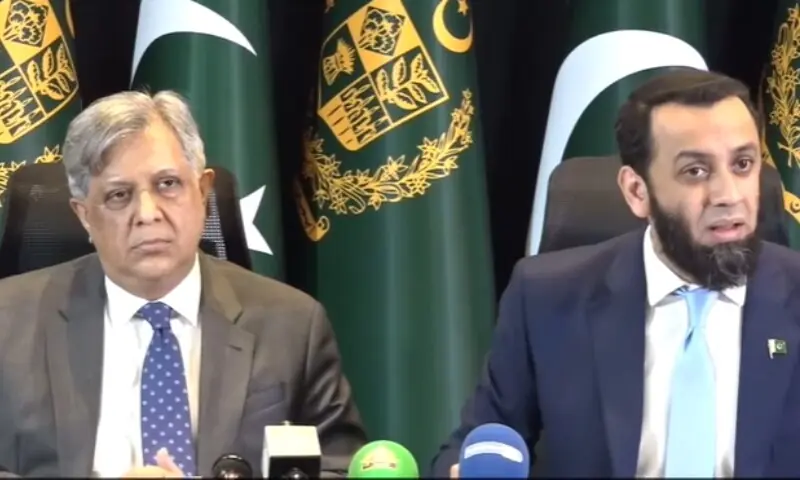
Information Minister Ataullah Tarar on Tuesday claimed that the people of Khyber Pakhtunkhwa had “welcomed” the federal government’s move to impose governor’s rule and emergency in the province, saying the measures had given them “hope”.
The federal government on Sunday imposed an emergency in 12 districts of KP, and placed the province under governor’s rule, taking note of the “provincial government’s deliberate disengagement from the fight against terrorism”.
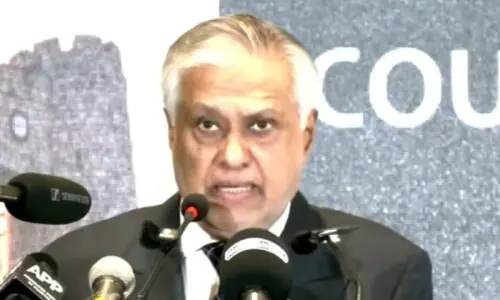
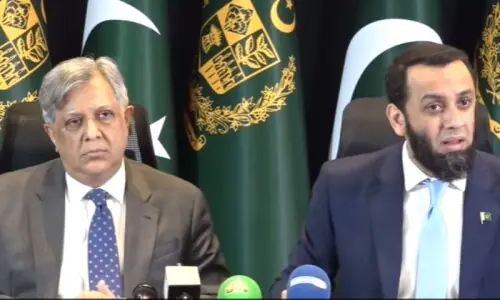
He made the remarks while addressing a press conference alongside Law Minister Azam Nazeer Tarar.
Ataullah noted, “Had the people of KP supported the pro-terrorist stance of the PTI government, you would have seen millions on the street.”
The minister went on to claim that “barely a dozen” people had gathered in protest.
Defending the move, the information minister said: “The people of KP have welcomed the step because they believe there is now hope for them. They believe they will now be provided with safety and security, their lives and livelihoods will be protected, and this political-crime nexus will be eliminated.”
At the outset of the press briefing, the law minister noted that the province in the recent past had witnessed a hike in terrorist incidents, noting a “195 per cent” rise, with 8,600 terrorist attacks recorded in 2024-2026 compared to 2,900 in 2020-2024.
Azam emphasised that it was essential that counterterrorism efforts taken by federal and provincial agencies be “harmonised”, adding that such an approach was standard practice globally.
“All these arrangements are made to run the country in a way that people feel safe,” he remarked.
At this, the law minister noted the “non-serious” attitude of the previous PTI-led KP government, which he said, “has now ceased to exist”.
He recalled that the PTI, allegedly using government resources, “launched an onslaught on the capital”. However, at the time, the imposition of governor’s rule and emergency did not come under discussion.
Describing the situation on the ground in the province, the law minister said: “The KP police were under attack, armed forces deployed in the province were under attack […] innocent people lost their lives.”
“You cannot shut your eyes after receiving such reports and seeing this rise in terrorist activity,” Azam added.
Recalling the events leading up to the federal government’s decision, Azam said the government had held “constant engagement” with the provincial authorities.
“Unfortunately, their response was somewhat different. Maybe their politics were more important to them than having the national interest at heart,” he said.
He maintained that the federal government had exhausted “all possible avenues” to resolve the differences. Azam said the provincial government should have intervened amid “internal disturbances or the likelihood or apprehension of such disturbances”.
Referring to Article 232, under which the emergency was imposed, Azam said it “deals with internal disturbances where the law and order situation is such, and the onslaught is of a nature that the provincial government cannot fight against it”.
Referring to the PTI, he said, “Your priorities were not to curb terrorism or to fight against it”.
“In such grave conditions, your priority should be to protect the people, not to pursue political gains.”
Azam said it was against this backdrop that the prime minister brought the matter before the federal cabinet, and a decision was subsequently made.
On being asked why similar measures could not be enacted in Balochistan, despite the prevailing security situation in the province, Azam said: “Look at the conduct of the Balochistan government; the chief minister is on his toes [..] he is trying hard.”
He noted that whenever there is a terrorist incident in Balochistan, the CM visits the area himself and personally oversees relief efforts.
‘Total breakdown of governance’
Ataullah, during the presser, reiterated that the federal government did not have a political agenda against the PTI-led provincial government; instead, it was pursuing “a unified policy on counterterrorism”.
“You cannot have a government in the country that sympathises with terrorists, supports terrorism or has a policy that enables terrorists to carry out their operational actions,” he said.
He questioned how one country could have two separate counterterrorism policies. “As the [law] minister explained, the framers of the constitution included these clauses (232 and 234) for a time like this,” citing a “complete breakdown” of law and order in KP.
He further went on to question why resources allocated to the provincial government via the National Finance Commission were not utilised to strengthen security-related infrastructure and equip KP police.
The information minister reiterated that the PTI-led government was facilitating the terrorists, describing it as a “political-terrorist nexus”.
He further said there was a “total breakdown of governance” in KP, noting a lack of reforms in education, health, and public services.
Sunday’s directives came after a meeting of the federal cabinet deliberated on the security situation in PTI-led KP. During the meeting, the cabinet noted the provincial government’s “deliberate disengagement from the fight against terrorism”.
Subsequently, the federal government imposed emergency under Article 232 and governor’s rule under Article 234.
Soon after, it also authorised the deployment of Pakistan Army troops and assets in aid of civil power in the province. On the ground, shipping containers were placed around the city of Peshawar to block several roads, with heavy police deployment.
Meanwhile, federal ministers alleged that the PTI-led government in KP had a “nexus” with terrorist groups, as the Centre sought to explain that the province’s security situation necessitated the imposition of emergency there.
A day earlier, Deputy Prime Minister and Foreign Minister Ishaq Dar defended the move, saying it was not politically motivated but instead taken to curb terrorism.
The Centre and the PTI have been at odds over various issues, particularly on the counterterrorism policy, which was one of the main reasons behind the breakdown of their October 3 talks.
The PTI has said it was being left out of security decisions concerning KP, which the Centre has denied. It also calls for reviewing the counterterrorism policy and opposes military operations.
On the other hand, the Centre has been criticising the KP government’s efforts to combat terrorism in the province and objects to its stance on dialogue with the Afghan Taliban.