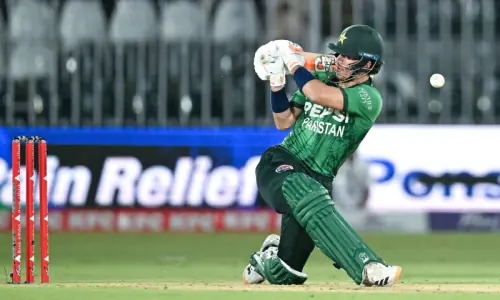
Maaz Sadaqat’s journey from Peshawar’s streets to Pakistan’s T20I spotlight
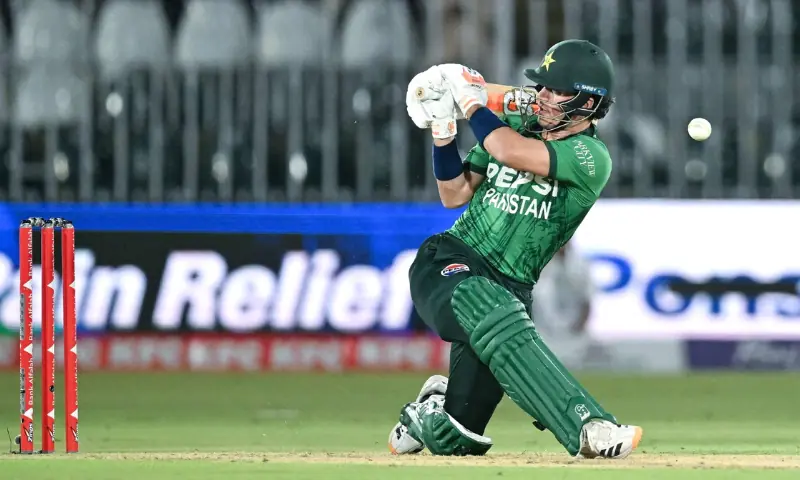
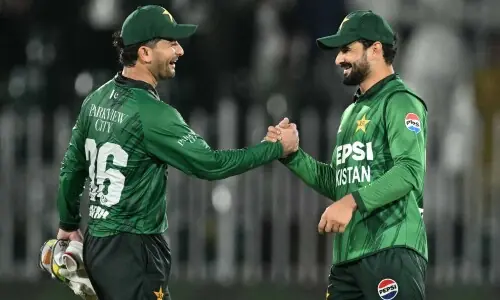
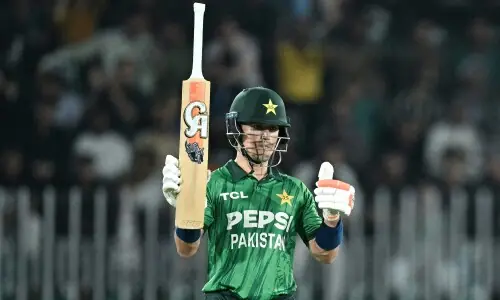
Maaz Sadaqat could hardly have asked for a more emphatic introduction to international T20 cricket. After scoring a brisk half-century in only his third Pakistan outing, against Sri Lanka, the 21-year-old left-hander followed it with a breathtaking 96 off 51 balls in the second match, helping the national side register their highest men’s T20I total on home soil and clinch the series with an 82-run victory.
The two innings came on the back of a remarkable Caribbean Premier League campaign in which Maaz struck two centuries for Jamaica Kingsmen, including one in the final.
He made 112 off 49 balls in the eliminator before scoring 114 off 58 deliveries in the title decider. Although Jamaica lost the final, his performances had established him as one of the most exciting young batters in the tournament.
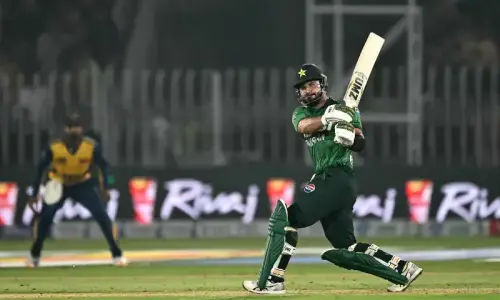
His innings against Sri Lanka have now brought that promise to a wider audience. Sunday’s knock featured six fours and seven sixes, taking Pakistan to 215-3 and equalling the record for the most sixes by a Pakistan batter in a men’s T20I innings.

Maaz fell four runs short of a maiden international century, but by then he had already helped Pakistan secure an unassailable 2-0 lead in the three-match series.
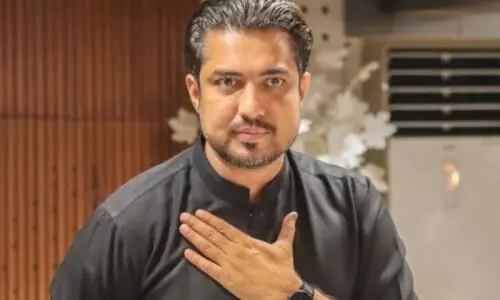
After Maaz’s 96, former Pakistan captain Mohammad Rizwan recalled on social media how the young batter had visited his home in Peshawar as a boy, accompanied by his elder brother, Haroon, with the ambition of one day representing Pakistan.
“It feels like yesterday when a young boy came to meet me in my Peshawar home with his brother Haroon, carrying a dream of one day playing for Pakistan,” Rizwan wrote on X, adding that seeing Maaz in the national shirt had brought him immense happiness.
The message offered a glimpse into the journey behind the sudden international attention, featuring a progression from tape-ball cricket in Peshawar to age-group cricket, domestic competition and, eventually, performances that could no longer be overlooked.
Born in May 2005, Maaz grew up playing cricket on the streets with plastic and tape balls. His elder brother, a first-class cricketer, helped introduce him to organised cricket after he completed his matriculation, taking him to Ashnaghar Cricket Club.
“I was a school kid and was hitting big sixes in my first club cricket game and everyone was super impressed,” Maaz had earlier recalled in a video posted by the Pakistan Cricket Board. His family subsequently encouraged him to attend trials, opening the way into the board’s pathways programme.
He progressed through district and regional under-19 cricket for Peshawar and Khyber Pakhtunkhwa, finishing among the leading run-scorers in youth competitions before representing Pakistan at the 2021 Under-19 Asia Cup and the 2022 Under-19 World Cup. The experience gave him an early grounding in competitive cricket, but the transition to senior level would require more than the ability to strike the ball cleanly.
Maaz made his first-class debut for Khyber Pakhtunkhwa in the 2022-23 Quaid-e-Azam Trophy. He soon demonstrated that his attacking instincts could translate into the longer format, scoring 91 in one of his early matches. He also gained experience overseas, making his List A debut for City Club in Bangladesh’s Dhaka Premier Division in 2023.
Raffatullah Mohmand, his regional head coach and a former Pakistan player, was among those who helped guide his development. He recommended Maaz for the Bangladesh opportunity after the youngster impressed in Peshawar, believing he deserved greater exposure.
“Apart from being a quick learner and skilled cricketer, Maaz’s success also lies in in-depth preparation of all the challenges fronting him,” Raffatullah had said.
According to the coach, Maaz had begun observing and speaking to experienced players, including Rizwan, Iftikhar Ahmed and current Pakistan Sahibzada Farhan, from his teenage years, applying what he learned from them to his training and preparation. That willingness to learn, Raffatullah suggested, had helped accelerate his progress.
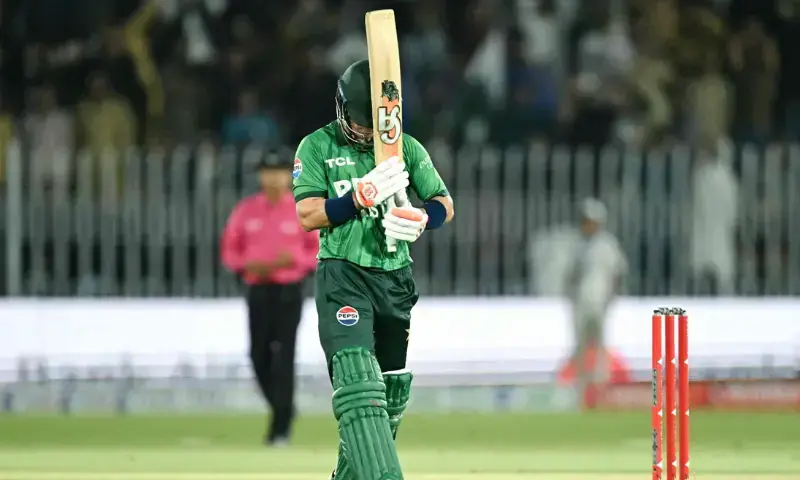
The first major glimpse of Maaz’s potential on a national stage came in the Pakistan Super League in May 2025. Making his debut for Peshawar Zalmi against Islamabad United, he walked in with his side in trouble at 38-3 while chasing 144. Rather than allowing the situation to dictate his approach, he counterattacked, scoring 55 off 33 balls in a match-winning partnership of 102 with Babar Azam.
Babar remained unbeaten on 53, while Sadaqat’s contribution earned him the Player of the Match award. For the young batter, sharing a partnership with one of Pakistan’s leading players was a moment of personal significance.
“With Babar at the other end, I felt no pressure and I turned to my natural game, acquiring more belief,” Maaz had said. “That time also helped me realise how much I have trained all my life to get here and do well.”
The innings appeared to announce the arrival of a promising new talent. Yet the attention it generated soon faded amid the demands of a crowded domestic calendar and the steady competition for places in Pakistan’s white-ball sides.
Maaz’s next breakthrough came later that year at the ACC Men’s Asia Cup Rising Stars in Doha. Representing Pakistan Shaheens in November 2025, he delivered an outstanding all-round campaign that made it difficult for selectors to ignore him.
He began with an unbeaten 96 off 54 balls against Oman and then produced one of the tournament’s defining performances against India ‘A’, taking two wickets for 12 runs before hitting an unbeaten 79 off 47 balls to help Pakistan Shaheens win by eight wickets. He finished as the tournament’s leading run-scorer with 258 runs in five innings at an average of 129, while taking seven wickets. He was named Player of the Tournament.
The performances were significant not simply because of the runs and wickets, but because they showed Maaz’s capacity to influence a match in more than one discipline. His left-arm orthodox spin offered an additional option, while his batting demonstrated that he could attack quality opposition without losing sight of the situation.
The Rising Stars tournament placed him firmly in the conversation around Pakistan’s future white-ball players. His subsequent engagements with Pakistan Shaheens, including overseas tours, provided further experience against different conditions and bowling attacks.
His next PSL campaign, however, was less transformative. Playing for Hyderabad Kingsmen in earlier this year, Maaz featured in 12 matches and scored 260 runs at an average of 23.63 and a strike rate of 178.08.
His highest score was 64, and he registered two half-centuries, hitting 27 fours and 16 sixes. The team reached the final, but Maaz’s season did not produce the same defining headline as his debut for Zalmi or his subsequent performances in the Caribbean.
The numbers nevertheless reflected a batter who continued to score quickly, even if he was not yet converting his starts into the kind of substantial innings that would make him a regular subject of national debate. His challenge remained to marry his high scoring rate with greater consistency.
Maaz had already taken another important step in March 2026, when he made his One-day International debut against Bangladesh.
In the second ODI, he scored 75 off 46 balls and took three wickets for 23 runs, earning the Player of the Match award. He finished the three-match series with 99 runs and three wickets.
The subsequent ODI series against Australia proved more difficult, with Sadaqat managing 35 runs across three matches. His early international record in the format offered encouragement, but it also illustrated the adjustment required to establish himself against senior opposition over a sustained period.
It was in T20 cricket, though, that he would soon make his most emphatic statement representing Jamaica Kingsmen in the CPL.
His selection for Pakistan’s T20I side, however, had a timeline of its own. The PCB announced him in the 15-member squad for the Asian Games in June, months before the CPL campaign. The tournament in Japan, scheduled for September and October, was to provide him with another opportunity to gain international T20 experience. His franchise commitments in the Caribbean meant that he was expected to join the national camp after the CPL concluded.
The Asian Games selection was an indication that the selectors were already monitoring his development. The CPL then offered a compelling demonstration of what he could bring to the format, before even as his international debut came in the Games, in which Pakistan took the silver medal.
While Maaz did not make a big impact in the two games Pakistan played in Japan, he impressed with a 50 off 29 balls as Pakistan chased down a target of 183 to take a 1-0 lead. Two days later, he went further, almost scoring a century.
The back-to-back performances brought together the strands of Sadaqat’s development — the fearless strokeplay first noticed in Peshawar, the lessons absorbed from senior players, the breakthrough in the PSL, the all-round success at the Rising Stars tournament and the proof of his power-hitting in the CPL.
At 21, he offers Pakistan an attacking left-handed batter who can also contribute with slow left-arm spin. His record so far also suggests that the next stage will be about consistency rather than discovery. The challenge is to turn eye-catching innings into a sustained run of performances and establish himself across formats, particularly in one-day cricket.
For now, Rizwan’s recollection of the young visitor to his Peshawar home provides an apt frame for Maaz’s rise. The dream of playing for Pakistan has become reality, and his first two T20Is have ensured that the conversation around him has moved well beyond the domestic circuit. The task ahead is to make this promising beginning last.