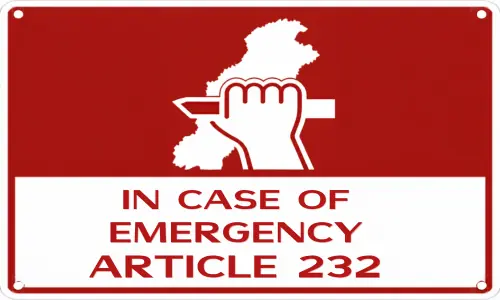
SUNDAY brought what was being whispered about in Islamabad for days: the dismissal of the PTI government in Khyber Pakhtunkhwa. The whispers had turned into news by Saturday.
All day long, the mainstream media kept reporting on the possibility of an emergency, adding that the prime minister would hold a cabinet meeting on Sunday morning to make the ‘final’ decision. But by Saturday evening, there were many other meetings as politicians from the government and opposition sides met or held consultations publicly and behind the scenes. These were last-ditch efforts to avoid taking a ‘painful decision’.
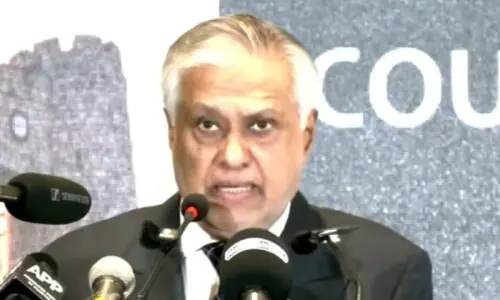
There was little clarity on what the outcome of these comings and goings would be. Apart from the government and PTI, the JUI-F, too, had jumped into the fray and offered to mediate between the two sides. In fact, on Sunday morning, channels reported that the prime minister called Maulana Fazlur Rahman during the meeting, creating the impression that some last-minute deal was being thrashed out. But clearly, these were red herrings, for soon it was announced that both an emergency and governors’ rule had been imposed. It later transpired that the call was simply to inform the maulana about the decision. The cabinet meeting was followed by a bunch of ministers, including of law and interior, holding a press conference to justify their decision. They all looked a bit glum; perhaps they hadn’t slept much.
The PTI’s reaction was muted as it was limited to social media. It seemed as if the television channels were not covering what was happening in KP; neither did they report on the fate of the PTI leadership. Social media posts claimed that the chief minister, Sohail Afridi, as well as other officials, including the KP Assembly Speaker, had been picked up. However, the number of those picked up or arrested is not known; there is little reporting on the issue and the government isn’t willing to provide details. It seems the party’s coverage on the mainstream electronic media is being limited.
By the evening, an advisory council had been put together, in which individuals were given portfolios. It also held a meet-and-greet session with the governor. From the details provided about the people and their portfolios, it seems that far more time had gone into the decision than a mere 24 hours. This is something that was lent more credence by the press conference by Maulana Fazlur Rahman, who alleged that the government had backed out of talks.
Governance by a technocratic administration in KP will help the PTI retain its popularity.
Interestingly, the federal government has imposed an emergency as well as governor’s rule. The logic is hard to understand, though one lawyer suggested it may be because governor’s rule has a time limit while an emergency endorsed by parliament doesn’t. The federal government didn’t want a time limit or to leave the PTI government in place; hence, it used both. And with the kind of administrative measures taken, along with the cabinet announced, it doesn’t seem the new set-up is here for a short time.
In the coming days, there will be much hand-wringing over the role of the PPP and the PML-N in dismissing a democratically elected government. But perhaps this is the price they had to pay to keep enjoying power without mandate. The two parties had got off the democracy train some time ago. At the moment, there is little likelihood of them getting back on. But this is not to say they can’t clamber back on; after all the party that has opposed Sunday’s decision unequivocally is the JUI-F, which was once part and parcel of a set-up introduced by Gen Musharraf.
In the land of the pure, parties find new positions quickly. They discover democracy again and again and again. It is a bit like some of us enjoy returning to the same books again and again; the familiarity is what makes it comforting. However, what will not be easily forgotten is this notion of political parties based in Sindh and Punjab adding to the instability facing the other half of Pakistan — Balochistan and KP, which face the brunt of the violence.
Now on to the issue of terrorism, which allegedly led to the decision to dismiss the KP government. Terrorism’s reincarnation in KP is a complex subject. It cannot be tackled in an article on politics but suffice it to say that this new set-up will not have much impact on the violence in the province. This is partly because terrorism was provided as a justification for the decision to impose an emergency, and is not the reason behind the dismissal of the PTI government, and partly because the government’s argument contradicts itself — it blames the PTI for not providing the political ownership of the state’s effort against terrorism and then proceeds to replace an elected government with a technocratic set-up. How will this provide the much-needed ownership?
More serious still is the decision of the federal government and establishment to take over the province and directly assume responsibility for all that happens there. If in the coming weeks and months, terrorism does not subside, there will be no PTI to blame. The failure — if it is there — will be Islamabad’s and Pindi’s to own. The failure will not be one related to terrorism solely, but will also include governance matters, and the economic hardship faced across the country.
These are all issues the lengthy caretaker government in KP faced and apparently failed to resolve. For this is why a populace tiring of the PTI voted back the party with a two-thirds majority in the provincial assembly. And since 2024, the shenanigans of Ali Amin Gandapur and Sohail Afridi once again led to disenchantment among the KP voters. However, governance by a technocratic administration will once again help the PTI retain its popularity, even though its second-tier leadership will face hardship, including arrests or kidnapping. But once these subside, the party might just flex its muscles to return to power.
Indeed, the weekend’s developments have brought no resolution to the political crisis in KP. The merry-go-round continues.
The writer is a journalist.
Published in Dawn, October 13th, 2026