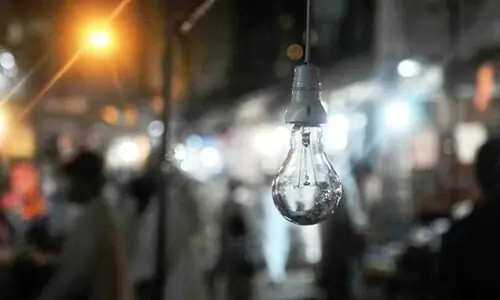
LAHORE: Forced loadshedding and tripping have reached their peak in Lahore and surrounding districts as the people have been facing outages for six to eight hours in urban and eight to 16 hours in the rural areas for the last one week.
On the other hand, the consumers have widely criticised the Lahore Electric Supply Company (Lesco) and the Power Division for depriving them of electricity through forced load management for many hours daily even in the areas that don’t fall under the category of high-loss or low revenue feeders, the areas where most consumers steal electricity directly from the high-tension wires.
“Though our area doesn’t fall in the high-loss feeder category, we are facing almost eight hours outages on a daily basis these days. It is very strange,” a consumer, who lives in Johar Town, told Dawn.
“Last night was very painful as the forced loadshedding was observed on hourly or half-hourly basis. The situation is also damaging the home appliances,” he complained.
Shortfall eases during the day as rooftop solar systems take load off the grid
Talking to Dawn, a resident of a locality near Thokar Niaz Baig, said the situation was worsening fast due to less attention allegedly on the part of Lesco.
“The Lesco field officials also avoid attending or responding to the consumers’ calls in such a situation,” he deplored, requesting the quarters concerned to take action by providing electricity to Lahore as per demand.
Besides Lahore’s several parts, Lesco region’s districts of Kasur, Okara, Nankana Sahib and Sheikhupura are also facing the worst loadshedding.
However, an officer of the Lesco, told Dawn that forced outages in Lahore and other parts had become common these days.
“When there will be no provision of electricity to Lesco as per demand, the company would have no option but to observe loadshedding. At present, Lesco is facing a considerable power shortfall, making it unable to provide uninterrupted power supply. He said the situation was better during the day as the use of solar power by the people, who have this facility, reduced the gap between demand and supply.
“But as soon as the evening starts, these consumers shift to the Lesco power supply system due to non-operation of solar power in the evening/night hours. Thus, it increases demand massively, widening the gap between demand and supply,” he explained.
To a question, the officer said the causes behind the increasing shortfall were probably non-operation of a couple of regasified liquefied natural gas-fired power plants due to meagre supply of gas because of the delayed arrival of the RLNG vessels from Qatar in the ongoing Middle-East war situation. He said the situation wouldn’t improve till the change in the weather as the rains were the only solution to reduce loadshedding.
The Lesco chief executive officer and spokesperson were not available for comments.
Published in Dawn, October 10th, 2026