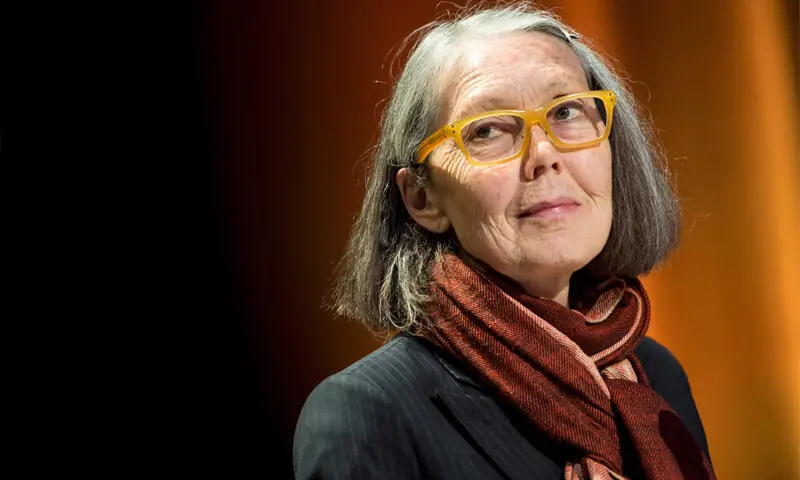
STOCKHOLM: The Nobel Prize in Literature was awarded on Thursday to Canadian poet Anne Carson for her modern twists on Greek mythology and antiquity that have inspired new forms of writing.
The 76-year-old — who announced in 2024 that she has Parkinson’s disease — was honoured “for her bold and inventive oeuvre that, in playful dialogue with the classical tradition, has created new forms for contemporary literature,” the Swedish Academy said.
“They’re all crazy,” Carson said of Academy members’ decision to honour her, in an interview with public broadcaster RUV in Iceland where she has lived part of the year since 2008 and has become a citizen. The permanent secretary of the Academy, Ingrid Carlberg, earlier told reporters that she had spoken briefly with Carson to inform her of the prize.
“All she had time to tell me was that she is for the moment in Iceland, where she’s listening to the wind.” Asked by RUV on a blustery roadside if she thought the Nobel would change her readership, Carson, holding tightly to her cap so it wouldn’t blow away, replied: “I’ll get a sticker on the front of my books.” Carson had at first ignored the Academy’s repeated phone calls.
“There were all these phone calls which I kept turning off because... I just always turn off the phone when it rings,” she said. Her husband convinced her to call back, she told the Nobel Foundation.
A professor of classics with a background in dead languages, literature, anthropology and history, she was described by The New York Times in 2001 as “one of the great pasticheurs.” Her unique contemporary poetry earned her several key literary prizes in the 1990s, including the 1996 Lannan Award and the 1997 Pushcart Prize.
A year later, Autobiography of Red: A Novel in Verse — loosely based on the Greek myth of the monster Geryon and Herakles but transformed into a modern tale of a gay love triangle — received widespread praise.
‘Author for our time’
The Academy singled out her 2010 poem Nox, printed on one continuous sheet of paper in homage to her brother who died in 2000, as “an unforgettable work”. “Palpable here is a deep sense of loss that works its way up from below. The result is a creation as sculptural as it is literary, an epitaph in the form of a box containing an accordion-fold-out of pictures, letters and other written texts dedicated to her dead brother.” It also highlighted her translations from Classical Greek, which “may be regarded as independent works in their own right”.
Academy member Steve Sem-Samberg told the Nobel Foundation Carson was “an author for our time”, connecting the contemporary with antiquity.
Published in Dawn, October 9th, 2026