French-Japanese duo wins 2026 Nobel chemistry prize
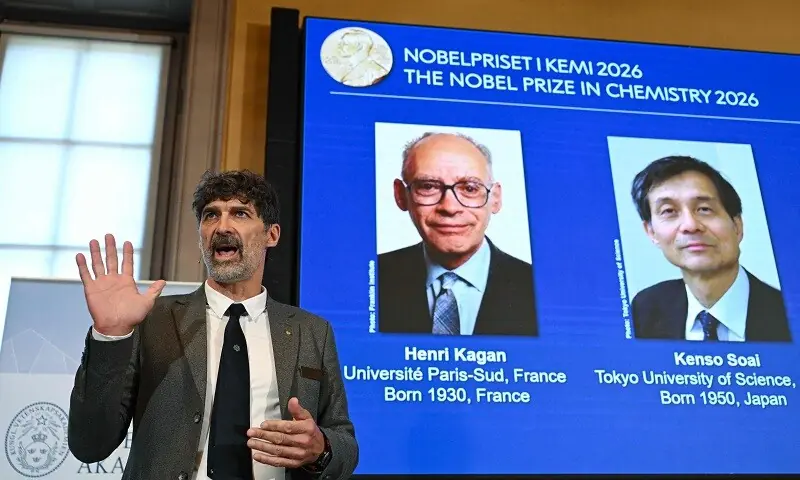
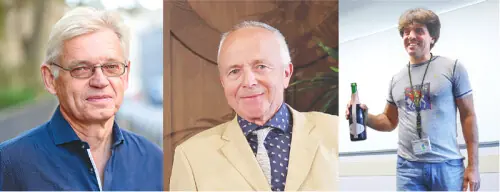
Scientists Henri Kagan and Kenso Soai won the 2026 Nobel Prize in Chemistry “for the discovery of non-linear effects and autocatalysis in asymmetric organic synthesis,” the award-giving body said on Wednesday.
The chemistry Nobel, always the third prize to be awarded during Nobel week, followed those for medicine and physics announced on Monday and Tuesday.
“So this year’s prize is about foundational chemistry. Many molecules occur in two different versions. Like my hands. They are one another’s mirror image, they look alike, but they are not identical. I cannot put my hands on top of one another. Such molecules are called chiral, from the Greek word for hand,” Heiner Linke, Chair of the Nobel Committee for Chemistry, said.
Established in the will of Swedish inventor and businessman Alfred Nobel, the prizes for achievements in science, literature and peace have been awarded since 1901, with a few interruptions mostly due to the world wars.
Nobel, a chemist by trade, amassed huge wealth in the 19th century from inventions primarily tied to warfare, most notably dynamite.
The economics prize is a later addition funded by the Swedish central bank.
Sometimes overshadowed by more famous laureates in the fields of physics, literature and peace, the chemistry awards have still recognised many influential discoveries such as nuclear fission and genetic sequencing techniques.
Last year’s chemistry award went to scientists Susumu Kitagawa, Richard Robson and Omar Yaghi for the development of so-called metalorganic frameworks, molecular constructions that can help tackle challenges such as climate change and lack of fresh water.
The laureates will receive their medals from Sweden’s King Carl XVI Gustaf at a ceremony in Stockholm on December 10, the anniversary of Alfred Nobel’s death. The awards are followed by a lavish banquet at Stockholm City Hall.
They also share 12 million Swedish crowns ($1.2 million), as well as the fame of winning arguably the world’s most prestigious science award.
The peace prize, the only Nobel not presented in Sweden, is awarded separately in Oslo.