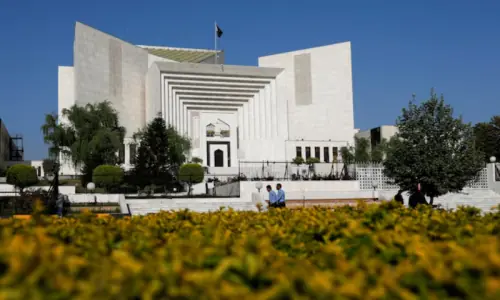
ISLAMABAD: The Supreme Court (SC) on Wednesday rejected the Sindh government’s petition seeking to revisit its June 10 decision overturning the convictions of two Muttahida Qaumi Movement (MQM) workers for their alleged involvement in the deadly 2012 Baldia Town factory fire in Karachi.
Over 260 workers, including 16 who could not be identified, were burnt alive when the multi-storey Ali Enterprises garment factory was set on fire in Baldia Town on Sept 11, 2012, in what became the deadliest industrial blaze in Pakistan’s history.
In June this year, the SC overturned the convictions of Abdul Rehman alias Bhola and Zubair alias Chariya on charges of murder, extortion, arson and terrorism, granting them the benefit of the doubt.
The convicts had challenged a 2023 ruling by the Sindh High Court (SHC) that upheld the death sentences handed to them in September 2020 by an anti-terrorism court for allegedly setting the factory on fire.
On Wednesday, a three-judge SC bench took up the review petition moved by the Sindh government through Sindh Prosecutor General Shabbir Shah, challenging the June 10 acquittal.
The bench was headed by Justice Malik Shahzad Ahmed Khan and also included Justice Aqeel Ahmed Abbasi and Justice Shakeel Ahmed. Sindh Additional Prosecutor General Saleem Akhtar presented arguments before the SC.
Besides rejecting the Sindh government’s appeal to revisit its June 10 decision, the SC also dismissed a separate petition moved for expungement of remarks from the June 10 decision regarding MQM.
The detailed order is expected to be issued later.
Sindh govt’s plea and SC acquittal
In its petition, filed in July, the Sindh government had contended that the June 10 judgment had suffered from “error of facts, circumstances, confessional statement and violation of law of vicarious liability and common object”.
The Sindh government had argued that the SC overlooked the evidence of star witnesses of the prosecution, the factory owner, a judicial magistrate and other key witnesses.
The petition had further contended that the report of the joint investigation team was also overlooked while passing the acquittal as there was sufficient proof against the accused.
In its June 10 judgment, the SC had described the Baldia Town factory fire as one of the most “tragic, painful and heart-rending disasters in Pakistan’s history”, in which 260 workers lost their lives and around 60 others suffered burn injuries.
“The victims were ordinary workers who had entered the factory to earn their livelihood, but many of them never came out alive,” Justice Khan had observed in his detailed 39-page judgement.
The order had noted that the original first information report (FIR) had been registered against the factory owners and management for allegedly failing to implement adequate safety measures.
However, around two-and-a-half years later, the prosecution changed its stance, alleging that the petitioners and their co-accused had deliberately set the factory on fire after its owners refused to pay Rs250 million in extortion money allegedly demanded by the MQM.
The petitioners, however, maintained that they had been made scapegoats to victimise their political party. Given these competing narratives, the judgement had stressed that the court was required to exercise utmost caution before reaching a conclusion.
The SC had also reiterated that it was the prosecution’s duty to prove its case beyond reasonable doubt and the court’s responsibility to ensure that no innocent person was convicted on the basis of presumptions or unreliable evidence. At the same time, it had emphasised that offenders should not escape punishment where credible and convincing evidence existed.
Referring to allegations of extortion, murders and arson attributed to MQM, the court had observed that probabilities and presumptions, however strong, could never substitute for conclusive proof required under the criminal justice system.
“We are clear in our minds that if there is no reliable evidence or conclusive proof against the petitioners to establish the alleged motive or other charges, their convictions cannot be sustained merely on the basis of presumptions, probabilities or general allegations,” the judgment had stated.
The court had also made observations regarding the Muhajir community, stating that it formed a cherished and respected part of the Pakistani nation whose members had made immense sacrifices during Partition in 1947.
The judgement noted that MQM had generally been regarded as representing a majority of Muhajirs, but stressed that alleged criminal acts by individuals could not justify attributing guilt to an entire community or its representative political party without tangible and convincing evidence.
Although the prosecution produced around 400 witnesses, the SC had found these statements weak, hearsay or otherwise unreliable.