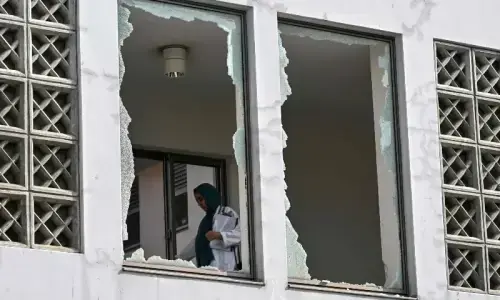
THIS is with reference to the report ‘Confusion arises over compensation after baby rescued in Pims fire incident dies’ (Sept 19). The ‘confusion’ is related to the payment of compensation amount to the aggrieved family, not about fixing the rot in the healthcare sector in the wake of a fire at the Pakistan Institute of Medical Sciences (Pims) that extinguished 15 innocent lives. A couple of days earlier, the editorial ‘Pims tragedy’ (Sept 17) had rightly noted that the country’s healthcare system is “trapped in a loop of doom”.
The unfortunate incident has raised serious questions about hospital administration, accountability, safety protocols and the overall functioning of the public healthcare system. If the federal health minister himself acknowledges that the system is severely dysfunctional, the most obvious question that follows is: who is responsible for fixing the system?
The government and the relevant ministry are responsible for identifying institutional weaknesses, introducing reforms and ensuring that those reforms are actually implemented. Simply declaring that the system is broken is not enough. The real test of leadership is what is done to repair it.
Another major concern is fire safety in public hospitals. The Pims tragedy was not the first of its kind in the country. Previous incidents had also highlighted problems involving fire safety, electrical systems, air-conditioning systems and emergency preparedness. Why have our governments consistently failed in finding a permanent solution, and ensuring its implementation?
Every tragedy is followed by committees, inquiries, statements and suspensions. After some time, however, the matter fades from public attention and the system returns to business as usual. This cycle must end. The problem is not limited to one hospital or one incident. It reflects a broader failure of institutional governance and reform. Unless fundamental reforms are introduced, simply changing officials or suspending a few individuals will not fix the system.
Unfortunately, our priorities often favour projects that are immediately visible, while the reforms that quietly strengthen institutions remain neglected. The success of the state should also be measured by whether a newborn is safe inside a public hospital, whether emergency exits are accessible during a crisis, whether fire safety systems actually work, whether officials are held accountable, and whether a family can trust the state with the life of its most vulnerable member.
The tragedy at Pims must be taken as an opportunity to conduct a serious and transparent review of hospital safety, emergency procedures, administrative decision-making, and accountability mechanisms. If we fail to fix the system today, who will guarantee that the next tragedy will not happen tomorrow?
If reforms are ignored simply because they do not produce attractive headlines in media, perhaps we need to reconsider not only our system, but also our priorities.
Hayan Ahmed Khan
Islamabad
Published in Dawn, October 6th, 2026