
Split between the past (the 1990s) and the past’s past (1958), Unabomber, a Netflix release about the real-life American bomber, takes longer than most films to pick up pace. And by that I mean it doesn’t really get going until the last 30 minutes of its 100-minute runtime.
Up until then, the audience will likely be split between continuing to watch the film (perhaps with 1.5x speed toggled on) or forsaking it to check out the documentary about him, also on Netflix. In either case, one might count it as a win for Netflix.
Director Janus Metz Pedersen (All the Old Knives, 2022), working from a screenplay by Sam Chalsen and Nelson Greaves, sets the stage with archival news footage of the Unabomber — the serial bomber who received substantial airtime between 1978 and 1995 for his mail bombings.
Caught by the FBI in 1996, he was revealed to be Ted Kaczynski, a mathematics prodigy who enrolled at Harvard at age 16, and later became an assistant professor at the University of California, Berkeley. His 17-year bombing spree resulted in 14 successful detonations and two failures due to mechanical malfunctions. Surprisingly, his bombings killed only three people and injured 23.
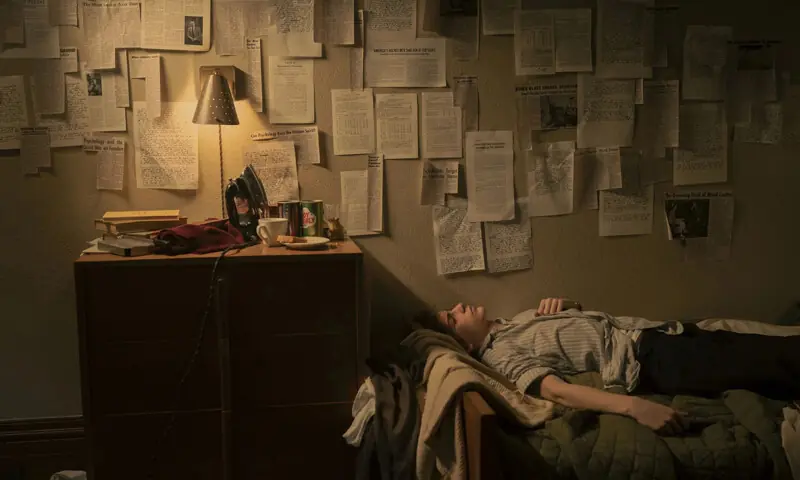
Netflix’s Unabomber splits its story between an FBI investigation into a 17-year bombing spree and some disturbing years at Harvard that may have triggered it, but neither thread generates the tension the material promises
Believing himself to be a righteous lone-wolf terrorist, Kaczynski was a complicated, angry and volatile man who campaigned against those he believed were advancing modern technology and destroying the natural environment. He authored a nearly 35,000-word manifesto and social critique that opposed modern technological society, rejected leftism and advocated violent revolution.
During the trial, his lawyers attempted a “mental disease or defect” defence, intending to argue that Kaczynski suffered from paranoid schizophrenia — a point raised in the final stretch of the movie. One presumed that a psychological trigger — though never highlighted or argued — was the series of experiments conducted by Prof Henry Murray (Russell Crowe) at Harvard in the late 1950s and early 1960s, of which Kaczynski was a participant.
That’s fascinating material, wouldn’t you agree? The filmmakers thought so too, one assumes. The narrative, however, never elevates itself above mundane, seen-it-all-before storytelling, and one that chooses not to show us the inner workings of this unhinged man or the details of his crimes, save for one fleeting, forgettable shot of a bombing at the very beginning.
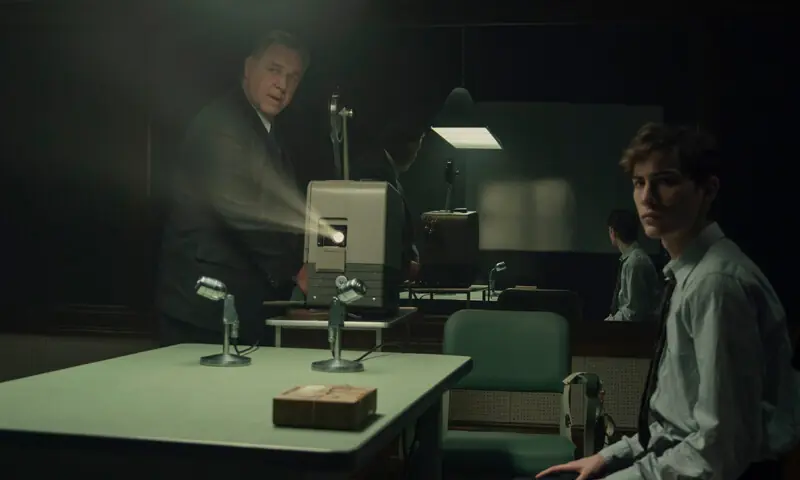
Dividing the viewers’ attention between a procedural and a character drama sounds good on paper. One follows FBI agent Joanne Miller (Shailene Woodley), who deduces that the bomber’s writing style and linguistics may help uncover his identity; the other explores young Kaczynski’s past during Murray’s experiments.
Miller’s subplot continually pulls you out of the story. Kaczynski (played by the very, very talented Jacob Tremblay) and his dynamic will hook you, on and off. The clash in tone, emotion, and style, however, is jarring and doesn’t serve the film.
Murray is an intriguing figure, well played by Crowe: a psychology professor who reveres Herman Melville and his novel Moby-Dick, and chases a giant white whale of his own — recognition and remembrance in his field. His psychological experiments, we learn, were funded by the CIA during the Cold War. Annabelle Wallis plays Christiana Morgan, his long-time romantic and professional partner.
One can see the appeal of a contemporary thriller — had the writers and director not sidelined the actual thrills — contrasted with the dimly lit period study of a madman-in-the-making. But neither thread works particularly well on its own. Each demands sharper detail, clearer narrative intent, and directorial panache.
The raw materials and spot-on performances are all here, courtesy of Tremblay and Crowe, yet the outcome is mostly an exercise in inertia, dominated by people talking, arguing, then cracking or retaliating under pressure. Their words speak of conviction, though one cannot see the conviction itself.
Sometimes, one deduces, it is better not to split a tale… and your audience.
Streaming on Netflix, Unabomber is rated suitable for ages 16 and over and features tiring scenes where people talk, walk and talk some more, before finally snapping
The writer is Icon’s primary film reviewer
Published in Dawn, ICON, October 4th, 2026