STYLE: THE CATWALK RETURNS TO KARACHI

A fashion show hasn’t been organised in Karachi for quite some time. Of course, there has been the occasional commerce-dictated solo show or haphazard assortments rustled together by sponsors wanting to uplift their brand’s image with a dose of glamour, and designers doing the needful by simply showcasing whatever they had in stock.
But a show in which the fraternity gathered together, where there was talk of design and inspiration, and where interpretations of a certain theme were the focus on what was seen on the catwalk, simply hasn’t happened for a while.
To be fair, over the past few years, Karachi’s designer lot has not seemed to be too inclined towards the runway, anyway. Their focus has been on business, on stocking their stores and e-stores with designs that would sell well, and one doesn’t need a catwalk to do all this.
Fashion shows require time, effort and money that the fraternity doesn’t seem to want to invest in, and most of them would never want to belittle their labels by being part of a slipshod show that was badly organised and had a worse crowd that just ogled at the models rather than enjoying the fashion.
After years of commercially driven collections and conspicuously absent runways, Kaleidoscopic Karachi brought the city’s fashion fraternity together for a riot of colour, craft and creativity — and reminded designers that the catwalk can still be a place to take risks
Credit then goes to the Laam Fashion Week (LFW) organisers for convincing some of the city’s most exciting ateliers to come on board for a single-day show, titled Kaleidoscopic Karachi.
LFW had made its catwalk debut last year with a four-day, extremely fashionable event in Lahore. It had been an exciting ‘fashion week’, boasting of several major names in the designer line-up, and the hype that followed was perhaps enough to convince the fashion industry that this is a team that means business.
The clout thus gained by LFW must certainly have been one of the reasons why, now in Kaleidoscopic Karachi, five major labels and one veteran fashion photographer readily agreed to be part of the show.
WHAT’S IN A NAME?
The name chosen for the event was apt; the designs on the runway were very varied, like pieces within a kaleidoscope, coming together into a single show.
As the press release for the show pointed out, Karachi can, of course, be likened to a kaleidoscope: nostalgic and modern, polished and unruly, its beauty simmering just beneath the chaos most identifiable with the city. A chandelier made of mirrored strips loomed above the catwalk, reflecting light and further driving home the kaleidoscope theme.
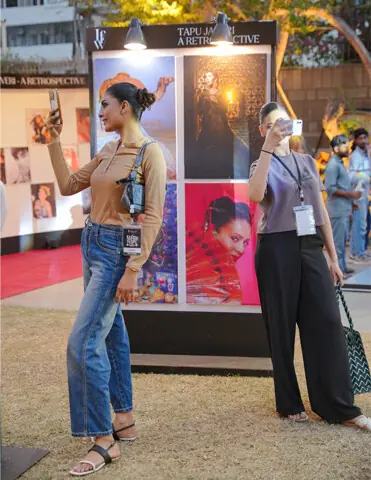
There was an installation of more than 100 pictures from photographer Tapu Javeri’s archives, stretching across his four decades in the fashion industry, and a showcase featuring collections by Deepak Perwani, The Pink Tree Company, Wardha Saleem, Khaadi and Sana Safinaz.
It wouldn’t be incorrect to say that the audience in the front rows was just as interesting as the fashion on the catwalk.
Milling about the lawn of the Indus Valley School of Art and Architecture (IVSAA) was a very impressive crowd of professionals from the fashion and entertainment industries. They zigzagged through the installations of Tapu Javeri’s portraits, sampled the food, which was very Karachi-esque — different variations of street food — and then went on to fill up the rows lined on either side of the catwalk.
The fashion fraternity arrived in droves: HSY, Kamiar Rokni, Fahad Hussayn, Shamoon Sultan, Saira Shamoon, Adnan Pardesy, Maheen Kardar, Sana Hashwani, Zaheer Abbas, Sania Maskatiya, Umair Tabani, Zahir and Scherezade Rahimtoola, Feeha Jamshed and Parishae Adnan, as well as veterans such as Bunto Kazmi, Faiza Samee and Maheen Khan, among others.
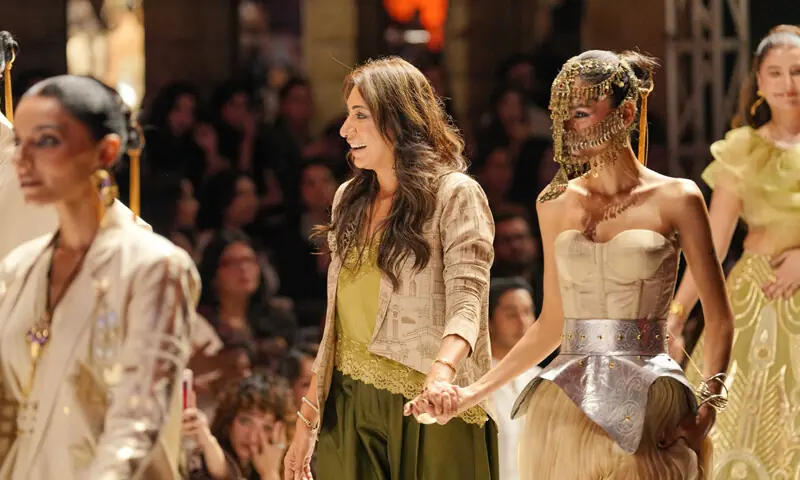
It is rare in these times for the industry to gather together at an event with such enthusiasm, and yet, there they all were, huddled together in the front rows, with the designers from Lahore having especially flown down for the show.
It is also rare in these times for fashion to eschew ‘celebrification’, letting the designs take centre stage rather than piggybacking on the popularity of a famous ‘showstopper’. There was no deluge of stars on the Kaleidoscopic Karachi catwalk, with the fashion being in focus.
GLAMOUR, GOTA AND GLITZ
Let’s talk about the fashion, then.
The event started with a collection by Deepak Perwani. Titled ‘The Cocktail Hour’, the collection reminded one of the Deepak of yore, before he became enamoured by the lucrative potential of the desi three-piece.
The models came wearing long gowns, saris, and tiered skirts paired with bustiers, showing a bit of skin here and there. The fabric flowed seamlessly, aided by just a bit of embellishment. The menswear also caught the eye: tuxedos, snazzy jackets, greys and silvers with pops of olive green.
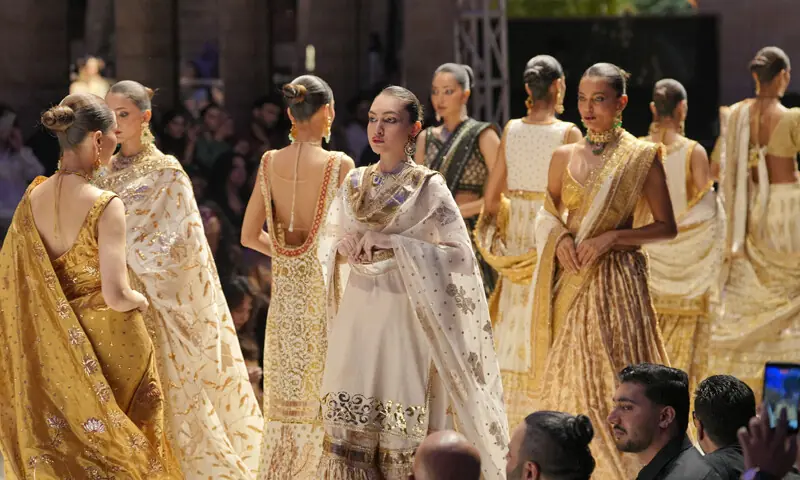
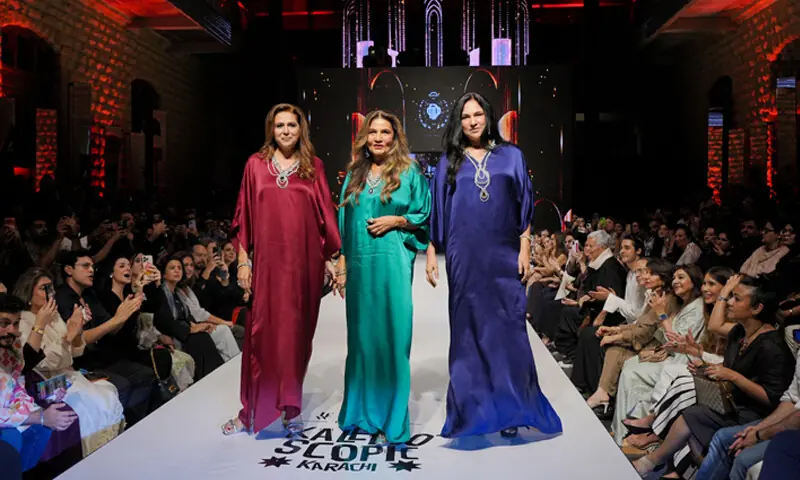
‘The Cocktail Hour’ concluded with three top models from the 1990s — Frieha Altaf, Seemi Pasha and Atiya Khan — wearing Deepak Perwani gowns on the catwalk. It was an impactful way of acknowledging the designer’s longstanding presence in Pakistani fashion, from his designs making waves and raising eyebrows on magazine covers in the 1990s to the present, with brick-and-mortar stores and a thriving e-store, dressing the women of today.
Keeping in line with the kaleidoscopic theme, the next collection was in complete contrast. Wardha Saleem dabbled with textures and embellishment as she navigated ‘Bandar Road Se Keamari’ [From Bandar Road To Keamari].
Anyone familiar with Wardha Saleem’s design journey knows that she is in her element when she experiments with technique. With this particular line-up, she turned a gimlet eye towards the details: miniature domes and balconies came to life with dainty aari-work, golden and silver florals were etched out with leather, there were quilted architectural outlines, pillars and jharokas [decorative, overhanging balconies] and odes to Karachi’s old tram station and the golden days of Radio Pakistan.
The innovations in silhouette, particularly in the case of the lowers, were interesting, with the designer dabbling with draped cowl shalwars, cowl skirts and the very first outfit showcased on the ramp, worn by model Javeria Hanif, featuring pleated pants evidently crafted using 40 yards of organza fabric!
Detailed, trendy and wearable, the line-up was a testament to some of Wardha Saleem’s strengths as a designer.
Mohsin Sayeed, Sheena Rizvi and Hadia Khan’s Pink Tree Company’s range of festive-wear stayed true to the brand’s ethnic signature. Cotton was elevated to formal wear with gota-work and variations in block print, and even the silks used in the collection seemed lightweight and free-flowing. There were lehngas in crinkled cotton, classic ghararas, angarkhas, lehnga cholis and a gorgeous sari in gold.
It was festive-wear which wasn’t weighed down by over-embellishments, using a palette of white, gold and black. Was it a new spin to what one expects from The Pink Tree Company? Not really. It was elegant and very pretty and quite in line with the brand’s ethos — although one would have loved some more experimentation.
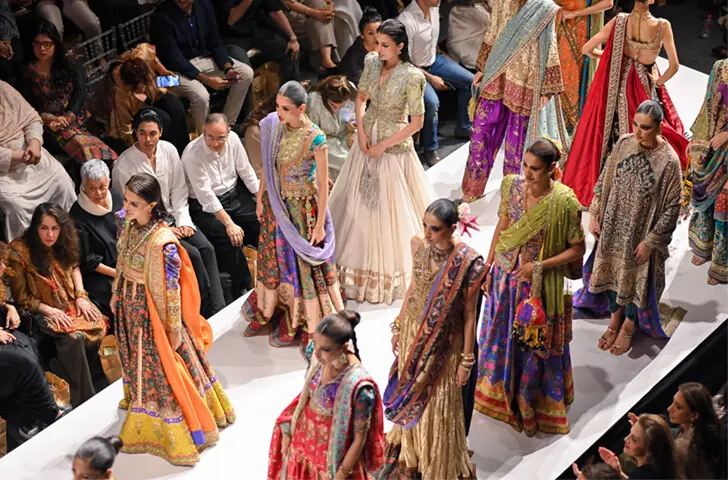
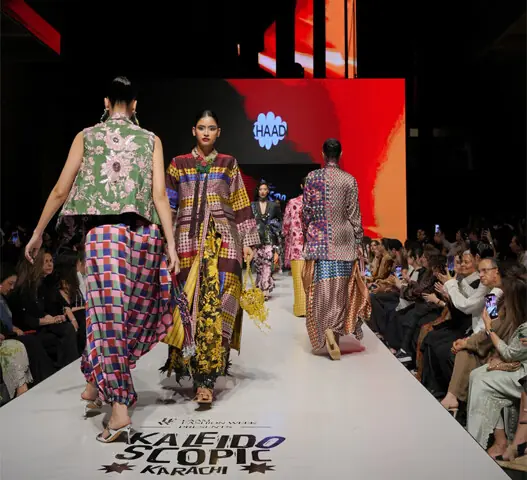
And then came Khaadi, upending all expectations that one might have had from a brand which is a high-street heavyweight. This was fashion that didn’t care about the high street or sales and was very maximalist, edgy, insouciant and rebellious. Print, texture, colour and embroidery clashed and were coordinated in a range of separates that ran the gamut from jackets to kaftans, jumpsuits, blazers and reinventions on lowers.
It was a collection that screamed high fashion, and which had you hooked as it unfolded on the catwalk. Khaadi’s stronghold on retail is undeniable, but happily, this was no elaborate sales pitch. Instead, this was a glimpse of the fashion-forward wild spirit that drives the brand and which lurks, unseen, beneath the concentric racks of wearable fast fashion!
Sana Safinaz took to the catwalk after a long, long time for the final show of the evening, with their ‘Mastani’ range of festive-wear. There was plenty of visual appeal: colours, embroideries, prints, beautiful dupattas and generous doses of bling. The designers introduced some playful touches to the familiar wedding-wear template, offering ensembles that seemed well suited to the festive season ahead.
Having said this, one was expecting more experimentation, more cutting-edge details, some of the oomph and sophistication that has always characterised Sana Safinaz’s couture and that moved beyond the familiar festive-wear vocabulary. As finales go, it was a colourful one, although perhaps not quite the fashion mic drop the evening might have warranted.
THE BIGGER PICTURE
With this, Kaleidoscopic Karachi came to an end, wrapping up within nearly an hour. Having weathered fashion shows in the past where time has stretched on and on, it was refreshing to be at an event where punctuality was valued. Credit is also due to Nubain Ali for conceptualising and choreographing the show, and to Nabila’s N-Pro team for handling the hair and make-up with admirable efficiency.
But the evening’s real achievement went beyond the collections, the choreography or even the impressive turnout. It was a reminder that the runway can be a space for designers to experiment and express themselves without worrying about whether every look can be translated to a bestseller.
It was also an indication that, contrary to what is often whispered within the fraternity in jaded tones, creativity in Pakistani fashion is not ‘dead’ — it is merely waiting for a platform that will allow it to be a little adventurous and audacious, showcase craftsmanship and celebrate new ideas.
The first LFW in Lahore was a testament to this, and Kaleidoscopic Karachi has done exactly that as well. Not every collection pushed creative boundaries in equal amounts, but it did all come together in a chaotic, tantalising ‘kaleidoscope’.
The writer is a fashion and entertainment journalist with over two decades of experience.
She can be reached at maliharehman1@gmail.com
Published in Dawn, ICON, October 4th, 2026