KARACHI: The Pakistan Stock Exchange (PSX) remained under pressure during the outgoing week amid the International Monetary Fund’s (IMF) review, geopolitical tensions and elevated global oil prices.
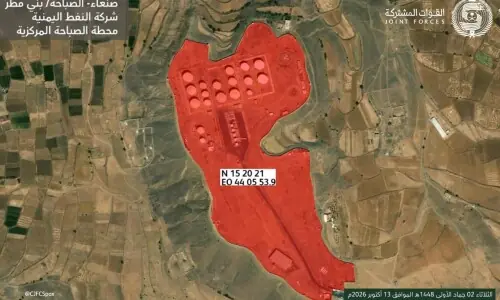
According to Arif Habib Ltd (AHL), the benchmark KSE-100 index closed at 168,155 points, down 2,610 points, or 1.5 per cent week-on-week. Geopolitical uncertainty and tensions involving Saudi Arabia and Yemen’s Houthis weighed on hopes of progress in peace talks between the US and Iran.
Oil prices touched $105.3 per barrel during the week as supply-chain concerns and China’s suspension of oil-product exports outweighed improving Gulf crude flows. Brent crude later eased to $99.5 per barrel.
For September, the KSE-100 declined 7,006 points, or 3.96pc, according to Topline Securities Ltd. The brokerage attributed the monthly decline to escalating geopolitical tensions, concerns over disruption to oil supplies and shipping through the Strait of Hormuz, and crude prices rising above $100 per barrel at times.
Index falls 1.5pc in outgoing week as elevated oil prices and economic uncertainty hit sentiment
Market participation weakened during the week. The average daily traded volume fell 21.7pc to 525 million shares, while average traded value dipped 16.6pc to $67.3m. On the macroeconomic front, consumer price inflation eased to 10.26pc year-on-year in September from 11.1pc in August, mainly due to lower food-price pressures. However, inflation remained substantially above the 5.76pc recorded in September 2025.
The trade deficit widened 6pc year-on-year to $3.6 billion in September, according to AKD Securities. Meanwhile, the IMF mission formally began policy discussions in Islamabad for the fourth review of the $7bn Extended Fund Facility and the third review of the $1.4bn Resilience and Sustainability Facility. The reviews are linked to combined disbursements of $1.2bn under these two programmes.
The Federal Board of Revenue collected Rs3.1 trillion during the first quarter of 2026-27. In September alone, tax collection rose 9pc year-on-year to Rs1,344bn, marginally exceeding the monthly target of Rs1,343bn.
In the latest Treasury bill auction, the government raised Rs880bn, with yields increasing across all tenors by 49-75 basis points. The three-month tenor accounted for Rs480bn. AKD Securities reported that cut-off yields rose by 61, 75 and 45 basis points for three-, six- and 12-month papers, respectively.
The country’s liquid foreign exchange reserves stood at $26.77bn as of Sept 25, down $39.7m. However, the State Bank of Pakistan’s forex holdings increased by $38.9m to $21.4bn, equivalent to 3.04 months of import cover. The rupee appreciated marginally by 0.03pc against the dollar, closing at Rs277.07.
Crude oil and petroleum imports rose 21pc year-on-year in August, driven by a 55pc increase in crude imports. Local crude production increased 7pc, taking the share of imported crude in the overall mix to 82pc from 75pc.
Refinery upliftment rose 32pc year-on-year to 1.084 million tonnes in September and increased 12.5pc month-on-month, supported by higher sales of petrol, high-speed diesel and furnace oil. Oil marketing companies’ sales, however, fell 2pc year-on-year to 1.35m tonnes amid higher fuel prices, although they increased 7pc month-on-month.
Among sectors, banks, cement, exploration and production, power and technology companies were the biggest negative contributors to the index, taking away 584, 412, 304, 180 and 174 points, respectively. Refinery, leather and tanneries, vanaspati and allied, textile and weaving, and synthetic and rayon sectors made modest positive contributions.
At the individual stock level, Pakistan Petroleum Ltd, United Bank Ltd, Pakistan Services Ltd, Systems Ltd and Hub Power Company were among the major negative contributors. Attock Refinery Ltd, Pakistan Oilfields Ltd, TRG Pakistan Ltd, Service Industries Ltd and Meezan Bank Ltd contributed positively.
AHL said the market’s direction would remain contingent on geopolitical developments and progress in talks between the government and the IMF.
AKD Securities noted that stronger economic indicators and the IMF review could influence market sentiment, while easing geopolitical tensions could reduce international oil prices.
Published in Dawn, October 4th, 2026