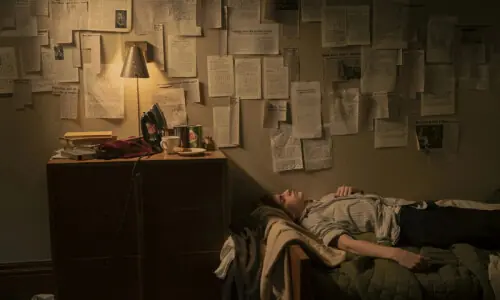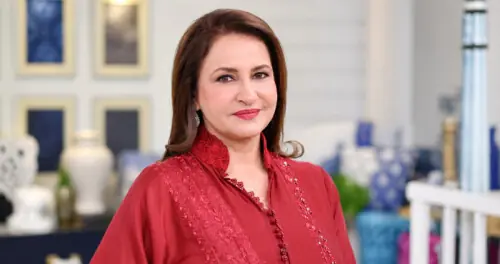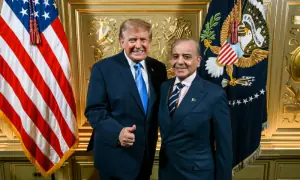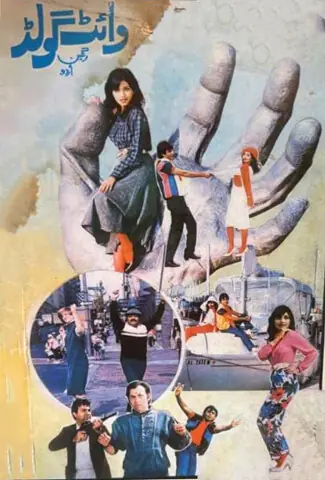
Would you believe that a Pakistani film about the drug mafia was shot entirely in America with permission from the highest levels and a dream cast? White Gold was one such ambitious production, which centred on drug smuggling from South Asia to the United States.
The legendary film actor Mohammad Ali played the drug lord ‘King’, travelling in limousines and helicopters with film star Nanha in one of his last major film roles. White Gold had all the ingredients of a Hollywood action thriller: police pursuits, shoot-outs, fights in a car junkyard, a chase at a shipyard, scenes inside American jails and, on the face of it, a climax around the Washington Monument. At the centre of the film were Noor Naghmi and Vagira, the film’s leads.
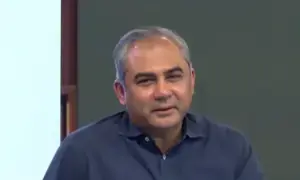
The son of legendary broadcaster Abul Hasan Naghmi, better known as Bhaijan, Noor was born in Lahore and grew up surrounded by broadcasting and the performing arts. When his father joined Voice of America in the 1970s, the family moved to the United States.
Noor later returned to Pakistan and appeared in a couple of Lollywood films in 1979: Tarana [Anthem], alongside Waheed Murad, Rani and Ghulam Mohiuddin, and Khushboo [Fragrance], with Shahid. He subsequently became a familiar face on PTV and NTM, often working with writer Anwar Maqsood. He is also remembered for his role in the comedic long play Sheri Aur Jozy [Sherry and Jozy, 1994], alongside his cousin Ali Shoaib and has, in recent years, appeared in movies such as The Sentinel (2006) and Life! Camera Action… (2012).
Forty years after its release, White Gold remains an extraordinary Pakistani production, taking its drug-smuggling story to the US on a scale rarely attempted by local filmmakers
White Gold emerged from Noor’s interest in taking Pakistani cinema beyond borders and, since he held US nationality and had contacts in the country, he was able to play an important role in the film’s production and was an uncredited co-producer of the film. He was also friends with the film’s credited producer and director, Zafar Shabab.
While Bollywood was increasingly shooting in the United States, Canada and Europe, Pakistani cinema had made only a handful of films abroad, including Rishta Hai Pyar Ka [A Relationship of Love, 1967]. With reports of South Asians becoming involved in drug trafficking in the US in the 1980s, Noor chose the subject of the movie and approached then first lady of the United States Nancy Reagan and the face of the highly visible “Just Say No” anti-drug campaign.
“We were lucky to get the approval and, with Nancy Reagan’s letter, all doors started to open,” he recalls from the US. “The [former] mayor of Washington DC, Marion Barry, was most cooperative and even provided his private helicopter for the shoot.” Noor currently resides in DC and is completing a comedy titled Jack and Jill.
Initially conceived as a Pakistan-Bangladesh-Sri Lanka co-production, the project had to be reworked after the Pakistani team encountered visa difficulties. The Bangladeshi team arrived, waited and eventually left. A Bangladeshi actor was originally set to play the rival of King but, when that arrangement fell through, the filmmakers turned to Arif Dar, a South Asian-American known for his radio show with Indian actress Deepti Naval.
The production of White Gold pushed the boundaries of what a Pakistani film could achieve abroad. The crew filmed the Halloween parade, cordoned off an entire block of Chinatown and even used serving police officers in a chase sequence.
The story drew from classic mafia films. At its centre was King, a powerful drug lord whose empire begins to crumble after a bitter rivalry with another gang costs him his family. Enter Aamir, a young Pakistani who travels to America in search of a better life and falls in love with King’s daughter. Played by Noor, Aamir becomes an unlikely force in the conflict, helping defeat the rival gang while earning King’s approval. Sri Lankan actress Vagira played his love interest, while Noor’s cousin Ali Shoaib made his big-screen debut as Sunny, one of King’s three children.
“I recently watched the film online and was surprised at how much we had managed to accomplish — police chases, shoot-outs, explosions, helicopters, American prisons, and locations across Washington DC,” says Noor.
Noor went to unusual lengths to find the right locations for Mohammad Ali’s character. “For King’s residence, I had a particular house in mind. It was perched on top of a mountain, and I felt it would be the perfect setting for King’s den. The house belonged to a renowned military officer, General Lee, and offered a breathtaking view of the Washington DC skyline. I simply went there, sought permission and shot there.”
In late 1985, Mohammad Ali travelled to America with his wife, Zeba, for two weeks and completed his portion of the shoot during that time. Actor-turned-singer Musarrat Nazir lent her voice to Vagira, and also contributed to the soundtrack with the wedding song ‘Aaya Larriye Ni Tera’, adding a distinctly Pakistani touch to the American-set production.
For Nanha, White Gold would prove to be one of his final major films. Noor remembers the shoot with particular affection. “I had worked with him in Tarana and admired him immensely. We had rented a house for the cast and crew in Washington, and Nanha would entertain everyone. He would actually cook for those staying there, including Vagira. The whole experience felt more like a picnic after pack-up. I completed the post-production in the US and, by May 1986, went to Lahore for dubbing.”
He says that, by that time, “Nanha seemed like a completely different man. He was depressed. His relationship with actress Nazli had ended, which had affected his health. I had gone to his home with the film’s director Zafar Shabab to pick him up for the dubbing session. When we arrived, we found Nanha lying in a pool of blood inside his house. It was a moment I have never forgotten. Ahmed Ali, a master of voices, eventually dubbed Nanha’s character.”
The production pushed the boundaries of what a Pakistani film could achieve abroad. The crew filmed the Halloween parade, cordoned off an entire block of Chinatown and even used serving police officers in a chase sequence.
However, the climax provided an unexpected twist.
“We were using toy guns and had barely begun rehearsing when real police arrived to arrest us. Despite permission, we were escorted away from the [Washington] monument. With the original location suddenly off-limits, we had to improvise and the climax was eventually ‘cheated’ using the stairs of the National Archives building,” Noor tells Icon.
For audiences in 1986, White Gold was unlike most Pakistani films of its time. While Punjabi action films and the familiar gandasa formula dominated the scene, it offered an international setting, an unusual subject and a scale rarely attempted by local filmmakers.
It found a select audience but, for Noor Naghmi, the real success was proving that his ambition could reach far beyond the limitations of the industry he came from.
White Gold can be viewed on YouTube
The writer is a vintage cinema enthusiast. He can be reached at suhaybalavi@gmail.com
Published in Dawn, ICON, October 4th, 2026