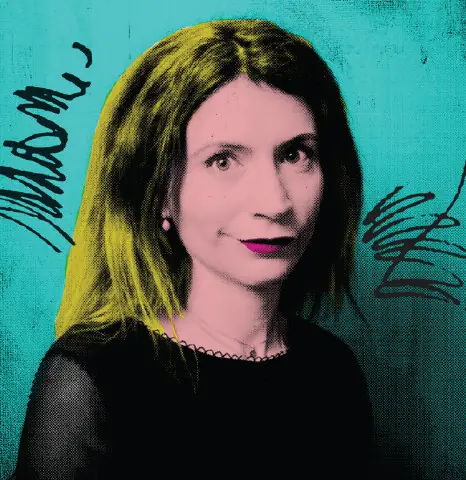
I am in Pakistan working on my Urdu. Here, I’ve been inspired by Rebecca F. Kuang’s Taipei Story. This is the young author’s most recent novel of seven, after the dark academia works Babel and Katabasis and, in between, the runaway bestseller Yellowface.
My column is less a review than some personal fragments about this lean new volume. The book fictionalises Kuang’s own experiences moving from an intermediate standard to a higher level of Chinese. I also refer to some Urdu reading I’ve been inching through with the help of my teacher. I felt compelled to write about Taipei Story, which has just reached stores like Liberty, because it connects with my own experience of learning a language as an adult.
Kuang’s protagonist, Lily, spends 10 weeks in Taipei on an intensive Mandarin course. Early in the programme, she is presented with a reading comprehension. Lily understands so little that she just takes stabs at the meaning. The passage describes a female student but the Chinese characters are hard to parse, so Kuang wittily has Lily call her ‘Something-Something’. This girl’s hostel room has become a mess, and Lily decides that a thief must have broken in. Faced with a multiple-choice question about why the room is dirty, she picks the answer that seems least implausible.
Towards the end of the course, Lily comes across the same test again. This time it is obvious. There was no thief but, instead, a storm had blown through an open window and scattered Something-Something’s belongings. The passage hasn’t changed but Lily has. What had seemed mysterious and vaguely sinister is suddenly clear and humorous.
I recognise something of my own experience in that. I have only a month here in Karachi, Lahore and Islamabad, while Lily spends more than double that time in Taipei. Plus, it is harder to ban English from my life in Pakistan than it is for her in Taiwan, where the Japanese and now mainland China loom as potential colonisers rather than the British.
I am not a heritage-speaker like her. Kuang foregrounds Lily’s precarious position within the Chinese-American diaspora. Her parents are from mainland China rather than Taiwan, complicating her sense of belonging. As both tourist and language-learner, she shuttles between shifting identities, competing affiliations and unequal power structures. Lily arrives in Taipei with the cultural capital of a Harvard scholar, yet occupies a marginal position as a student struggling with Mandarin.
As for me, I have to acknowledge my white privilege in the praise I get for attempting even the most faltering Urdu. Fellow learners from my online Urdu group call me ‘Captain Russell’, after the baddie from the 2001 film Lagaan, because of my awful accent. The nickname also warns of the colonial extractivism that accretes to language acquisition.
Even so, I’ve certainly changed, just as Lily does. It’s fascinating to watch comprehension accumulate almost without the learner realising. Words that initially seem like a “Great Wall of meaning”, in Kuang’s phrasing, or perhaps an unscalable K2 for me, begin to gain context. Things that would once have required guesswork start making sense.
It’s like donning a series of increasingly fancy glasses. Before, I didn’t know how much I was flailing in a haze in Pakistan. But since taking the plunge into language-learning, each time I come, I see things more clearly. Yet, there is still a profound linguistic astigmatism that I’ll have to spend a lifetime working to correct. Kuang, too, talks about immersive study in visual terms. She gets headaches from “decipher[ing] street signs” and appreciates, for the first time, how much information she takes in from English on quick glance back home.
Improvement is not linear. There are moments when Kuang, like me, finds she has “lost all of my progress”, forgetting the most basic words and becoming tongue-tied. In the novel, her Teacher Sun tells Lily this is part of the language journey:
“Suddenly one day everything gets harder. Your brain is making new connections, but that requires breaking all the old connections. You’re emptying out your house — clearing space for new furniture. … You have always sounded like an idiot. It is considerable progress that you can now hear it.”
That is one of the things I love about Taipei Story. Kuang takes something as potentially dry as pedagogic feedback, flashcards and textbooks, and turns it into tragicomedy. She simultaneously skewers the novice’s embarrassment and fears of failing to understand. The humour comes partly from Lily’s wildly wrong interpretations, but also from seeing, later, just how far she has come.
Lily doesn’t do much in Taipei. She has an excruciatingly awkward encounter with a potential love interest that leaves her socially shamed. She bickers with her roommate, and gets texts from her landlord, adorned with poop emojis concerning their temperamental toilet. Failing to make many friends, she attends Western classical music concerts and worries she is not getting the full Taiwan experience. Above all, she speaks, listens and reads. Through this, Kuang’s readers feel they have been on an expansive journey with Lily, even though, apart from the initial plane ride, they’re mostly just inside her head.
For my part, my Urdu ustaad [teacher] and I have been reading an as-yet-unpublished travelogue, entitled London Ke Na Thay Yeh Koochey… [These Streets Were Never London’s Own…]. The manuscript is based on the experiences of a young Indian Muslim writer, Mohammad Amanullah, of living, studying and travelling across Britain over the last two years.
In it, he quotes a woman he meets as saying, “Mujhay safar ka shauq hai, lekin mere liye har kitaab ek mulk hai, har satr ek shehar” [I love travel but, for me, every book is a country, and every line is a city]. Not only an apt metaphor, this speaks to what Kuang is doing in her cerebral work of autofiction or novel of ideas. Indeed, I want to rebuff my husband with the sentence when he says I never take my nose out of a book when we’re on holiday in some foreign place. I’m travelling right here in these pages, so don’t necessarily make me look out of the hotel window!
What craft it takes to make something as inward and gradual as language-learning so funny and absorbing. Kuang is insanely talented. And although I sometimes suffer in my linguistic and physical safar [travel], her book is affirmative. It has strengthened my conviction that we should seek knowledge, even if it takes us as far as China.
The columnist is Professor of Global Literature at the University of York in the UK, and author of five books. Bluesky: @clarachambara
Published in Dawn, Books & Authors, October 4th, 2026