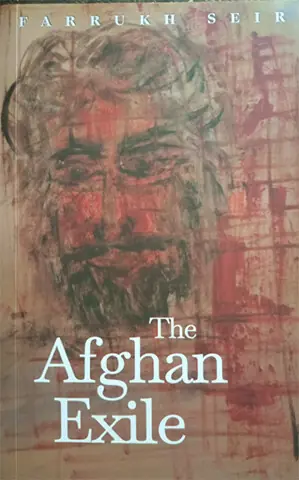
The Afghan Exile
By Farrukh Seir
Ushba Publishing International
ISBN: 978-969-9154-67-6
97pp.
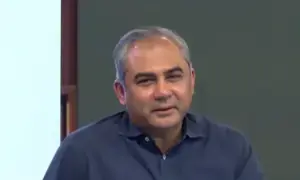
A slim volume of just over 100 pages, The Afghan Exile is written by Dr Farrukh Seir, a retired major general and former caretaker minister for health and higher education. In his retired life, Seir has taken up painting and opened an art gallery in Islamabad. The Afghan Exile is his first foray into the literary world.
The author declares that he used artificial intelligence (AI) in writing this novel. He states that AI was used only as a tool, directed at all times by the author himself. Perhaps because of the assistance of AI, the language used in the novel is meticulously correct. There is an overabundance of adjectives and other qualifying words, but the text is flawless and easy to read. Let’s leave the moral questions engendered by this declaration aside for the moment.
The Afghan Exile is a quick read. It tells us of the problems faced by poor, often illiterate, Afghans who become homeless through no fault of their own. It is convoluted global history and the ambitions of nations, which such underprivileged Afghans are only vaguely aware of, that govern their fates.
Izzatullah is the hero of the novel. He is born in Afghanistan but, while still a young child, war and strife push him and his family into neighbouring Pakistan. In his eventful life, Izzatullah is buffeted between the two countries, over and over again. This repeated change of residence, involuntary exile actually, does not allow him to feel at home anywhere.
An Afghan man is repeatedly buffeted between Pakistan and Afghanistan in a slim novel, finding neither country an uncomplicated home as war, exile and circumstance shape his life
He is not fully accepted in either country, not even Afghanistan. He has to contend with government intrusion and difficulties in both places. The nature of the sufferings faced by Izzatullah, however, differs in the two states between which he vacillates. The one thing that is clear is that, wherever he might be living at any given time, Izzatullah remains a staunch Afghan and holds fast to the virtues instilled in him through his Afghan heritage.
He is rooted in Islam, but tribal traditions remain paramount. Loyalty, obedience to elders and, most importantly, honour, rule his life. It is his Afghan traditional values that support him through thick and thin and peace and war. He passes his deeply held beliefs to his offspring as well.
Amazingly, in all of Izzatullah’s forced migrations, Pakistan comes out as the country which allows him to live most comfortably and affords him the most choices. Afghanistan is portrayed as neither a welcoming nor a nurturing state. Even though Pakistan expels Izzatullah at one time and he is obliged to return to his native land, it is Pakistan and Pakistanis who help him in his hour of need and provide protection and education to his daughter.
In Afghanistan, he is looked upon as an alien and faces desperate straits because of the extreme weather conditions and a total absence of opportunities to earn money. Izzatullah can turn only to his former employer, in Pakistan, for help. Aid is granted forthwith and sent through the agency of another Pakistani willing to go the extra mile for Izzatullah.
After this interlude in Afghanistan, Izzatullah returns to Pakistan as soon as the border reopens. He knows life is better in his adopted land, both for himself and his family. In Pakistan, his only daughter can go to school, pursue higher studies and even become a doctor.
The ending of the novel is ambiguous. In Chapter 26, the reader discovers that Izzatullah and his daughter are in Afghanistan. But in Chapter 27, without any elaboration, explanation or reason, Izzatullah is found spending his twilight years in Pakistan and his daughter is practising medicine in Taxila.
In a departure from typical fiction writing, the first and last chapters of The Afghan Exile are not part of the story. The former is an essay on Afghan culture, and the values and morals that govern the life of Afghans such as Izzatullah. The latter gives a short account of modern Afghan history, with a passing reference to Izzatullah’s life.
It is unfortunate that the preface by the author and the introduction by retired bureaucrat, poet and author Ejaz Rahim give away most of the plot of the novel. When the story actually unfolds, there is very little that is left for the reader to discover. As it is, there is not much meat to the tale. Even the 90-odd pages of the actual novel are more than necessary to narrate the story.
Perhaps because of the paucity of plot, the author resorts to constant repetition. For example, Izzatullah’s supplications to Allah, which remain the same in essence, have been written down, both in English and Pashto, innumerable times. All his conversations with his daughter are also needlessly reported in two languages.
On the other hand, it is a very welcome addition to the story that Izzatullah’s wife, Gul Meina, is not disregarded. It is gratifying to see that she is praised for staying strong and steadfast under the worst privations and the gravest of hardships. Another female, Palwasha, the daughter, is also invested with importance while even the names of her brothers are not mentioned, except that of the youngest, ailing one, who is called Bathoor.
The novel is narrated by an unnamed character in the first person. This is the Pakistani, living near Taxila, who gives Izzatullah employment and provides him financial aid when conditions become bleak for the Afghan in his home country. Yet, the author also makes him relate the most detailed accounts of Izzatullah’s inner, unstated feelings, thoughts and realisations, like an omniscient third-person narrator. This is both jarring and implausible.
The Afghan Exile is remarkable in that it validates the Afghan point of view. Generally, Pakistanis consider Afghans to be unwanted intruders posing perpetual problems. But this book succeeds in presenting the other side of the story with grace and empathy. Farrukh Seir is to be commended for writing about the sad plight of the Afghans. Izzatullah becomes the epitome of stoical suffering and involuntary displacement. Our sympathy is aroused where normally we only feel exasperation.
The issue of AI-generated text probably requires a separate article. As numerous recent international controversies around novels alleged to have been written with AI-assistance show, the question of authorship is complicated, even with claims of direction.
The reviewer is a freelance writer, author of The Tea Trolley and My Life as a Corporate Gypsy: A Memoir and the translator of Toofan Se Pehlay: Safar-i-Europe Ki Diary
Published in Dawn, Books & Authors, October 4th, 2026