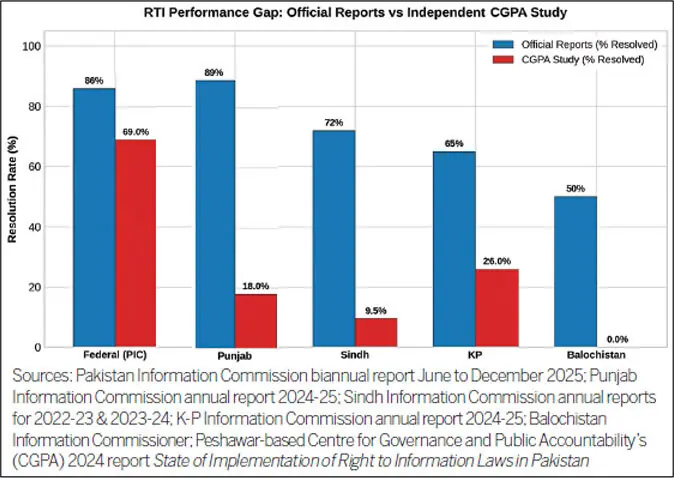
Article 19-A of Pakistan’s Constitution recognises citizens’ right to access information in matters of public importance. Federal and provincial right-to-information (RTI) laws subsequently established information commissions to help enforce this constitutional guarantee.
These commissions were intended to function independently of government influence, each comprising a retired bureaucrat, a senior jurist and a civil society representative. This composition was designed to bring different perspectives into the interpretation and enforcement of the right to information, including representation from civil society.
That intended balance, however, is increasingly disappearing.
Each commission has a retired bureaucrat and senior jurist, filling two of the three slots, barring Balochistan, which has four seats. However, the civil-society seats in the federal commission and Sindh have remained vacant since January 2024, in Punjab since March 2025 and in Khyber-Pakhtunkhwa (KP) since April 2026. One of the appointed commissioners also serves as the chief information commissioner (CIC).
Balochistan offers a somewhat different picture. Although its RTI law, passed in 2021, required an information commission to be established within 120 days, the body only began functioning in 2025. Two commissioners were eventually appointed, including a civil-society representative, but the positions of the CIC and another commissioner remain vacant.
Pakistan has laws guaranteeing citizens access to information and commissions meant to enforce them. But when those watchdogs are themselves understaffed, slow and difficult to navigate, how meaningful is the right to know?
This raises a fundamental question: what happens to an institution established to represent the public interest when the public’s own voice is missing?
The missing third perspective
Zahid Abdullah, a former commissioner at the federal Pakistan Information Commission, says commissioners from different backgrounds bring different perspectives to interpreting and implementing RTI.
“When this [civil-society commissioner] position remains vacant, an important balance built into the composition of the commission is lost,” Abdullah tells Eos.
The absence of a third commissioner can also have a practical impact. Where two serving members disagree, there is no third commissioner to establish a majority and resolve the matter.
This is significant because information commissions are not ordinary government departments. Their primary purpose is to provide citizens with an independent mechanism through which they can demand accountability from public bodies.
If that mechanism becomes slow, inaccessible or dominated by administrative perspectives, the constitutional right can remain strong on paper while becoming increasingly weak in practice.
A case from Punjab
The problem becomes particularly tangible in Punjab, where my own experience with the provincial commission illustrates how procedural problems can undermine the purpose of the RTI.
On February 23, 2026, I submitted an RTI request to the Punjab police chief, seeking official information about the October 2025 protests by the proscribed Tehreek-i-Labbaik Pakistan (TLP).
After the Punjab police failed to provide the information within the prescribed two-week statutory period, I approached the Punjab Information Commission on March 13. Following repeated reminders and visits, the case was disposed of on June 9. The decision cited an allegation by the police’s public information officer (PIO) that I had links to TLP.
I was not notified of the allegation, nor was I provided an opportunity to respond. I filed a review petition and followed it up with reminders. On August 18, the commission dismissed it, stating that I had remained absent from the proceedings. I dispute this finding: I was never served notice of a hearing date or asked to attend.
In fact, I was at the commission’s office on August 18 to inquire about the case. Despite repeated requests, I was not given a hearing or informed about the order. When I inquired about it later, I was sent a copy through WhatsApp.
Punjab’s former CIC Mehboob Qadir Shah says an allegation linking an RTI activist to a proscribed organisation should not be included in a public order without first giving the individual an opportunity to respond. Such conduct, he tells Eos, offends “procedural due process.”
The wider concern is bigger than one case. If a public body can resist disclosure by making an unverified allegation against an information seeker, and an information commission accepts that position without providing the citizen an opportunity to respond, the RTI enforcement mechanism itself becomes vulnerable.
More hurdles for citizens?
The concern becomes more significant in light of proposed changes to Punjab’s RTI framework.
In its 2024-25 annual report, the Punjab Information Commission proposed 14 amendments to the Punjab Transparency and Right to Information Act 2013 and its rules.
The proposals include exemptions for records relating to pending matters and internal correspondence; rejection of requests deemed “vexatious”, “malafide” or “vague”; personal attendance requirements for citizens submitting requests electronically; and extending the period for deciding complaints from 60 to 90 days.
These proposed amendments raise questions about whether the commission is making access to information easier and more timely, or adding further obstacles.
A national implementation problem
The difficulties are not confined to Punjab.
Karachi-based RTI activist Naeem Sadiq says he is dealing with around 200 RTI matters involving public bodies and information commissions. According to him, responses are generally slow and that information is obtained in only about half of the cases. He considers Punjab the worst-performing jurisdiction, followed by Sindh and the federal system.
In KP, journalist Anees Takkar says he has been waiting for information on appeals filed before the provincial commission for around a year. Officials sometimes call to ask whether he has received the requested information, he says, but no effective resolution follows.
In Balochistan, journalist Matiullah Matee identifies another obstacle: limited awareness of RTI laws among citizens and public officials. If government departments themselves do not understand their obligations, he asks, how can citizens expect them to provide information?
Balochistan’s Information Commissioner Abdul Shakoor says the commission has also faced institutional constraints, including inadequate office facilities, lack of staff and delays in releasing its allocated budget.
Strong laws, weak enforcement
Pakistan’s experience also demonstrates the difference between having a strong legal framework and implementing it effectively.
The World Justice Project’s 2025 Rule of Law Index places Pakistan’s overall Rule of Law score at 0.37, ranking it 130th among 143 countries. Its Open Government score was 0.39, below the global average of 0.52.
The contrast is important. Pakistan may have the relevant legislation, but citizens continue to encounter delays, bureaucratic resistance and institutional barriers when attempting to exercise that right.
Civil-society organisations, including the Free and Fair Election Network (Fafen) and the Centre for Governance and Public Accountability among others, have called for greater transparency in the appointment of information commissioners. Among their proposals are parliamentary oversight of appointments, equal representation of government and opposition members on appointment committees, public hearings, stronger gender representation, effective penalties for non-compliance, digital notifications at every stage of an RTI request, mobile applications, and web portals for submitting and tracking requests, public RTI compliance indices and online hearings for citizens unable to attend proceedings physically.
These proposals point towards a common principle: transparency cannot be effectively enforced by institutions that are themselves opaque, inaccessible or insufficiently accountable. Otherwise, the institutions created to open the doors of government may themselves become another bureaucratic door that citizens struggle to get through.
The question is ultimately simple: if nobody is watching the transparency watchdogs, who will protect the citizen’s right to know?
The writer has been associated with journalism for the past decade.
X: @naeemahmad876
Published in Dawn, EOS, October 4th, 2026