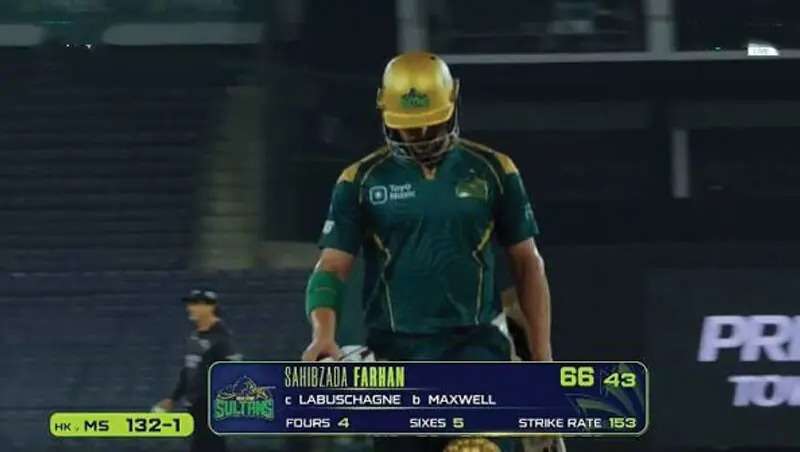
Picture two batters walking off the pitch, both with 40 runs off 24 balls. Statistically, they are identical.
One scored them in a chase, where his team needed 110 off 60 balls with six wickets remaining, which means a high pressure environment, and aggressive intent were required. The other scored the 40 runs when only 70 were needed off 72 balls, with eight wickets in hand — no urgency, less pressure and things more in control.
Statistics treat both innings identically. However, any cricket fan watching from Mumbai to Lahore to Sydney knows that they were not.
Numbers lie, or at least they hide something. This gap between what the numbers say and what actually happened on the field isn’t just becoming annoying, it’s glaring in the context of T20s. It is also the starting point for a new analytical framework called Contextual Batting Intelligence, or CBI, developed by me.
Strike rate alone was never built to answer the question that actually matters to T20 captains, coaches and selectors: did the batter make and execute the right decision for that specific moment? Contextual Batting Intelligence attempts to give that answer…
A DIFFERENT QUESTION ALTOGETHER
Most cricket analytics still lean heavily on strike rate, which is a metric that measures runs scored per hundred balls faced. It’s useful and simple, but it’s also blind to context. A batter smashing 20 off 10 balls in a hopeless chase looks identical, statistically, to one doing the same in a tight finish.
My framework argues that strike rate alone was never built to answer the question that actually matters to captains, coaches and selectors: did the batter make and execute the right decision for that specific moment?
A recent widely debated instance of this emerged during the Indian Premier League (IPL) 2025, when the former India batter and commentator Sanjay Manjrekar (who always catches the limelight for his controversial remarks) decided to drop Virat Kohli from his personal top-10 list of IPL batters.
He argued that “T20 cricket is as much about strike rate as runs” and, hence, picked players with higher strike rates over Kohli’s mammoth run tally.
Sanjay’s remarks triggered a heated backlash. One camp strongly advocated that strike rate taken alone ignores the situations those runs were scored in. Others said that strike rate matters the most in T20 cricket.
This is the debate CBI aims to resolve.
Rather than ranking batters by strike rate or the total runs alone, the model would assess whether Kohli’s tempo in a given innings matched what his team actually required at that very moment. This would validate a “slower” knock that was, contextually, the ideal one. This is something a single number like strike rate or final score can never fully explain.
CBI doesn’t discard strike rate; in fact, it recontextualises it. Instead of judging an innings purely on the pace, CBI evaluates every ball as a decision made under a particular set of conditions.
The model assesses how many wickets are left, how many balls remain, the gap between the required run rate and the current run rate, which phase of the innings it is, and the quality of the opposition bowling attack.
TURNING CRICKET CONTEXT INTO MATH
CBI’s goal is to turn what sounds subjective — “this was the right shot for the situation” — into a sequence of measurable mathematical steps.
For every ball of the game, the model first defines the state of the match: the inning’s phase, the wickets lost, the legal balls remaining, the current run rate and, in a chase, the required run rate. All of these factors are taken into account.
These variables form the current state vector, as that provides the model with a numerical overview of what the batter is facing at that exact moment. The framework then estimates how costly it could be to lose a wicket in that instance in the match. Its risk coefficient, (s), increases as resources become scarce.
During the second innings, the model adapts; it bridges the gap between the required and current run rate, meaning the same wicket will carry a different cost when a team needs 40 runs from 30 balls than when it needs 40 from 60. This is exactly how it is supposed to be according to cricket experts as well.
That risk is then combined with the expected outcome of each broad batting action. In this case, essentially three possibilities are accounted for: playing a dot ball, rotating the strike, or attacking for a boundary. So, CBI’s core utility equation comes out to be:
U(a|s) = (b,t) × E[runs | s,a] (s) × P(out | s,a)
Here, ‘U’ stands for the contextual utility of choosing action ‘a’ in match state ‘s’, ‘’ is the quality of opposition (with ‘b’ for the ranking of the bowler and ‘t’ for the opposing team), ‘E’ for the expected runs, and ‘P’ for the probability of dismissal.
We could simply say that the CBI weighs expected scoring value against the risk of dismissal, evaluating whether a risky or defensive shot is worth the potential payoff. Another variable, omega (), adjusts with the quality of the opposition.
The model then uses a Boltzmann probability function to translate these utility values into the relative likelihood of each action being appropriate in the given context. After that, it finally takes a mean of those delivery-level probabilities to produce a player’s CBI Index.
CBI AND NUMBERS
To test the idea, I ran CBI against delivery-level data from T20 World Cups played between 2016 and 2024. I went on to compare the resulting rankings with the International Cricket Council’s (ICC) official player rankings.
The differences were striking.
Scotland’s George Munsey came out on top under CBI, despite sitting 72nd in the ICC list. Chris Gayle ranked second under CBI against 24th under ICC, while Andre Russell, a player often dismissed by traditional stats as inconsistent, came out eighth under CBI, compared with 149th in the ICC’s ranking system.
That’s not a minor calibration difference; it makes one think that the two systems are answering fundamentally different questions. The ICC ranking evaluates performance and circumstance through an established points methodology. On the other hand, CBI is asking how closely a batter’s skill is incorporated with decision-making, matched with the demand of the situation.
WHY THIS COULD MATTER FOR PAKISTAN
For Pakistan cricket specifically, a framework like this could sharpen conversations that are currently driven mostly by gut feeling and emotion. These include team selection talk show debates, batting order arguments, and the endless “was that innings good, bad [or mere stat padding]” discourse that follows every Pakistan Super League and international game.
A contextual model like the CBI doesn’t settle those arguments outright, but it gives fans, selectors and analysts a different lens to view: was a given knock appropriately aggressive, needlessly cautious, or reckless in regard to what the match required?
I have also built a public web app based on the framework, letting users test it against real match situations rather than treating it as a purely academic exercise; the web app also lists the ranking of batters based on CBI for the tested dataset.
STILL A WORK IN PROGRESS
Cricket being such a dynamic sport (the game isn’t over until the last ball is bowled), it inherently refuses to be reduced to a single formula. From the bowler, the pitch, the fielding positions and the match-ups, all shape what “the right decision” is. Therefore, my research paper flags several directions for future work, starting from a larger number of match states to incorporating computer vision.
T20 cricket has outgrown traditional statistics; it is high time that analytics did too.
The writer was the youngest participant in
and is the only Pakistani to win the
Kolkata Knight Riders mock auction.
He is drawn to equations that quietly govern the world
Published in Dawn, EOS, October 4th, 2026