Japan’s Ohashi lights up home Asiad with world record
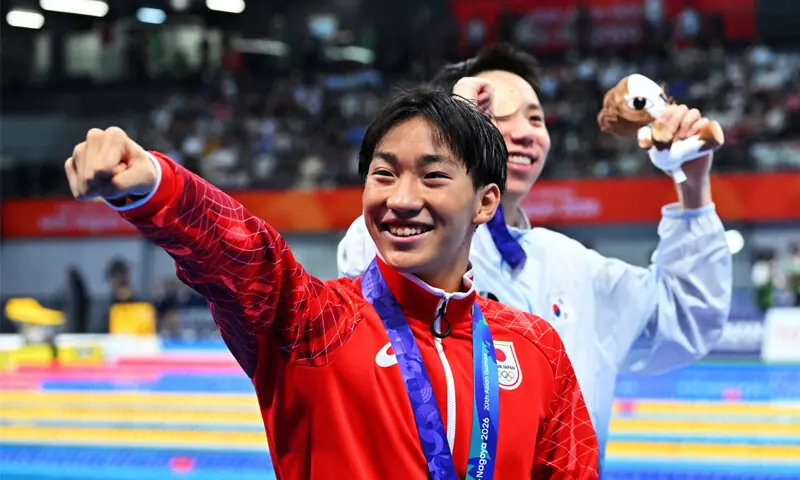
NAGOYA: Japanese wunderkind Shin Ohashi followed in the slipstream of China’s Yu Zidi to become the latest teenage sensation to set the Asian Games pool alight on Thursday, shattering the men’s 200 metres breaststroke world record.
A day after 13-year-old Yu capped her fairytale Asian Games debut with a hat-trick of golds, 17-year-old Ohashi produced a blistering 2:04.83 to eclipse the mark of 2:05.48 set by China’s Qin Haiyang at the 2023 world championships in Fukuoka.
It came little more than a week after Ohashi fell ill with Covid-19, which he said may have been a blessing in disguise.
“The world record was my goal, so I’m very happy to get it,” he said at the Tokyo Aquatics Centre.
“My next goal is for the gold medal at the world championships,” added the teenager, showing why French superstar Leon Marchand views the Japanese prodigy as a serious rival.
“I’m scared. I’m very scared of him,” Olympic 200m breaststroke champion Marchand said of Ohashi earlier this week.
“He’s still so young. His coach is really good. I think his entourage, the people around him, are really good, so I hope he’s going to keep improving.”
Zhang Zhanshuo won his sixth gold of the Aichi-Nagoya Games after helping China to the men’s 4x100m freestyle relay title.
Elsewhere, Carlos Yulo, the Philippines’ first Olympic gymnastics champion, added an Asian Games title to his trophy cabinet with victory in the floor exercise, and felt redemption after disappointment at Jakarta 2018.
Yulo, who honed his craft in Japan on a scholarship from the local Olympic committee, scored 14.666 to edge Kazakhstan’s Milad Karimi (14.600) in a cliffhanger. His brother Karl Eldrew also competed in the final.
The 26-year-old was delighted to complete a career grand slam of world, Olympic and continental crowns.
“This medal, it’s like winning the Olympics,” Yulo told Reuters. “It’s really a good story, and I feel like I redeemed it in this competition.”
Eight-time Olympian Oksana Chusovitina missed out on a medal at the age of 51, coming fifth in the women’s vault final, 32 years after she took bronze at Hiroshima 1994.
But the Uzbek said Nagoya would spur her on to try to qualify for a ninth Olympics in Los Angeles 2028.
“Honestly, I get so much enjoyment out of seeing the crowd and stepping onto the podium. It brings me immense pleasure, and that’s why I keep going.”
CHINA’S GOLD RUSH
Sporting powerhouse China continued their imperious march through the multi-sport event, breaching the 75-gold mark.
On the shooting range, Jiang Yiting held her nerve with her final shot to complete a hat-trick of golds at the Aichi-Nagoya Games. The 22-year-old’s poise denied South Korea and earned China the skeet mixed team title, adding to her individual and women’s team victories.
China also commanded the trails, with Wu Zhifan and Liang Zhenglan securing a one-two finish in the women’s cross-country mountain bike final.
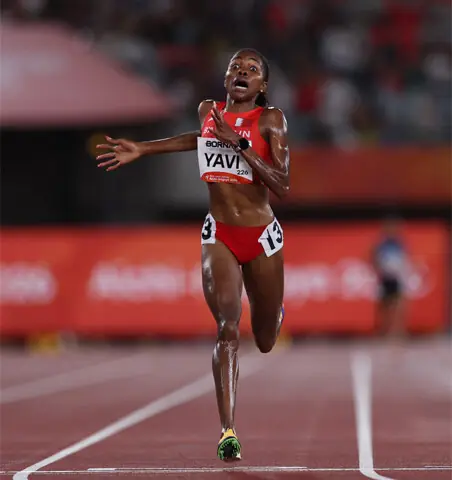
On track, Bahrain’s Winfred Yavi edged out home favourite Nozomi Tanaka of Japan to win the women’s 10,000m gold at the Nagoya City Mizuho Park Athletic Stadium.
Yavi, 26, clocked 32 minutes 39.18 seconds to finish 2.36 seconds ahead of Tanaka. India’s Seema took the bronze medal in 32:50.05.
Bahrain added another gold medal in the mixed 4x400m relay, with its quartet setting a new Games record in 3:12.87. India claimed silver in 3:14.46, while Vietnam secured bronze in 3:14.54.
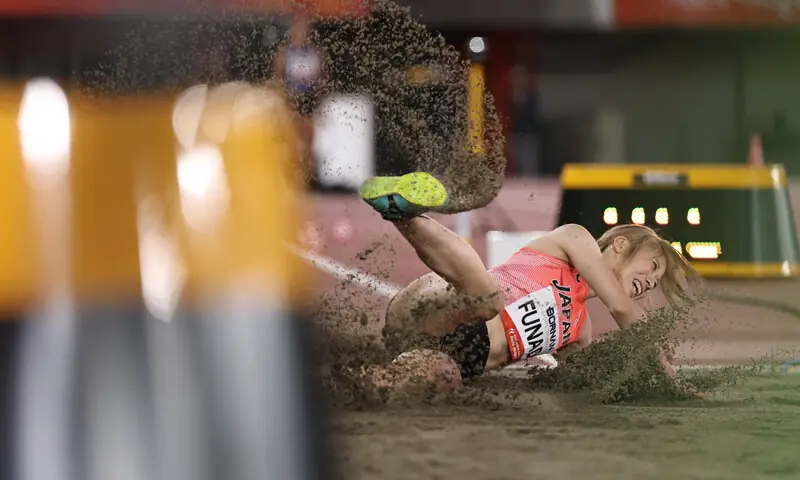
In the women’s triple jump, Uzbekistan’s Sharifa Davronova produced a personal best of 14.35m to take gold. China’s Yingying Huang finished second with 14.12m, while compatriot Yi Li won bronze with 13.83m.
China’s Abuduaini Tuergong won the men’s discus throw with a 64.26m effort. Compatriot Nanjun Wu took silver with 61.58m, while Iran’s Sadegh Samimishalamzari earned bronze with a personal-best throw of 60.32m.
Away from the competition venues, local organisers spent another day defending the athletes’ accommodation after residents added their voices to concerns over the shipping container-style modular units.
Organisers scrapped the original plans for a dedicated Athletes’Village to control costs, housing 17,000 athletes and officials across a mix of hotels, container-style modular units and a cruise ship instead.
Several athletes have voiced dissatisfaction over the cramped dimensions of their cabins and beds — a criticism echoed by residents who toured a prototype unit near the Nagoya TV Tower.
“Once inside, I noticed that the space was quite long and narrow,” 49-year-old nurse Wada, who shared only her surname, told Reuters.
Asian Games Organising Committee official Yuta Matsuo, however, maintained that athlete feedback had been taken into consideration from the very beginning.
Published in Dawn, September 25th, 2026