
A 2017 interview of Prof Ayesha Jalal in the Bangladesh newspaper The Daily Star was circulating again on social media around Independence Day this year. As always, Prof Jalal, one of the most influential historians of South Asia, puts forward interesting interpretations of pre-Partition politics in the Subcontinent.
Three claims she makes in the interview are: (i) the partition of Punjab and Bengal were not an inevitable product of the Partition of India; (ii) Quaid-i-Azam Muhammad Ali Jinnah and the Muslim League aimed to achieve substantial power-sharing for Muslims in an undivided India and an independent nation-state for Muslims was not their actual end-goal; and (iii) Partition was a result of “federal dilemmas” in pre-independence India and not a consequence of religious difference alone.
It is illuminating to read claims made by Prof Jalal in light of B.R. Ambedkar’s book Pakistan or the Partition of India, first published in 1940 and updated in 1945. B.R. Ambedkar was one of the most influential political leaders and thinkers of India during the freedom struggle. He was a visionary leader of Dalits and independent India’s first law minister as well as the chair of the committee that drafted India’s constitution.
Ambedkar’s politics was in tension with that of the Indian National Congress. He believed that Congress was not sufficiently sensitive to injustices faced by Dalits and backward castes in India. His vantage point as a Dalit political leader, combined with his acute perceptiveness, allowed him to dispassionately assess Muslim League claims and the demand for Pakistan. Ambedkar was able to view the anxieties of Muslims in 20th century India more realistically than most Congress leaders.
Was the demand for Pakistan only a bargaining strategy for greater Muslim power in an undivided India, as historian Ayesha Jalal argues? Indian constitutionalist B.R. Ambedkar’s analysis from that time offers a provocative counterpoint to an influential interpretation
Pakistan or the Partition of India is so rich with information and analysis of Indian politics in the years before Independence, it is a disservice to sum it up in a few words, but I will try. Here is Ambedkar’s argument:
Politics in India was becoming increasingly communalised along religious lines during the 20th century. The revitalisation of the Muslim League in the 1930s under the leadership of Jinnah and the demand for Pakistan intensified the communalisation. While the logic behind the creation of Pakistan was weak, the sentiment in favour of it among Muslims by the 1940s was strong and, if ignored, could intensify conflict and destabilise an independent India. Therefore “if Muslims must have Pakistan, there is no escape from conceding it to them.”
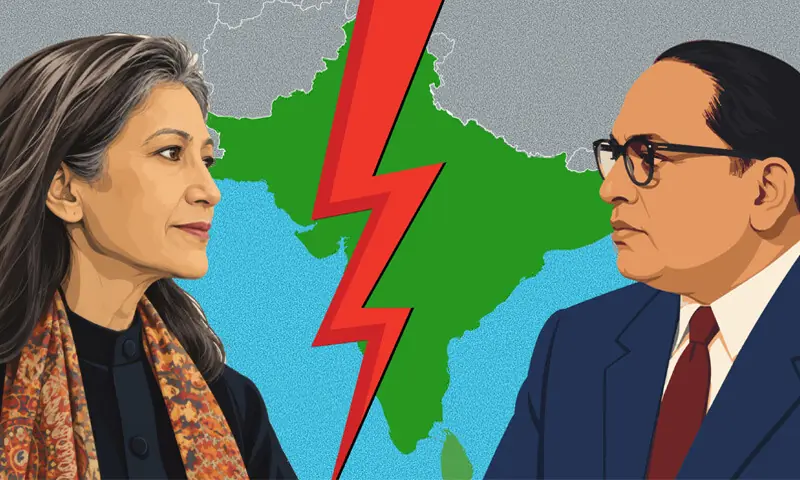
Some of Ambedkar’s arguments in his book challenge the interpretations put forward by Jalal. Ambedkar and Jalal are writing in different eras and they approach the question from very different perspectives. One wrote about Partition while it was a hotly debated and live proposal. The other writes about it with the hindsight of a scholar. Reading the two side by side enriches our understanding of pre-Partition politics.
PARTITION OF PUNJAB AND BENGAL
Ayesha Jalal says:
“The partition of India was effectively the partition of the two main Muslim-majority provinces, Punjab and Bengal. There was nothing inevitable or pre-determined about this. Until the bitter end, Mohammad Ali Jinnah insisted that it was wrong to equate the principle of Pakistan with the partition of Punjab and Bengal. The prospect of a united and independent Bengal remained a possibility and was scotched only because the Congress high command was averse to the idea of a united Bengal outside the Indian union.”
Ambedkar wrote that Jinnah’s resistance to the partition of Punjab and Bengal was inconsistent with his demand for Pakistan. The basis for the demand for Pakistan was that: (i) Muslims in India are a separate nation; and (ii) in the north-west and east of India, they live in easily severable and contiguous areas. A Pakistan can therefore be carved out in these areas.
In other words, the logic underlying the demand is that: “[i]f a nationality lives in easily severable and contiguous areas, other things being equal, a case can be made out for territorial independence.”
Following this logic, Ambedkar says that “Punjab and Bengal would thus necessarily be subject to division.” This is because:
“In Bengal and Punjab, the Hindus occupy two different areas contiguous and severable. In these circumstances, there is no reason for conceding what the Muslim League seems to demand, namely that the present boundaries of Punjab and Bengal shall continue to be the boundaries of Western Pakistan and Eastern Pakistan.”
According to Ambedkar, if the territorial contiguity of the nation should define its boundaries, the fact that the Hindu majority regions in Bengal and Punjab are “contiguous and severable”, entails that the states should be partitioned accordingly. He emphasised that a “demand for regional self-determination must always be a two-edged sword.”
This argument contradicts Prof Jalal’s claim that the partition of Punjab and Bengal was due to Congress intransigence. It was, according to Ambedkar, a logical outcome of the Muslim League demand for Pakistan, which was based on the assertion that distinct nations living in contiguous and easily separable geographical areas have a right to territorial independence.
Ambedkar is right if the demand for Pakistan were, in fact, a territorial claim. A difference between Ambedkar’s analysis and that of Professor Jalal is that she does not consider the demand for Pakistan to be, in essence, a Muslim claim for separate and independent territorial control. She says that the essence of the demand was substantial power for Muslims in independent India, and a separate nation-state was not the end-goal for Jinnah and the Muslim League.
A CLAIM FOR TERRITORIAL INDEPENDENCE?
In The Daily Star interview, Prof Jalal says:
“Insofar as nations are imagined communities, the Two-Nation Theory was based on a subjective belief in the right of Muslims, regardless of their internal divisions, to acquire a substantial share of power in an independent India.”
She goes on to say, “It was Congress’ eager embrace of the idea of non-negotiable and indivisible sovereignty that foiled Jinnah and the All-India Muslim League’s efforts to win a large share of power for Muslims in an undivided and independent India.”
This argument is developed in her book The Sole Spokesman, in which she argues that Pakistan as a separate nation-state was not the end-goal for Jinnah; it was a bargaining chip in Muslim League negotiations with Congress and the British for greater Muslim power in an independent, united India.
Prof Jalal says that Jinnah’s goal was greater power for Muslims in the central government of independent India. At the same time, he wanted influential Muslim leaders in the Muslim majority provinces of north-west India and Bengal to support him and the Muslim League. These Muslim leaders cared more for provincial autonomy than a strong centre, given their status in provinces where Muslims were a majority. It was to bring them within the Muslim League fold, and to put greater pressure on Congress and the British, that Jinnah put forward the Lahore Resolution.
In The Sole Spokesman, Prof Jalal writes that Jinnah endorsed the demand of the Lahore Resolution because he “calculated that, when eventually the time came to discuss an all-India federation, [the] British and Congress alike would be forced to negotiate with organised Muslim opinion, and would be ready to make substantial concessions to create or retain that centre”, with substantial, statutory Muslim representation. “The Lahore Resolution should, therefore, be seen as a bargaining counter.”
Historians will continue to debate how serious the Muslim League was about the idea of Pakistan as an independent nation-state. Ambedkar, writing in 1945, however, took the Lahore Resolution as a serious expression of Jinnah’s and the Muslim League’s demands. One of the most astute political thinkers in India at the time believed that Jinnah and the Muslim League’s proposal involved redrawing territorial boundaries. Ambedkar did not perceive the essence of the demand to be increased power-sharing in a united India.
If Prof Jalal is right and the demand for Pakistan was indeed a bargaining chip, Mr Jinnah and the League were betting for the highest stakes imaginable. Did they foresee that, if they put the chip down (which they eventually did), without being prepared for the upheaval that Partition could unleash, the result would be catastrophic?
One may claim that the violence unleashed by a poorly planned Partition was not foreseeable when the Muslim League leaders made their vague demand for Pakistan. But Ambedkar anticipated it. This is why he wrote that clarity is the need of the hour.
He emphasised it was important to be clear about what a proposed Pakistan should look like to smooth the transition to Independence, and he was critical of the Muslim League’s refusal to put forward a clear proposal about Pakistan. To fill this gap, Ambedkar proposed a plan for drawing of boundaries and population transfer, should the demand for Pakistan be implemented.
But Jinnah, the great lawyer, chose to be vague and kept his cards close to his chest. One can see why a lawyer would adopt such a strategy in settlement negotiations, where the risk is borne by the client alone and, hopefully, the client is made aware of the risks and accepts them. But was this the right strategy for a political leader to adopt in such a momentous period in history?
FEDERAL DILEMMAS
Another interesting claim by Prof Jalal is that the causes of Partition lay in India’s “federal dilemmas” and should not be reduced to religion alone. She says:
“Both 1947 and 1971 ensued from the political failure to arrive at power-sharing arrangements that could have made drastic solutions like Partition unnecessary. If the causes of Partition in 1947 had been properly understood as a product of India’s federal dilemmas, and not reduced to ‘religion’ alone, the policies of the post-colonial state of Pakistan may have been less insensitive to the needs and aspirations of the majority population in the eastern wing.”
In the years leading to Independence, it became clear that India would be a federation. The distribution of power between the centre and the state/provinces was to be negotiated. There was no clear federalist solution to the Muslim claim to nationhood because Muslims were scattered across India.
The federal “dilemma” arose because the interests of Muslims in the Muslim-minority provinces and Muslim-majority provinces were at odds. Muslims in the Hindu-majority provinces would gain from a strong centre with a substantial statutory Muslim presence in the central government. On the other hand, Muslims in the Muslim-majority provinces would gain from strong provincial autonomy, so that they have greater control over the areas in which they already have a strong presence.
The logical flaw in the demand for Pakistan was this: it advanced a solution that was unnecessary for Muslims in the Muslim-majority provinces, if provincial autonomy were conceded in independent India; and it was of no help to the Muslim minorities in Hindu-majority provinces, as they would not be a part of Pakistan anyway!
Ambedkar emphasised this logical inconsistency: “Will Pakistan obviate the establishment of the Hindu Raj in provinces in which Musalmans [sic] are a minority? Obviously it cannot… Can Pakistan prevent the establishment of Hindu Raj at the centre over Muslim minorities that will remain in Hindustan? It is plain that it cannot. What good is Pakistan then? Only to prevent Hindu Raj in provinces in which the Muslims are in a majority and in which there could never be Hindu Raj!!”
It should also be acknowledged that this “federal dilemma” followed from the Two-Nation Theory. In other words, it becomes a dilemma when Muslims and Hindus in India are defined as distinct nations. Therefore, while Prof Jalal may be right to say that Pakistan was a response to a problem that could not be reduced to “religion alone”, religious difference was an inextricable part of the way the problem was framed. That there were many criticisms of this framing and the Two-Nation Theory itself, including amongst Muslims, is well-documented.
It is because of the privileging of religion that it is not so straightforward to link the federal dilemmas in pre-Partition India with those of independent Pakistan. The federalist demands in independent Pakistan were premised on ethnic and linguistic differences that cut across religious similarities.
For provinces in independent Pakistan to demand greater provincial autonomy as a matter of right based on ethnic and linguistic similarities involved a paradigm shift from the Two-Nation Theory. Because the partition of India was premised on the privileging of religious over ethnic or indeed any other identity, it became difficult for the Pakistani state to recognise other identities as a basis for provincial autonomy.
The federalism question in independent Pakistan was also different because, in another sense, it was much easier to resolve. Federalist solutions to demands for greater autonomy for distinct nationalities are feasible when the nationalities are based in, more or less, territorially contiguous areas.
So, Bengalis in Pakistan were largely organised in one territory that could be made a semi-autonomous federal unit. Similarly, the condemnation of the West Pakistan one-unit by Sindhi, Pashtun and Baloch nationalists was justifiable because provincial sub-units organised around ethnic or linguistic majorities were practical. In comparison, the demand of Muslims for a federalist solution to concerns about Hindu majoritarianism was less feasible because Muslims were territorially so spread out across India.
There was something about the logic of the demand of Pakistan that made post-Partition federalism questions difficult to resolve. Resolving these would involve acknowledging space for affiliations other than religion to be the basis of a distinct political identity.
Ambedkar’s detailed analysis reveals the thoughts of a perceptive political leader and thinker on the questions around Partition while it was a live debate with immediate consequences. Jalal’s historical research shows the contradictions in pre-Partition Muslim politics. Their views, read together, seem to affirm the formulation of another historian, Alfred Cobban, who described Partition as a “non-solution to an insoluble problem.”
The writer is a lawyer based in Karachi
Published in Dawn, EOS, September 27th, 2026