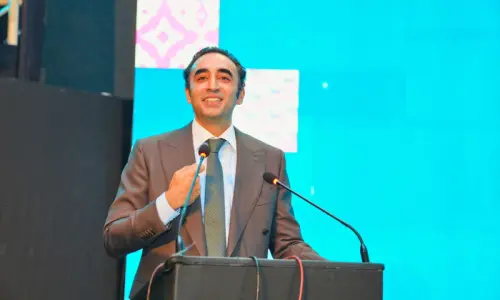
LAHORE: Leader of the Opposition in the Punjab Assembly Moeenuddin Riaz Qureshi on Thursday filed a constitutional petition in the Lahore High Court (LHC) against recent amendments to the province’s anti-terrorism law, under which terrorism cases can now be held under a confidential regime, including keeping the identities of judges, prosecutors, defence lawyers and witnesses secret.
The amendments were approved by the Punjab Assembly last month despite strong objections, protest and a walkout by the opposition lawmakers.
Through the legislation, Section 21AAA was inserted into the Anti-Terrorism Act, 1997, creating a “special security case” mechanism for cases in which participants required extraordinary protection.
In his petition, filed through Barrister Abuzar Salman Niazi, Mr Qureshi argued that it was unconstitutional.
Under the law, identities of judges, prosecutors, police officers, witnesses and counsel to remain undisclosed
The plea contended that Section 21AAA conflicted with the existing, near-identical section 21AA of the Act, which vested protective powers in courts rather than the executive. Section 21AAA was, therefore, void under Article 143 of the Constitution, it said.
The petition further argued that the provision violated the right to open justice and fair trial under Articles 9, 10-A and 14 of the Constitution, equality before law under Article 25, and separation of powers under Article 175(3), by shifting control over trial procedure from judges to an anonymous executive official.
It also questioned the “excessive delegation” of legislative power, arguing that the law provided no objective criteria for when a case qualified to be tried under the special regime.
The plea cited the UK House of Lords’ 2008 ruling in R v Davis, which found anonymous-witness procedures incompatible with a fair trial.
In his plea, Qureshi urged the court to declare Section 21AAA ultra vires the Constitution and to suspend its operation, including restraining the authorities from classifying any case as a “special security case,” during the pendency of the petition.
Under Section 21AAA, a designated authority — an officer of at least BPS-20 whose identity would itself remain confidential — can declare a case or a class of cases a special security case. At the authority’s request, the LHC chief justice can then assign the case to an anti-terrorism court’s judge.
Once a case is classified as a special security case, the identities of the judge, prosecutors, police officers, witnesses and the defence counsel involved in the proceedings are to remain undisclosed. For such cases, judicial orders carry official titles instead of the judges’ names, while witnesses are identified through codes issued by the designated authority.
The trial record is kept sealed and trials could be held at secure premises or conducted through video links, including from prisons.
MPO sections: Two opposition members in the provincial assembly on Thursday filed a petition before the Lahore High Court (LHC) challenging sections 3 and 16 of the Punjab Maintenance of Public Order Ordinance, 1960 (MPO), which allow the authorities to order detention and restrict judicial review of such orders.
The petition, filed by PTI MPAs Chaudhry Muhammad Ijaz Shafi and Sheikh Imtiaz Mehmood through Advocate Muhammad Azhar Siddique, names the Punjab chief secretary, the home and law departments, all deputy commissioners across the province and the inspector general of police as respondents.
The petitioners refer to an earlier LHC order of June 19, 2025, in which the court had referred three reform proposals to the Punjab Law Department — greater transparency in detention orders, a right of appeal and deterrent penalties for misuse of the power — after being told that 4,770 detention orders were issued in 2023 alone. The petitioners say these reforms remain unimplemented.
The petitioners cite a batch of at least 17 detention orders issued in Multan on Sept 8, three in Rajanpur on Sept 10 and one in Sialkot on Sept 11, alleging that these orders used identical, standardised language without individualised evidence. They argue that the impugned provisions violate constitutional guarantees, including the right to liberty, due process, freedom of movement and assembly and equality before the law.
The petitioners ask the court to declare the provisions unconstitutional, order disclosure of compliance records, direct a province-wide safeguards framework, and review recent detention orders for legality.
Justice Abher Gul Khan will take up the petition on Friday (today).
Published in Dawn, September 18th, 2026