Gastech 2026: Pakistani company invites investment for gas storage, pipeline networks at Bangkok show
BANGKOK: A private gas company represented Pakistan at Gastech 2026 conference on Tuesday, pitching investment options for urban gas storage and targeted gas pipeline networks in load centres as an alternative to existing gas networks of state-owned entities with significant system losses.
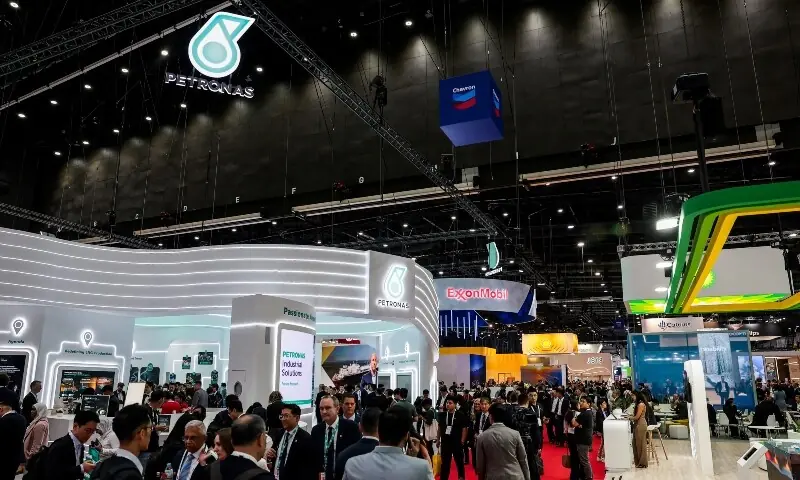
The Universal Gas Distribution Company’s (UGDC) participation in Gastech 2026 — a global exhibition for natural gas, LNG, low-carbon solutions and AI for energy — marked the first time Pakistan was represented at the exhibition, being held in Thailand.
A total of 150 countries were represented at the inaugural session of the 54th annual Gastech 2026 conference, with Pakistan among the three debutants. According to the organisers, 8,000 delegates and 1,000 exhibiting companies are participating in the event.
The UGDC established a stall alongside leading global energy majors, including ExxonMobil, Shell, ConocoPhillips, Petronas and Sinopec. The exhibition also featured multinational gas companies from different countries, including the United States.
For its part, the UGDC has pitched foreign investors the idea of a separate distribution network to provide cheaper gas to consumers.
Presently, two state-owned gas distribution companies — Sui Northern Gas Pipeline and Sui Southern Gas Company — have distribution networks in Pakistan. Now, the private sector is vying to set up distribution networks in joint ventures with foreign companies to provide cheaper gas to consumers.
The UGDC is providing gas to its consumers at cheaper rates compared to the tariff charged by state-owned gas companies.
“The government has announced a policy to [allow] the allocation of 35 per cent gas [output of exploration and production firms’] to the private parties, which is an important step towards the deregulation of gas distribution,” UGDC Chief Executive Officer Ghiyas Abdullah Paracha told the media at Gastech.
Paracha also outlined his company’s vision to transform Pakistan’s energy market by attracting foreign direct investment and establishing direct business-to-business (B2B) joint ventures to cut gas prices.
He said his company appreciated Prime Minister Shehbaz Sharif and Petroleum Minister Ali Pervaiz Malik for opening up the industry to the private sector, enabling the UGDC to invite foreign companies to invest in Pakistan’s gas distribution network.
He said a private-sector gas distribution network would also help cut gas losses, resulting in the provision of cheaper gas to consumers.
“We want to see more companies from the private sector invest in the gas sector,” Paracha said.
“The UGDC has already operationalised three dormant gas fields by processing raw gas into pipeline-quality supply. Plans are underway with international partners, including top US firms, to scale purification infrastructure and integrate stranded reserves into the national grid,” he said, adding that the company also wanted to attract foreign investment in this area.
To address seasonal supply shortages and pressure fluctuations, the UGDC had been actively engaging in short-term and long-term LNG import deals in the past, Paracha said. He also advocated for commercial underground gas storage facilities to capture favourable international prices.
Gas losses have been a key factor in rising gas prices in Pakistan. To reduce high unaccounted for gas (UFG) losses and bypass inefficient legacy distribution networks, the UGDC also aims to construct targeted private pipeline infrastructure for high-volume industrial units and major residential schemes, Paracha said.
Expanding on previous milestone agreements with global leaders such as ExxonMobil, QatarEnergy, ConocoPhillips, and Trafigura, the UGDC continues to invite international majors to co-invest under Pakistan’s newly deregulated framework, he said.
Addressing bureaucratic hurdles, Paracha emphasised that private sector participation operates entirely on private capital without government subsidies. It generates significant revenue for the state through pipeline transit tariffs and taxes and enables job creation, he said.
“Greater market liberalisation will lower energy costs for end consumers, enhance industrial competitiveness and usher in a resilient, market-driven energy future for Pakistan,” he said, adding that the government would collect more taxes while consumers would get cheaper gas through the private sector’s participation in the sector.
He added that foreign participation in gas distribution and storage would improve business practices and technology transfer.
Pakistan’s ambassador in Bangkok Sadia Qazi also visited the UGDC stall at the Gastech exhibition and termed the company’s participation at the event a “watershed” moment for Pakistani business globally.
She said that while gas was a conventional fossil fuel, integrating modern technology, AI optimisation and low-carbon solutions was essential to securing Pakistan’s long-term energy security.