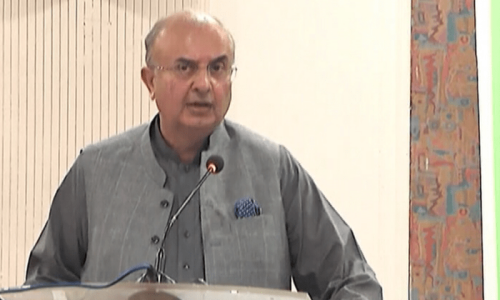
ISLAMABAD: Pakistan is well-positioned to emerge as a preferred seat of international arbitration because of substantial cost benefits and prevailing geopolitical goodwill, said Justice Jawad Hassan of the Lahore High Court’s Rawalpindi bench.
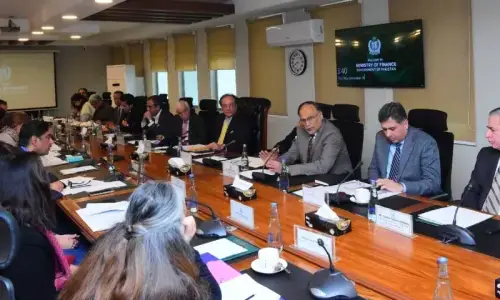
“Pakistan is making good progress on infrastructure and laws on arbitration and mediation as there is a large demand for commercial arbitration and mediation,” Justice Hassan said while speaking at a seminar titled “Can Pakistan Become a Seat of International Dispute Resolution?” at the Islamabad Policy Research Institute (IPRI).
Justice Hassan added that the pending judgement in the Star Hydro case would set the stage for further progress in this regard.
Former Punjab advocate general Asma Hamid, Barrister Salahuddin Ahmed of MCA Law Associates, Brig (retd) Raja Shozab Majeed, Deputy Director and Chair of the Chartered Institute of Arbitrators (CIArb) Pakistan, Feisal Naqvi of BNR, Barrister Mian Sheraz Javed, Chair of CIArb, and eminent international lawyer Ahmer Bilal Soofi participated in the discussion.
Country’s arbitration capacity expands as case law, mediators grow
Senior jurists, advocates and arbitration specialists brainstormed on whether Pakistan could establish itself as a venue for international arbitration and mediation.
A broad consensus emerged that while the potential exists, realising this vision would require sustained, decade-long strategic collaboration across the legal and institutional sectors.
The panel was unanimous that Pakistan had a genuine opportunity to become an international arbitration hub, but only through sustained legal and institutional reforms and capacity-building over the coming decade.
Building the arbitration ecosystem
It was noted that as Pakistan expanded trade and attracted investment through projects such as CPEC, most of its commercial disputes were still heard abroad in London, Singapore or Dubai, making the country a consumer rather than a provider of arbitration services, at considerable cost in terms of money, time and confidence.
Speakers observed that each international arbitration typically costs parties no less than two to three million pounds or dollars. They also pointed to Pakistan’s recent emergence as an international mediator, including its hosting of US-Iran talks in Islamabad, as evidence of a credibility that could be extended to commercial dispute resolution.
Speakers stressed that some of the foundations were already in place. Pakistan is a party to the New York Convention, meaning awards made domestically can be enforced internationally, while its courts have developed a clear pro-enforcement approach towards foreign arbitral awards.
The panel noted the striking growth in relevant case law. While the arbitration framework, which still rests on the 1940 Act, produced only 56 reported judgements two years ago, arbitration-related judgements are now emerging at a rate of around 120.
It was also noted that Pakistan is one of only seven countries in the world with a mandatory mediation regime. Mediation has already saved substantial public money, including more than Rs1 trillion through settlements with independent power producers and a recent $6.6 billion refinery upgrade deal.
The discussion also highlighted Pakistan’s rapidly expanding pool of arbitrators. The number has grown from six to eight just two years ago to nearly 100 fellows of the Chartered Institute of Arbitrators today, compared with roughly 150 in Singapore, 39 in the UAE and 42 in India.
Published in Dawn, September 13th, 2026