BRICS urges ‘maximum restraint’ in Mideast
• Joint statement demands protection of civilians, respect of sovereignty, global trade routes; condemns strikes on N-plants as breaches of international law
• Calls for ceasefires in Gaza, Lebanon, Sudan, Syria
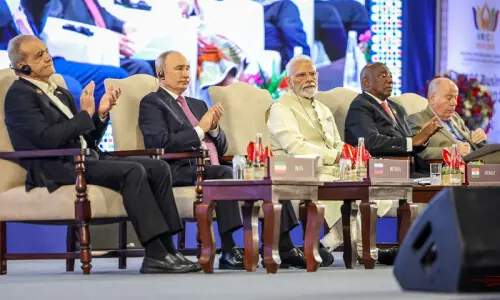
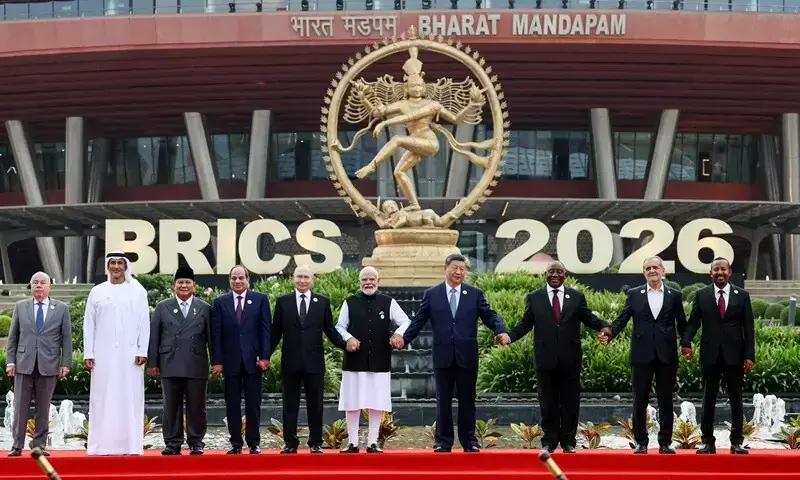
NEW DELHI: Members of the 11-nation BRICS group, including China, Russia, Iran and UAE, urged “maximum restraint” in the Middle East on Saturday, papering over months of division to issue a joint statement even as fighting between the US and Iran shows no sign of abating.
The declaration, released on the opening day of the group’s summit in New Delhi, called on countries to avoid steps that might inflame the conflict further and demanded protection for civilians, sovereignty and the free flow of trade, energy and shipping through the region.
“We express deep concern over the continued escalation of tensions in the Middle East/West Asia and, recalling our respective national positions, call for exercising maximum restraint, as well as avoiding actions that could further aggravate the situation,” said the statement.
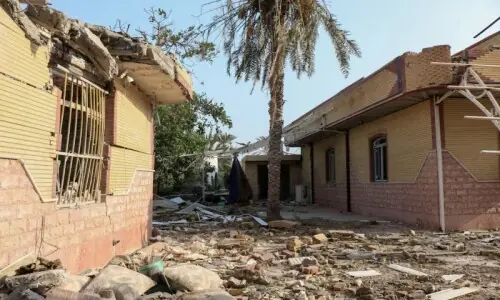
Pointedly, the 11 nations also condemned strikes on nuclear sites, warning that attacks on facilities under the safeguard of the International Atomic Energy Agency (IAEA) breached international law.
“We express serious concern over deliberate attacks on civilian infrastructure and peaceful nuclear facilities under full safeguards of the IAEA, in violation of international law and relevant resolutions of the IAEA,” the declaration said.
“Nuclear safeguards, safety and security must always be upheld, including in armed conflicts, to protect people and the environment from harm.”
The bloc, which also addressed the crises in Gaza, Lebanon, Sudan and Syria, called for ceasefires and humanitarian access across all four.
Reaching any consensus at all marked a shift from May, when BRICS foreign ministers meeting in the Indian capital failed to agree a joint text on the Middle East because of sharply differing views among member states.
Much of the diplomatic effort in New Delhi has gone into narrowing the gap between Iran and the United Arab Emirates, whose disagreements have intensified as Tehran and Washington trade strikes.
Iran has targeted the US bases across the Gulf during the war, hitting the Al Minhad Air Base in the UAE as recently as late August.
Foreign policy analysts said reaching a common statement reflected the bloc’s effort to maintain dialogue despite disagreements among its members.
They added that the declaration was unlikely to immediately alter the course of the conflict but showed an attempt by emerging economies to present a coordinated position.
“The key to ending the war lies with the US and Israel,” Sunjay Sudhir, a former Indian ambassador to the UAE, told Reuters. “What India has done is keep the difficult conversations going by showing that countries of the region can sit at the same table.”
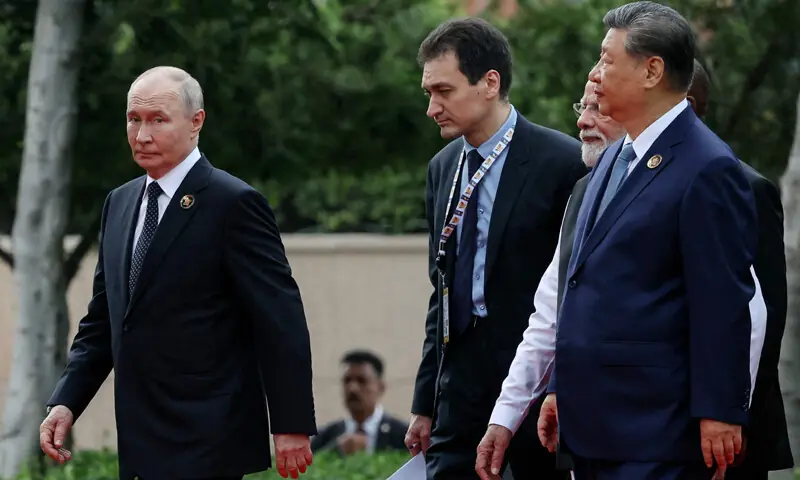
China’s president, Xi Jinping, used the summit to press for a political settlement, telling the state broadcaster CCTV that the war served nobody’s interests.
“Relevant parties must remain committed to a political settlement and work towards achieving a permanent and comprehensive ceasefire,” he said.
Xi also said China was ready to play its “due role” in achieving peace and stability in the Middle East.
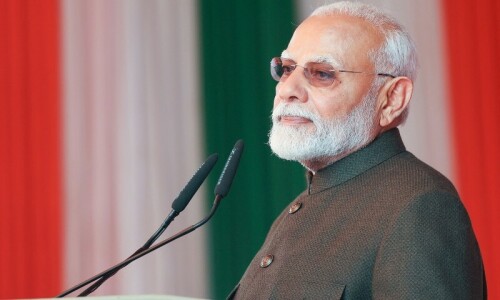
Indian Prime Minister Narendra Modi said BRICS members should focus on turning their cooperation into practical outcomes.
Published in Dawn, September 13th, 2026