3 Adiala jail inmates move FCC after IHC denies them Imran-like facilities
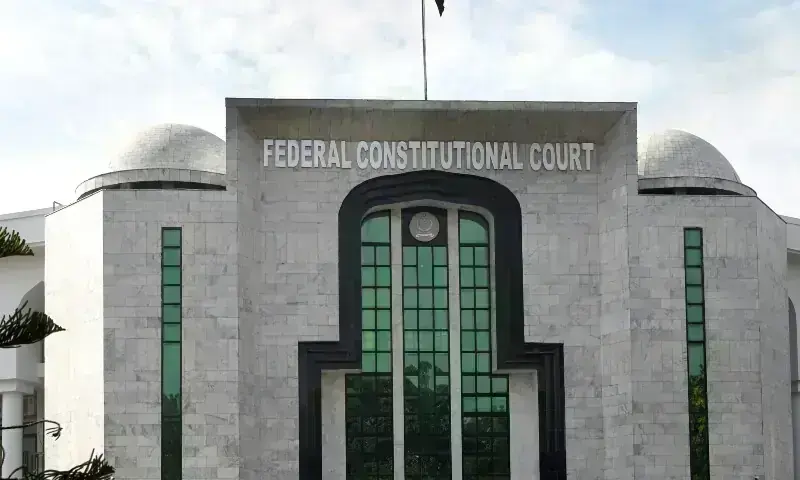
ISLAMABAD: Three Adiala jail inmates approached the Federal Constitutional Court (FCC) on Tuesday to challenge the Islamabad High Court’s (IHC) dismissal of their pleas seeking treatment at private hospitals, similar to the relief granted to incarcerated former prime minister Imran Khan.
“We are seeking interpretation of Rule 197 of the Pakistan Prison Rules, 1978, which governs the manner and mode of the transfer of a prisoner to the hospital,” Advocate Akhtar Cheema told Dawn.
He added that the relief had become “necessary” after the Aug 18 Supreme Court order regarding Imran, which had directed the government to shift the PTI founder to Shifa International Hospital, a private facility. However, the government had taken him to the government-run Pakistan Institute of Medical Sciences.
Subsequently, three Adiala inmates had approached the IHC seeking relief similar to that granted to Imran. On Aug 31, the IHC had dismissed the petitions.
On Tuesday, Advocate Cheema appeared on behalf of one of the prisoners, Muhammad Ilyas Khan. He said the other inmates, namely Mohammad Ismail Hussain and Owais Altaf, were being represented by Advocates Irfan Nasir Cheema and Syed Jaffer Baqir, respectively.
“Three separate petitions were filed before the FCC today,” he said.
Advocate Cheema said that Rule 197 prescribed that inmates could be shifted to a civil hospital, arguing that the distinction being drawn by the government that the term only referred to a public hospital was wrong.
He said the wording implied a distinction between a military and government hospital, adding that against the backdrop of the Aug 18 SC order, any inmate with a serious ailment could be shifted to a private hospital for treatment, paid by their family.
Cheema said his client had severe internal bleeding issues and had been brought to the public hospital for treatment eight times during the last two months.
“Given the condition of the public hospital system, we have no trust that my client will get appropriate medical attention at a public hospital,” he said.
The petitions filed in the FCC requested that the previous IHC decision be declared null and void, and that “the petitioners be provided with the same medical facilities as available to the PTI founder”, Cheema told Dawn.
The petition contended that Article 25 of the Constitution mandated equal treatment for all citizens, arguing that the three petitioners should be granted the same treatment as was ordered for Imran.
The petition also requested the FCC to issue directions for the prisoners to be allowed to communicate with family members living abroad through WhatsApp.
While dismissing the petitions, the IHC had held that imprisonment meant restrictions on freedom according to law, and that “every technical facility cannot be declared a fundamental right”. A prisoner, it said, had no legal right to be transferred to a private hospital of his choice.