ISLAMABAD: The Islamabad High Court has sought an explanation from the federal government and other authorities over the apparent failure to enforce fire safety laws in the capital.
The court asked them to explain whether buildings were being allowed to operate without mandatory safety clearances despite a regulatory framework empowering authorities to inspect, order compliance and even seal dangerous premises.
Chief Justice Sardar Mohammad Sarfaraz Dogar directed the federation and other respondents to submit a report and para-wise comments within two weeks on a petition seeking a fire safety audit of all buildings in Islamabad and sealing of those operating without the requisite No-Objection Certificate (NOC).
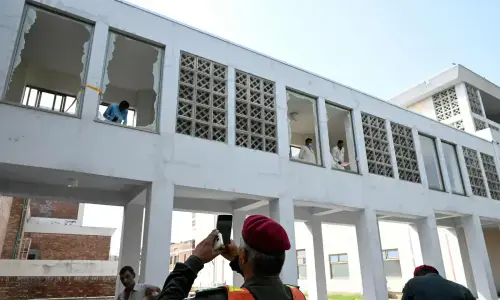
The proceedings assume significance in the wake of the August 26 fire at the Pakistan Institute of Medical Sciences (Pims), in which several newborn babies lost their lives.
The petition raises a fundamental question: if the Islamabad Fire Prevention and Life Safety Regulations 2010 have prescribed mandatory safety requirements and vested enforcement powers in the authorities, why have buildings allegedly continued to operate without the required safeguards?
The petitioner contended that Pims incident had exposed serious weaknesses in the implementation of fire safety laws in the federal capital.
According to him, a large number of commercial, residential, educational and medical buildings were being used without adequate firefighting equipment, emergency exits and mandatory fire safety NOCs.
The regulations themselves provide a mechanism for authorities to inspect buildings and determine whether prescribed fire prevention and life safety measures have been adopted. They also provide for recording deviations and directing owners or occupants to undertake specified corrective measures.
The regulatory framework goes beyond merely requiring safety precautions. In cases where a building is found dangerous, the Director Emergency and Disaster Management can order its evacuation. If occupants fail to comply, the regulations provide for their removal with police assistance and sealing of the building in the presence of a magistrate.
This provision has raised an obvious enforcement question in the wake of the Pims tragedy: whether the authorities have been routinely inspecting buildings, identifying violations and taking action against those failing to comply with the prescribed standards.
The regulations also contemplate fire safety clearance at different stages of a building’s life, including approval of building plans and issuance of completion certificates. Existing buildings are likewise required to adopt the prescribed fire safety measures.
The petitioner sought a comprehensive audit of every building in Islamabad, rather than an inquiry limited to Pims.
He requested the court to direct the authorities to identify and publicly disclose buildings operating without fire safety NOCs and seal premises that remain in violation of the law until compliance is achieved.
He also requested that registration of hospitals and educational institutions be linked to possession of valid fire safety NOCs, arguing that these facilities cater to particularly vulnerable populations and cannot be permitted to function without basic life-saving arrangements.
The petitioner invoked Articles 9, 14 and 25 of the Constitution, arguing that failure to enforce fire safety standards amounts to a violation of the fundamental rights to life, dignity and equality.
Meanwhile, the court also clubbed the petition with another case concerning a judicial inquiry into the Pims fire tragedy.
During the hearing of the petition filed by citizen Munir Ahmed, Advocate Azhar Siddique pointed out that the issue had already been examined by the National Assembly’s Standing Committee on Health last year.
He told the court that the committee had written to the Prime Minister and the Speaker regarding the condition of Pims, but no action appeared to have followed the recommendations. He also referred to a letter written by Standing Committee chairman Amjad Khan.
Chief Justice Dogar observed that an order had already been passed in a similar petition and that the relief sought in the present matter was substantially the same. He ordered the cases to be consolidated.
The chief justice observed that the attorney general should also examine the matter as it concerned the same issue.
The court directed the federation to submit a detailed report, including para-wise comments and details of action taken on the previous standing committee report.
The case has been adjourned until September 24.
Published in Dawn, September 4th, 2026