Lord Mountbatten, the last Viceroy of India, told Congress leader Jawaharlal Nehru that Pakistan was not economically viable and would come begging to re-join India within six months: “Administratively it was the difference between putting up a permanent building, a Nissen hut or a tent. As far as Pakistan is concerned, we are putting up a tent.”
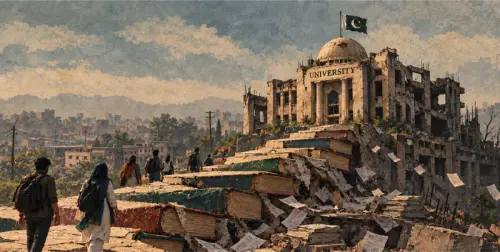
There is a compelling logic to that conclusion. Pakistan was not an existing political entity but a conceptually new country, an idea, two territories on either side of a hostile country, with extraordinary cultural diversity. It had a handful of industrial units, no military equipment and no government structure. From a security perspective, as the British Commander in Chief of the Indian Army Claude Auchinleck noted, Pakistan lacked strategic depth, with no natural barriers with India.
A skill vacuum was created by the exodus of Hindu and Sikh professionals after Partition. The coffers were empty. India did not release its portion of funds until Mohandas Karamchand Gandhi went on a fast to exert pressure. The military equipment sent was damaged, uniforms had mismatched shoes and crates contained scrap wood and stationery instead of equipment. The first government offices in Karachi were tents with furniture made of crates.
Indian statesman Vallabhai Patel echoed Nehru and Abul Kalam Azad’s sentiments, saying, “A year or two’s experience of Pakistan will cure the Muslims of their fever… and they will return to us.”
Pakistan was created by mass mobilisation and much of its continued existence has been due to the contribution of people rather than successful governance.
Pakistan was dismissed at birth as a country that would collapse within months. Nearly eight decades later, its survival and the resourcefulness of its people tell a very different story
Between August 1947 and September 17, 1948 — hours before Indian forces took control of Hyderabad State — the Nizam of Hyderabad engaged an Australian pilot to secretly fly in several vital supplies, gold and cash. The businessman Adamjee Dawood responded to an SOS by Mohammad Ali Jinnah in January 1948 with a blank cheque, and persuaded the Gujarati Muslim business community to migrate to Pakistan and establish industries. Dawood and Mirza Ispahani created Orient Airways in 1946, which eventually became Pakistan International Airlines (PIA), soon to become a premier global airline and aviation mentor.
The industrialist Fakhruddin Valika established Pakistan’s first textile mill in 1947. The Teli family launched Pakistan’s first bottled drink, Pakola, green like the flag, on August 14, 1950. Dr Mahbubul Haq shaped Pakistan’s development policy in the 1960s, leading to rapid economic growth that surprised the pundits and was emulated by South Korea. Huge dams were built, rockets sent into space and long-grain Pakistani Basmati rice gained worldwide recognition.
The public-private cooperation of the 1960s became private enterprise as successive governments remained preoccupied by their own internal, contentious conversations. People came to see government policies, usually established to please some international overseer or the other, as an interference in the business of everyday life, to be bypassed where possible.
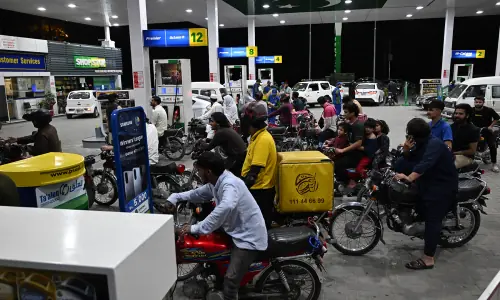
Pakistan has a flourishing informal economy. Ordinary people, unable to open bank accounts, save in local committees groups. When government falls short, private transport, schools and hospitals spring up in every locality and private ambulances fill emergency needs. When housing for the poor is ignored, basti [settlement] dwellings appear. Barbers and cobblers set up shop on pavements. Small workshops, catering, tailoring and hand carts keep the economy afloat, fulfilling the daily needs of people.
Athletes win international medals and make sporting history. Musicians, poets, artists, filmmakers, stand-up comics, innovators and businessmen gain international recognition, all due to private investments rather than state support. Pakistan‘s grassroots solar energy revolution, open criticism on social media of those in power, or fighting enemy aggression with humorous memes all reflect a positive energy that is difficult to ignore. The attitude of ‘Koi masla nahi [It’s not a problem]’ and finding a jugaarr [resourceful solution] to any problem keeps society functioning and contributes to the buoyancy and good humour of its people.
Less acknowledged is the quiet resistance to radicalisation and the refusal to be oppressed for too long. Pakistan continues to surprise the world as it refuses to fit neatly into the label of a failed state. British journalist Owen Bennett-Jones wrote in 2011, “Western academics are now debating whether the country [Pakistan] is in fact more stable than many people think.” Pakistan may have failed governments, but it has a populace that always finds ways to succeed.
Durriya Kazi is a Karachi-based artist.
She may be reached at
durriyakazi1918@gmail.com
Published in Dawn, EOS, August 30th, 2026