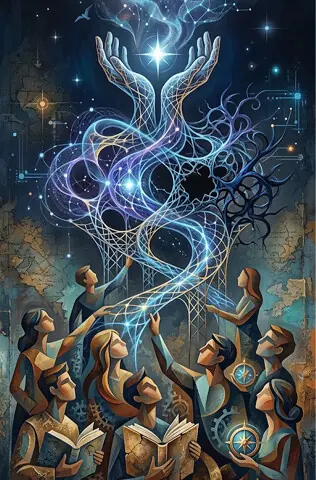
ARTIFICIAL intelligence (AI) is reshaping nearly every aspect of modern life, including education. For decades, our schools have prioritised memorisation over understanding, examination scores over problem-solving skills, and textbook learning over creativity. AI can now retrieve information, summarise reports, solve equations and generate content within seconds. When knowledge is instantly accessible, the real value of education lies not in remembering facts, but in inter-preting and questioning.
Much of the debate around AI in education focuses on concerns that students may misuse it for assignments. While these concerns are valid, history suggests that resisting technology is rarely the answer.
In reality, calculators did not replace mathematics, nor did the internet replace research. Likewise, AI should be viewed as an effective learning partner rather than a substitute for human intelligence.
Students must be taught how to use AI responsibly, asking better questions, verifying information, recognising bias, and applying technology to strengthen their own reasoning. At the same time, assessment systems must evolve to reward originality, analysis, and problem-solving instead of simple recall.
Meaningful reform should begin in early childhood and at primary education level, where lifelong learning habits are formed. Equally important is investing in teachers. Without continuous professional develop-ment, digital literacy and AI training, our educators cannot effectively prepare the students for an AI-driven future.
Many countries like Singapore, Finland, Estonia and China are already redesigning education around inquiry, digital literacy and innovation. Their experience shows that successful reform is not about intro- ducing more technology into classrooms; it is about transforming how students learn and how teachers teach.
With one of the youngest populations on Earth, Pakistan has an extraordinary opportunity. If we continue preparing students for examinations instead of real-life challenges, we risk leaving an entire generation behind. But if we equip them with the ability to think critically, learn continuously and use AI responsibly, we will prepare them not just to adapt to the future, but to shape it.
Nazakat Hussain
Islamabad
Published in Dawn, August 25th, 2026