Punjab to seek Centre’s help for check dams in capital to avert flooding in Pindi
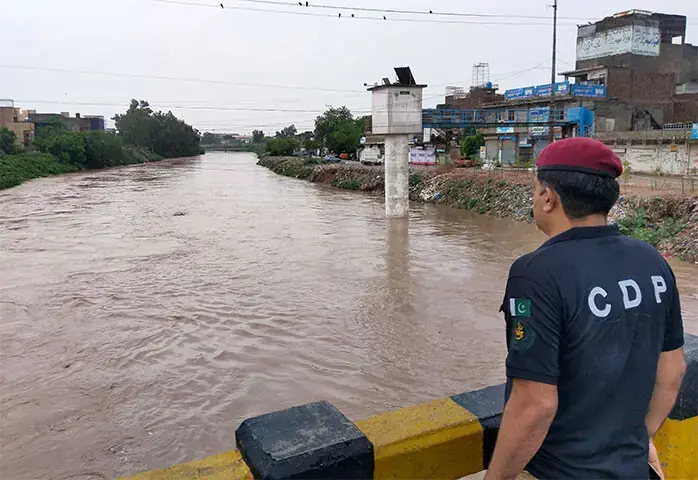
RAWALPINDI: To avoid flooding and conserve rainwater in Rawalpindi, the Punjab government will approach the federal government for the construction of check dams on nullahs in Islamabad. Moreover, the provincial government will construct ground storage tanks to save rainwater in Rawalpindi.
On the special directives of Chief Minister Maryam Nawaz, a meeting was held at the commissioner’s office to review arrangements for dealing with monsoon rains and the potential threat of urban flooding.
The meeting was chaired by Commissioner Rawalpindi Salman Ghani and Provincial Disaster Management Authority (PDMA) Director General Saif Anwar Jappa. Deputy Commissioner retired Capt Nadeem Nasir, representatives of Nespak, Rescue 1122, Civil Defence, Wasa, Rawalpindi Waste Management Company, PDMA and heads of other departments attended the meeting.
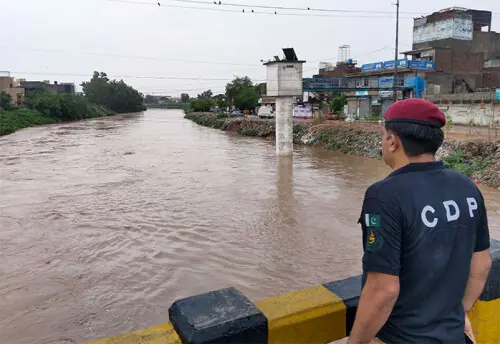
The meeting was told that Leh Nullah had a total length of approximately 17 kilometres, while its current water-carrying capacity is around 20,000 cusecs at New Kattarian, 33,000 cusecs at Gawalmandi, and 35,600 cusecs at Chaklala.
Survey ordered to construct ground storage tanks to conserve rainwater in Rawalpindi
The meeting also reviewed channel improvement and necessary engineering measures to enhance the flow capacity of Leh Nullah from approximately one kilometre downstream of Chaklala Bridge up to Kattarian Bridge. The proposed channel design has been prepared on the basis of a 25-year return period.
The commissioner said due to the geographical link between Rawalpindi and Islamabad and their upstream and downstream dynamics, heavy rainfall in Islamabad could have a more severe impact on Rawalpindi. Therefore, he said effective coordination and a joint strategy between the administrations and relevant departments of both cities were essential.
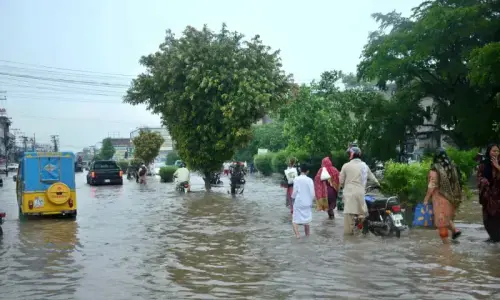
Mr Ghani said the federal government would be approached for the construction of check dams on the nullahs in Islamabad. In addition, an immediate survey would be conducted to explore the feasibility of constructing ground storage tanks in the low-lying areas of Rawalpindi, particularly Safdarabad, Pirwadhai, Dhoke Khabba and Sadiqabad, to prevent urban flooding.
He directed Wasa to complete its survey within the next 15–20 days, including the preparation of flood hazard and flood risk maps, identification of vulnerable locations and proposals for locally viable solutions.
He said as an immediate measure the Safe City cameras installed along Leh Nullah should also be used to monitor illegal dumping, while the immediate removal of encroachments from the right of way of the nullah must also be ensured.
The commissioner directed that the water flow in Leh Nullah and its connected storm water drains be continuously monitored, while the flood forecasting and early warning system should be upgraded on modern lines.
“An effective mechanism should also be developed to ensure the timely dissemination of information to relevant departments and the public,” he said.
He said special attention should be given to the timely desilting and dredging of Leh Nullah, cleaning of the drainage system and removal of obstructions from major drains and nullahs so that the natural flow of water is not obstructed during heavy rainfall.
The meeting also considered proposals for the construction of ponds and water-storage facilities at various locations as a permanent solution to urban flooding.
The PDMA director general said that technical assessments should be conducted to identify suitable locations for regulating the natural flow of water and storing excess water.
“These proposals will be shared and discussed with the Islamabad administration in the next meeting so that a joint and practical strategy for both cities can be formulated,” he said.
The deputy commissioner said that despite continuous rainfall for the past five days, no loss of life or property had been reported in Rawalpindi.
He said a proposal would be made to the Islamabad district administration to develop a treatment plant for rainwater before discharging it into Leh Nullah.
The meeting also considered a proposal to construct underground storage tanks at Fatima Jinnah Park for the conservation and storage of rainwater.
Published in Dawn, August 23rd, 2026