Residents of twin cities face another day of rain, flooding fears
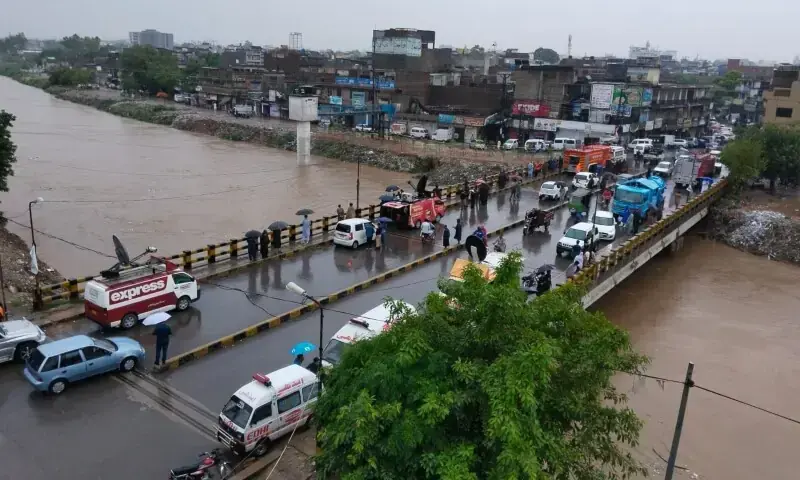
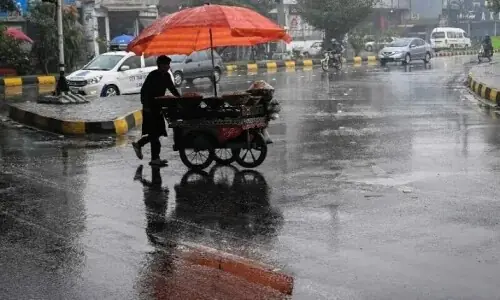
RAWALPINDI: Parts of the twin cities of Rawalpindi and Islamabad on Thursday received heavy rainfall for the fourth consecutive day, adding to the woes of residents living in the low-lying areas.
The Pakistan Meteorological Department, commonly known as the Met Office, has forecast another spell of rain on Friday (today) in Rawalpindi, Islamabad, upper Punjab, Kashmir, upper and central Khyber Pakhtunkhwa and Gilgit-Baltistan.
It has also warned of urban flooding in low-lying areas of Islamabad/Rawalpindi, Mardan, Swabi, Peshawar, Nowshera, Gujranwala, Gujrat, Sialkot and Lahore. The Met Office has further warned that heavy rains may trigger flash flooding in nullahs of Kashmir, Murree and Galiyat and landslides in hilly areas.
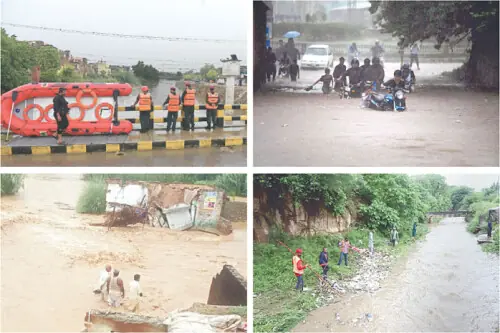
According to Rescue 1122 officials, rescue teams evacuated 12 people safely in different incidents in Rawalpindi district on Thursday morning. Three people were rescued at Hakla Interchange, five in Shahbagh and four in Khadkan village.
Met Office forecasts more rains today
In Jhelum, the Rescue 1122 teams rescued three people stranded in floodwaters and shifted them to a safe place.
Heavy rain in Jhelum district severely affected roads and mini-dams after nullahs overflowed. A bridge on Kaluwal Road in Dina tehsil was also swept away, disrupting land connectivity to several areas.
According to the weather report, the rain brought down the temperature to 30 degree Celsius, but humidity level remained 79 per cent, making the weather hot and humid. The Met Office recorded 66 milimeters (mm) rain at Islamabad International Airport, 35mm at Golra, 23mm at Bokra, 14mm at Saidpur and 12mm at Zero Point in Islamabad while 46mm at Kattarian 31mm at Pirwidhai, 29mm at Gawalmandi, 25mm at Chaklala and 21mm at Shamsabad in Rawalpindi.
Fearful nights
Meanwhile, the residents of low lying areas, especially along Leh Nullah in Rawalpindi, spent another restless night fearing flood-like situation. However, after the morning rain, the water level in Leh Nullah remained low.
It may be recalled that the twin cities residents had witnessed the heaviest rainfall of the current monsoon season on Wednesday, alerting the local administration for possible evacuations from certain localities.
Amjad Hussain, a 45-year-old resident of Rawalpindi’s Nadeem Colony, said that for him and his family, the night between Wednesday and Thursday was the worst as he had to spend the whole night shifting his goods to the second storey of his house, stating that the rainwater had already damaged some of his household items, including furniture.
“The rain started in the night (Wednesday) when my wife awoke me and asked me to shift refrigerator and TV on the upper portion,” he said, mentioning that they were already without electricity.
According to Muhammad Naseer, a resident of Arya Mohallah, the heavy rains had choked domestic drains.
“We spent a restless night in fear of flood but less water accumulated as the rain stopped with small gaps,” he said.
He said they had been living in the area for last 25 years and faced the same situation every year, but the government turned a blind eye to solve the issue to clear drains and Leh Nullah.
The areas which were inundated due to rain on Thursday included Bazaar Kallan, Dingi Khoi, Raja Bazaar, Akaal Garh, Nadeem Colony, Javed Colony, Dhoke Ratta, Gunjmandi, Jamia Masjid Road, Banni Chowk, Sadiqabad, Satellite Town, College Road, Bohar Bazaar, Naya Mohallah, Mohanpura and Amarpura.
Power supply
Meanwhile, heavy rainfall coupled with water accumulation at various locations, resulted in a large number of electricity faults, including underground cable faults, overhead transformer faults, feeder faults, as well as individual consumer complaints.
The Islamabad Electric Supply Company (Iesco) in a statement on Thursday claimed that, despite these challenging weather conditions, the company made every possible effort to ensure the prompt restoration of electricity supply and timely resolution of consumer complaints.
Iesco’s Chief Executive Chaudhry Khalid Mahmood has urged the consumers to ensure their safety during rainfall and to strictly follow all precautionary and safety measures. He has advised them to maintain a safe distance from electricity wires, poles and other electrical installations.
The Iesco chief has also advised the people to avoid construction work near electrical wires, warning departmental and legal action against individuals who undertook such unsafe activities.
— Hamid Asghar from Gujar Khan also contributed to the report
Published in Dawn, August 21st, 2026