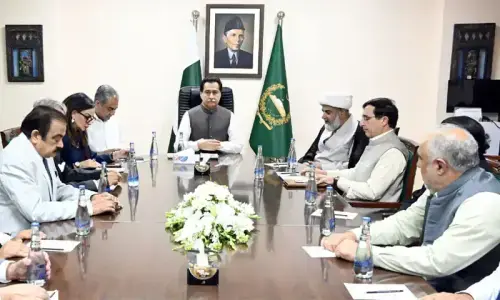
The government on Wednesday announced a “significant decrease” in the price of diesel after holding talks with petroleum refineries.
Petroleum Minister Ali Pervez Malik, speaking to the media, said diesel prices would be reduced by more than “Rs30 to Rs32” following the discussions with refineries.
The announcement comes after consecutive increases in diesel prices amid a sharp rise in global petroleum prices following the escalation of the war in the Middle East.
“Prime Minister Shehbaz Sharif also made a request to the refineries. He instructed me, and after that we had two or three virtual meetings with the refineries,” Malik said.
“I am happy to announce that the refineries have accepted the government’s demand while acknowledging the difficulties, and decided on a significant decrease in the price of diesel — of more than Rs30 or Rs32.
“After some time, you will see that Ogra, after its calculations, will finalise it.”
At the outset of his talk, Malik said the government was aware of the difficulties faced by the public because of rising petroleum product prices amid the war in the Middle East.
“The government is trying its best to address these issues using its limited resources, and Prime Minister Shehbaz Sharif is issuing orders to address them without wasting a single moment,” he said.
The minister said the government had allocated more than Rs100 billion over the past three to four months to shield the public from the impact of rising prices, despite being under an International Monetary Fund (IMF) programme.
Malik assured the public that the government would continue to “protect” them during the difficult period by ensuring adequate fuel supplies.
He said the renewed escalation of the war in the region had led to a sharp increase in the prices of refined petroleum products in global markets.
“The crack margin of refined products over crude oil is now touching $60 to $70 for diesel,” Malik said.
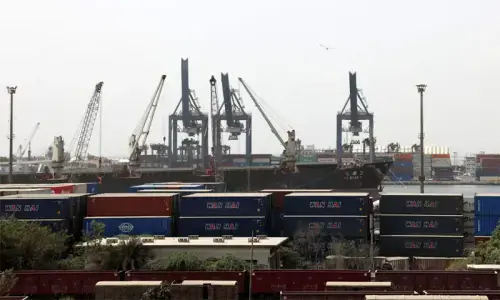
He said a significant portion of the diesel consumed in Pakistan was supplied to oil marketing companies after crude oil was refined locally.
Malik said the reduction would provide some relief to farmers, who use diesel to run tractors and tube wells, as well as the public, who rely on buses for transportation.
He also announced that, on the prime minister’s instructions, he would visit Karachi next week with his team to thank the city’s refineries.
The minister said the government would also begin work on upgrading the refineries.
“Within the next few days, the work of upgrading the refineries will be initiated under the leadership of Prime Minister Shehbaz Sharif to strengthen the state of Pakistan, which we could never do in the past 70 years,” he said.
He added that the government would also begin working on operationalising bonded schemes to facilitate the storage of oil at border locations in cooperation with friendly countries.
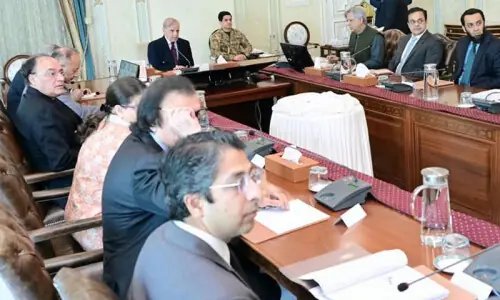
Tarar, addressing the media after the petroleum minister, said the premier had chaired a meeting earlier in the day, attended by the petroleum minister and petroleum secretary, at which he directed officials to hold negotiations with oil refineries and extend “any possible relief to the public”.
“Refining is a key part of diesel production,” Tarar said. “Ogra will soon announce a Rs32 reduction. The prime minister specifically requested negotiations, and the petroleum minister worked hard to ensure that they were successful.”
He added that the premier and the government understood the hardships faced by the people, noting that oil prices had risen worldwide due to the war in the Middle East.
“To extend relief to the people whenever possible, the prime minister used subsidies, targeted subsidies [and] spent Rs130bn in difficult conditions to prevent fuel prices from rising,” Tarar explained.
“This is a major step and a gift from the prime minister to the people,” he added. “Our goods transporters and public transport use diesel, and negotiations on locally produced diesel have been successful. I believe this Rs32 decrease will lift a weight off the people’s shoulders.”
Tarar expressed hope that the move would have a positive impact on the economy and hinted at “more good news” in the coming days.
The price of diesel has come down from a peak of Rs520.35 recorded on April 3. Its price had started rising from Rs281 per litre after the US-Iran war broke out on February 28.
Earlier, the petroleum minister had announced that fuel prices would now be fixed on a daily basis due to fluctuations in international market prices following renewed hostilities between Iran and the US.
The government had been announcing weekly revisions to fuel prices since early March, alongside measures for the conservation of fuel amid possible oil supply disruptions due to the ongoing conflict in the Middle East.