KARACHI: During a public hearing about the proposed Karachi Port to Qayyumabad Corridor Project on Tuesday, residents of DHA, Clifton, Qayyumabad and adjoining communities formally submitted detailed objections to the Environmental and Social Impact Assessment (ESIA), calling upon the Sindh Environmental Protection Agency (Sepa) to withhold approval until significant deficiencies in the assessment are independently reviewed and resolved.
The public hearing was conducted by Sepa Director Waris Gabol and technical consultants along with the ESIA firm.
While supporting the efforts of the government to improve freight movement, reduce congestion and strengthen Karachi Port connectivity, the representative of Defence Society Residents Association (DSRA), Jamal Macdi, with Phase 2 Residence Association and Seaview Residents Association, argued that the current proposal would place a high-volume elevated freight corridor through established residential, educational, healthcare and environmentally sensitive areas without adequate evidence that it is the safest, most sustainable or least harmful option available.
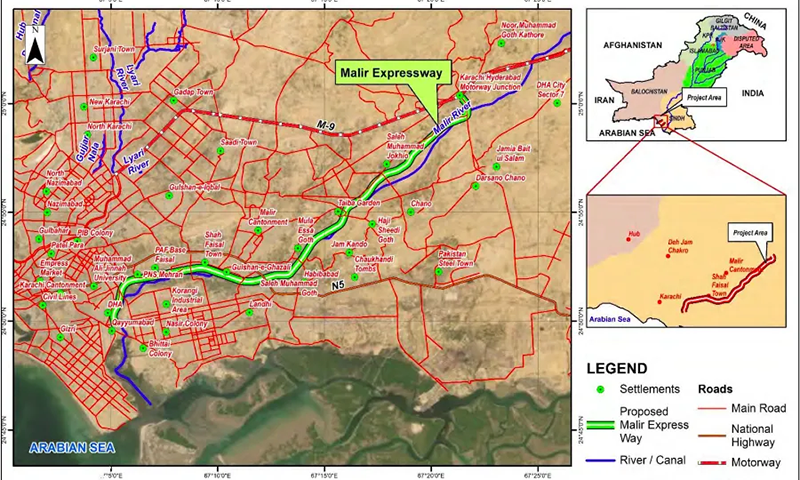
According to the ESIA, the project involves an elevated four-lane access-controlled freight corridor extending more than 16.5 kilometres between the Karachi Port and Qayyumabad. The same assessment acknowledges that the corridor would pass through residential and commercial areas and result in what it describes as a “significant and irreversible impact.”
DHA, Clifton, Qayyumabad residents question environmental impact assessment; demand independent review of alternatives and a revised assessment before approval
Residents raised concerns regarding inconsistencies within the project documentation itself, noting that different sections of the submitted materials describe varying project lengths, costs, construction schedules and alignments. They said that environmental approval cannot be based on documents that do not consistently define the project under review.
The residents’ objections also highlighted an inadequate evaluation of alternatives. They said that the ESIA does not provide a transparent comparison of the proposed alignment with other potential freight solutions, including upgrades to the Northern Bypass, the Karachi Port Trust to Pipri freight rail corridor or combined rail-road alternatives. They were particularly concerned about the projected freight volumes (the Traffic Impact Assessment forecasts heavy vehicle traffic rising from 15,399 trucks per day in the opening year to 25,090 trucks per day by 2036).
Therefore, the residents called for independent reviews and a revised public consultation. They asked Sepa to exercise its authority to require substantial revisions to the ESIA before considering any approval.
Their recommendations included independent peer review of environmental studies, a multimodal alternatives assessment, completion of all major management and emergency response plans and expanded community consultation at the household level.
The residents said that environmental assessments should fully quantify the consequences of these traffic levels on surrounding neighbourhoods rather than rely primarily on qualitative conclusions.
Their additional concerns included operational noise, air-quality impacts, hazardous cargo transportation, privacy, urban heat-island effects, property impacts and mangrove ecosystems. They said that the ESIA lacks key studies, including receptor-specific noise modelling, air-dispersion modelling, quantitative hazardous-material risk assessments, property-impact evaluations and project-specific urban climate analysis.
They further seek written confirmation that no civil works, excavation, construction or related activities may commence until the statutory environmental approval process has been fully completed.
Among the key demands made to Sepa are a revised and internally consistent ESIA, an independent assessment of rail, Northern Bypass and hybrid freight alternatives, detailed noise, air-quality and public health studies, a quantitative hazardous-material risk assessment and independent review of mangrove, hydrology and climate impacts.
They also wanted a transparent property impact and compensation framework, publication of all technical studies for public review and a second public hearing following revision of the ESIA.
Published in Dawn, August 19th, 2026