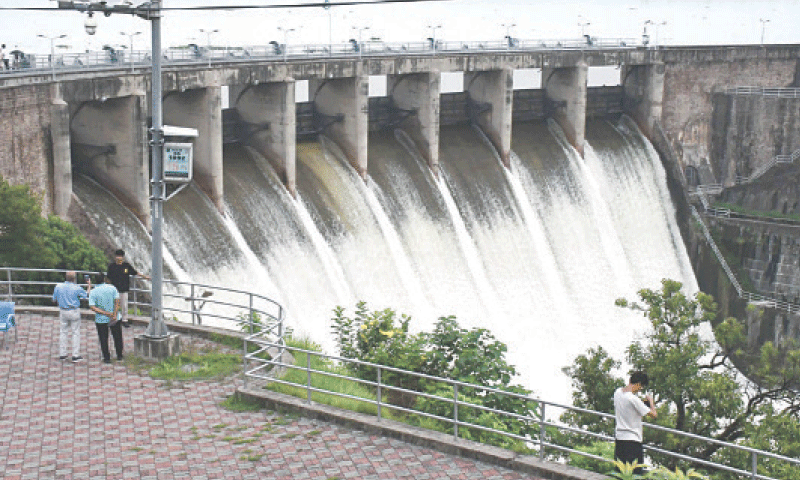
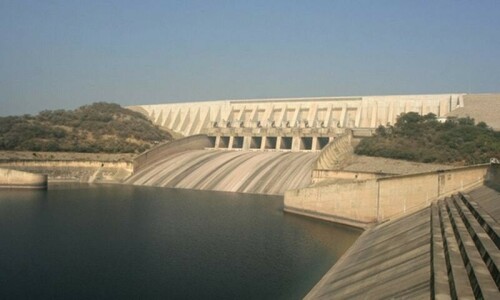
Heavy rains pushing water level higher in Mangla Dam
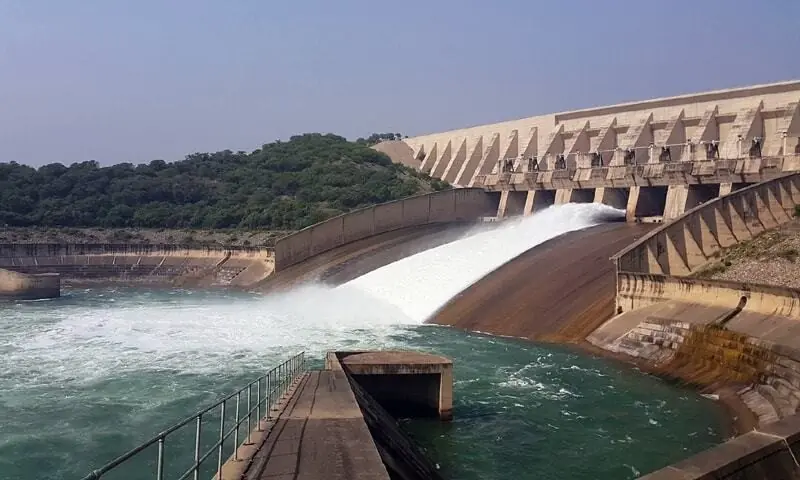
LAHORE: The water level in the country’s largest reservoir in terms of storage (Mangla Dam) is rising fast—almost a foot daily these days, as it reached 1,212.80 feet on Tuesday evening, following frequent rains in its catchment area.
According to Water and Power Development Authority (Wapda) daily reports, the water storage level in the dam was 1,199.35 feet on Aug 3 and it touched the figure of 1,212.80 feet at 6pm on Tuesday—nearly 29 feet short of its maximum conservation level of 1,242 feet.
“If the rains continue in the catchment area, the dam may be able to attain its maximum storage level of 1,242 feet above mean sea level within the next 30 days,” said a water expert while talking to Dawn on Tuesday.
“Last year, Mangla filled to its maximum storage level probably on Oct 8 or 9,” he recalled.
FFD says low level flood expected in some rivers in next 48 hours; forecast for flash flooding in hill torrents, urban flooding in major cities
It is pertinent to mention that Tarbela Dam, the country’s second largest reservoir in terms of storage, already attained its maximum water conservation level of 1,550 feet on Aug 10. It is still maintaining the same level. Before this, Chashma lake had also attained its maximum storage level of 649 feet. The filling of the country’s reservoirs is a good omen for irrigation and affordable hydel power generation purposes.
Mangla Dam was completed in 1967 and since then, it continues contributing significantly in the country’s economy being a major source of irrigation besides helping the country to mitigate floods and provide clean, green and affordable hydel power generation to the national grid. Upon completion in 1967, Mangla Dam had a live storage capacity of 5.88 million acres feet (MAF), which, according to Wapda, gradually decreased to 4.6MAF by 2004 due to sedimentation.
In 2004, Wapda commenced Mangla Dam Raising Project and upon its completion, the authority not only regained the lost storage capacity but also enhanced it to 7.5 MAF with an addition of 2.9 MAF, turning it to the biggest water reservoir having 1,000MW power generation capacity currently which is being increased to 1350MW through implementing Mangla Refurbishment Project in a phased manner.
Meanwhile, the Flood Forecasting Division (FFD) says that some rivers at various gauging stations and barrages are expected to attain low level flood over the next 48 hours, with a risk of flash flooding in hill torrents and urban flooding in major Punjab cities.
On the Indus, Sukkur Barrage is likely to enter the low flood level, while Kalabagh, Chashma, Taunsa and Guddu barrages are expected to remain at the low flood level. On the Chenab, Head Marala and Khanki are also likely to attain the low flood level. On the Ravi, Shahdara and Sidhnai are also expected to enter the low flood level just as Balloki.
The FFD further forecast that Mangla on the River Jhelum could reach a low flood level during the next 48 hours. It warned of possible flash flooding in streams adjoining the Kabul River and in hill torrents of the Dera Ghazi Khan division. Urban flooding is also likely in Rawalpindi, Lahore, Gujranwala, Sialkot, Faisalabad and Gujrat during the period.
According to Wapda daily report, the River Indus at Tarbela on Tuesday (6am) had inflows of 233,200 cusecs and outflows of 232,600 cusecs, followed by the River Kabul at Nowshera having inflows of 31,500 cusecs and outflows of 31,500 cusecs.
Jhelum at Mangla was flowing at 29,800 cusecs inflows and 7,000 cusecs outflows while Chenab at Marala recorded inflows of 66,500 cusecs and outflows of 41,200 cusecs.
Tarbela Dam’s water level recorded on Tuesday was 1,550 feet—equal to its maximum conservation level 1,550 feet and live storage of 5.580 MAF. Mangla reservoir’s level was 1,212.50 feet (6am on Tuesday)—nearly 29 feet less to its maximum level of 1,242 feet. It recorded live storage of 5.060 MAF.
Published in Dawn, August 19th, 2026