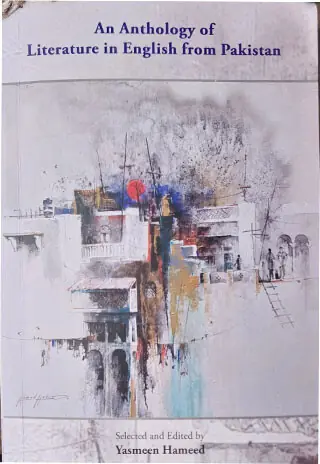
YASMEEN Hameed, a well-known poet and translator, is recognised as an untiring scholar, too, as she comes up with some new work every few years. Her latest book, An Anthology of Literature in English from Pakistan, is a 543-page collection of writings in English by Pakistani authors and it must have taken years of unremitting toil.
The anthology proffers selections from poetry, short stories, novels and non-fiction and these are original writings in English by Pakistani authors, not translations. Ms Hameed in her intro has appreciated the cooperation of the libraries that she collected the material from — including GCU Library, FCCU Library, Quaid-i-Azam Library, Dyal Singh Library, Punjab University Library — a heartening assurance that library culture is alive in Pakistan.
She has given credit to some works that served as guideline for her book, in particular Tariq Rahman’s A History of Pakistani Literature in English 1947-1988 (1991; Oxford, 2015) and Muneeza Shamsie’s Hybrid Tapestries: The Development of Pakistani Literature in English (Oxford, 2017).
Giving a thumbnail history of English literature from Pakistan, she first recalls a few works penned in pre-independence era by some renowned authors, such as, Ahmed Ali, Khwaja Ahmed Abbas, Firoz Khan Noon and Mumtaz Shahnawaz. She quotes Muneeza Shamsie as saying “Mumtaz Shahnawaz wrote the first work of English language fiction in post-independence Pakistan and her intensely political book The Heart Divided (1957) is possibly the first South Asian English novel about partition”. Mumtaz Shahnawaz “died in an air crash in 1948” and her novel, written between 1943 and 1948, was published posthumously, adds Ms Hameed.
The anthology begins with selections from poetry, offering 80 poems by 46 bards, some of them quite young, for instance, Ammar Aziz (born 1989), and some have departed for their heavenly abodes decades ago, for instance, Shahid Suharwardy (1890-1965). The section on short fiction has 25 short stories by 24 writers, as Peerzada Salman’s two stories have made it to the selection.
As for long fiction, 34 excerpts from Pakistani English novels have been included. Portion on non-fiction has 10 articles by nine authors. This makes the book an all-inclusive and representative anthology of Pakistani English literature from 1947 to the present times. All in all, over 100 authors have contributed to the anthology and it is simply not possible to name them all here, but you may rest assured the selection is made purely on merit and no big name is missing.
The contents of the book are arranged in chronological order and, reading in that sequence, one can observe the changing moods and colours of the writings, as well as the quality and quantity. As notes Ms Hameed, “The initial 10 to 15 years after 1947 were rather quiet and lazy except for a novel by Elsa Kazi … a collection of short stories by Zeb-un-Nisa Hameedullah and Mumtaz Shahnawaz’s The Herat Divided.”
But some of the poets and writers who were active contributors to literature in English in 1960s, 1970s and early 1980s, she notes, “have vanished”. In 1980s poetry, rather than the prose, remained more popular literary genre in English literature written in Pakistan, she says while quoting Tariq Rahaman. However, as she mentions, “during the last decade of the 20th Century, the nucleus of Pakistani literature in English began to gradually shift from poetry to fiction, mainly long-fiction”.
She feels that Pakistani fiction writers seem to have followed Tariq Rahman’s advice to Pakistani poets who had said that English language poetry written in Pakistan should engage with experiences of Pakistan. But, strangely enough, the fiction writers took a slightly different path and, as put by Ms Hameed, “portrayal of the dark, gloomy side of Pakistan’s social and political culture is a popular, recurring theme” in long fiction. And during the last quarter of a century, the very same dark and gloomy “writings from Pakistan in English have been widely recognised around the world”. Well, one feels that Tariq Rahman should offer a new piece of advice to the writers and ask them to focus on some other aspects of Pakistan society as well.
The book is published by Pakistan Academy of Letters, Islamabad, under its series on selections from Pakistani languages —as English is also included in the 75-odd languages spoken in Pakistan. A glossary of Urdu terms commonly used in Pakistani society and a transliteration guide are appended at the back of the book and may come in handy. A section offering brief notes on the contributors is another help for the readers.
Ms Hameed has published five collections of her poetry in Urdu and several other works both in Urdu and English. This book is yet another feather in her cap.
Published in Dawn, August 17th, 2026