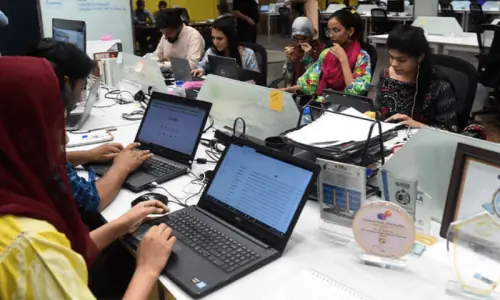
Pakistan’s computer-based IT services have emerged as one of the country’s top export performers in recent years. But a new study warns that its impressive growth is resting on a fragile foundation.
According to the study — Expanding Pakistan’s IT Footprint — by the Pakistan Business Council, computer services exports nearly doubled from $1.67bn to $3.24bn in five years to FY25, while total information and communication technology exports reached $3.81bn. The sector accounted for 45pc of total services exports and generated a $2.4bn trade surplus, the highest among services categories.
Yet the report says the official figures may significantly understate the sector’s actual size. Including IT-related earnings routed through personal remittance channels and revenues generated by Pakistani-founded firms registered abroad, the sector’s true earnings could be closer to $5bn or more.
The more serious concern is the composition of growth. Freelance transactions accounted for 90.8pc of recorded IT export entries in FY25 but generated only 24.1pc of their value. At the same time, the median value of freelance transactions fell 41pc between 2021 and 2025 from $106 to $63. This is despite a 114.6pc increase in total freelance exports. The report says this points to growing commoditisation and increasing exposure to artificial intelligence.
The median value of freelance transactions fell from $106 to $63 between 2021 and 2025 indicating increased exposure to AI
With AI rapidly disrupting the technology services, Pakistan’s IT industry is at a point where the next phase of growth will require much more than producing software developers and freelancers to sustain the current growth momentum.
“The experience of competing exporters suggests that growth cannot depend indefinitely on low-cost outsourcing,” says Badar Khushnood, former P@sha chairman. India and Poland, for instance, are seeking to move from service provision towards innovation, AI and research and development, while successful hubs increasingly combine predictable regulation, reliable digital infrastructure, specialised technology zones and advanced skills.
“Now is the time to move into the next phase, and build infrastructure, skills, finance and institutional capacity needed to turn a promising IT sector into a major export industry,” argues Mr Khushnood, the lead investigator for the PBC report.
Many industry players agree that this is an area where China-Pakistan cooperation can move beyond the traditional China-Pakistan Economic Corridor model of roads, power plants and infrastructure. Pakistan’s decision to join the 29-member World Artificial Intelligence Cooperation Organisation (Waico), a China-led intergovernmental initiative formally launched on July 16, adds a new dimension.
Beijing can be central to Pakistan’s digital strategy, not simply as a source of investment or hardware but as a partner in infrastructure, technology transfer, skills development and access to international markets. Islamabad’s immediate opportunity is to build the physical infrastructure underpinning the digital economy.
The most obvious starting point is data centres. The country’s expanding digital economy requires large, reliable facilities for computing and data storage. Chinese technology companies have considerable experience in building and operating such infrastructure. Pakistan should invite them to establish large-scale data centres, particularly in designated technology zones where land, connectivity, taxation and power supplies can be provided on predictable terms. These should not be built merely to serve the domestic market. Pakistan’s location gives it the potential to provide cloud and digital services to businesses in the region and, eventually, African markets.
But this opportunity will remain theoretical unless Pakistan solves the power problem. A software company can survive an occasional power interruption with backup arrangements. A major data centre cannot. Cloud computing and artificial intelligence require continuous electricity and increasingly large amounts of it.
Pakistan should therefore develop dedicated technology clusters with redundant grid connections, backup capacity and long-term commercial power contracts. Chinese expertise in solar generation, batteries, energy storage and efficient cooling could be particularly valuable. Reliable renewable power could itself become a competitive advantage for Pakistan’s data-centre industry.
Another challenge is computing capacity. Pakistan has begun developing its AI ecosystem, but there is a risk that it will become primarily a consumer of technologies developed elsewhere. China could help change that through joint AI laboratories, computing centres and applied-AI programmes involving Chinese and Pakistani technology companies, universities and local startups. The focus should be practical applications in agriculture, healthcare, logistics, manufacturing, banking, energy and public services.
Chinese companies could provide cloud capacity, computing resources, technical expertise and mentors, while Pakistani researchers and companies develop applications for emerging markets. The objective should be to create intellectual property in Pakistan rather than merely deploy imported AI systems.
Talent is equally important. Pakistan has no shortage of young people entering technology, but the skills mix needs to move beyond relatively routine software development and business-process services towards artificial intelligence, cloud engineering, cybersecurity, semiconductor design, robotics, embedded systems and advanced software.
China could also become a gateway to markets that Pakistani IT companies have largely overlooked. Its companies with global operations could become anchor customers for Pakistani software, engineering, cybersecurity, animation, gaming and business-process firms.
The objective should not be to turn Pakistan into a low-cost back office for Chinese companies. It should be to integrate Pakistani firms into Chinese companies’ global supply chains and technology networks.
Chinese electronics and technology companies could help establish design and engineering centres and train Pakistani engineers for international projects.
The same principle applies to cybersecurity. As businesses across developing markets digitise, demand for affordable cloud security, threat intelligence and secure software will grow. Pakistan could build an export-oriented cybersecurity industry.
But infrastructure and skills will not produce a digital export boom if the business environment remains cumbersome. Pakistan must also encourage its technology companies to scale. It has many small firms but relatively few globally significant ones. Incentives should therefore be linked to measurable outcomes: export growth, skilled employment, research and development, intellectual-property creation and foreign-exchange earnings.
The objective should be to move Pakistan from a low-cost outsourcing destination towards a regional digital-services and technology hub. This cannot be achieved only through government-to-government cooperation. It requires active participation of Pakistan’s companies through joint ventures with Chinese counterparts where needed.
Published in Dawn, The Business and Finance Weekly, August 17th, 2026