For a simple, straightforward movie, The Last House is surprisingly confused about what it wants to be.
Is it an alien invasion thriller? A survival story? A family drama where most of the runtime is taken up by perfunctory decisions that work only for the time being, while the crucial choices — the ones leading to actual revelations and the high points of the story — are held back for the climax?
Here’s a hint: it is all of the above, with a heavy emphasis on the last part.
The director is Louis Leterrier — The Transporter, The Incredible Hulk (the Edward Norton one), Now You See Me, Clash of the Titans and Fast & Furious 10. The writer is Matthew Robinson — Love and Monsters and Dora and the Lost City of Gold. The producer is Peter Chernin — Oblivion, all recent Planet of the Apes films, Ford v Ferrari.
The Last House juggles alien invasion, family drama and survival horror, but takes far too long to make any of them compelling
The cast includes Greta Lee, of the Oscar-nominated film Past Lives and Tron: Ares, and Wagner Moura of Narcos and the Oscar-nominated The Secret Agent, alongside two pairs of actors playing their on-screen children: Riley Chung and Emma Ho as the daughter, and Noah Alexander Sosnowski and Gabriel Barbosa as the son. There is a reason for casting two sets of child actors.
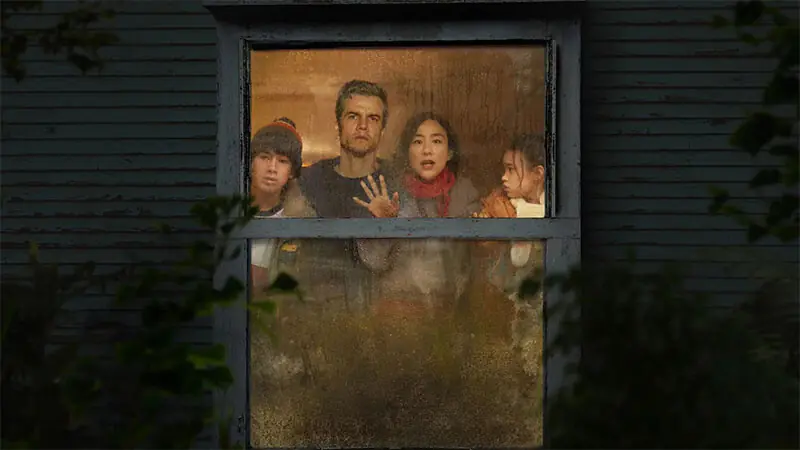
The story goes like this: a family gets trapped inside their home, which has been mysteriously sealed by an impenetrable force field that weakens only when rain falls and the creatures outside attack. Despite dwindling rations and eventual power and gas cut-offs — the phone lines and internet went down immediately after the invasion — the family somehow survives for seven years, before finally growing desperate enough to fight back.
Although, for the audience, seven years go by in 20 or so minutes, it feels agonisingly longer as the family musters the courage to cobble together a plan. A plan that should have been executed in the first month, if not the first year, and certainly not delayed until after the film shamelessly lifts the cellar-hiding sequence straight out of Steven Spielberg’s War of the Worlds.
By then, almost everyone (at least in this writer’s household) had had enough, and it becomes clear why Chernin’s production company — which once had an exclusive deal with 20th Century Fox before moving on to Netflix — chose to release the film on a streaming platform.
For a production company, direct sales to a streaming company may make solid business sense. However, in this film’s instance, the audience also gets an added benefit not found in cinemas: the 1.25x and 1.5x playback speed buttons.
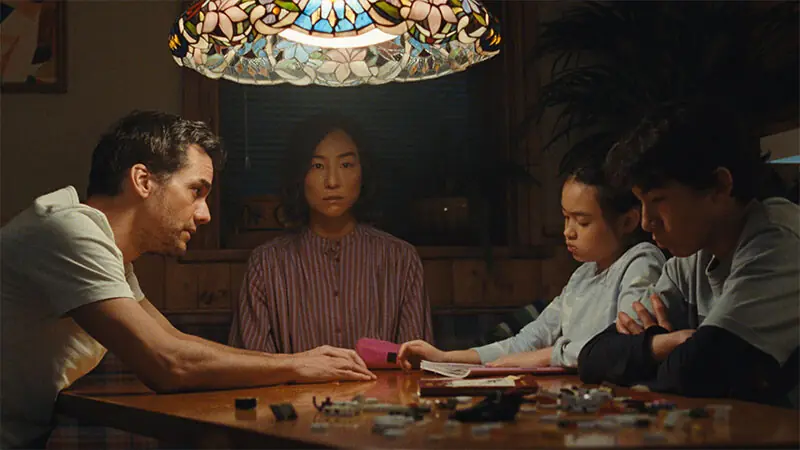
The Last House juggles various themes in hopes of bringing emotional conviction and intellectual depth to an alien-invasion narrative. It gets partially there, mostly because of an okay-to-good performance from Moura and passable work from Lee and the young actors. More often than not, though, one feels that the limited premise — alongside a deliberate decision to keep the budget in check — prevents the story from breaking out of its own self-imposed force field.
M. Night Shyamalan’s Signs and George A. Romero’s Night of the Living Dead (the 1968 progenitor of modern zombie cinema) — both operating within roughly the same ballpark runtime, give or take 10 or 15 minutes — demonstrated what can be achieved with a single-location set-up and tight narrative constraints. And, if anything, a leaner runtime in Signs, Night of the Living Dead, or even A Quiet Place kept the tension taut and the pacing relentless.
As it stands, The Last House works, but only until you reach the halfway mark and find yourself asking: why haven’t I turned on the 1.25x speed yet?
A Netflix Original production currently streaming at the No 1 spot, The Last House is rated suitable for viewers 16 and above, and features scenes where, in desperate survival mode, characters resort to eating cute animals
The writer is Icon’s primary film reviewer
Published in Dawn, ICON, August 16th, 2026