Solar eclipse darkens Arctic Russia on course for Spain
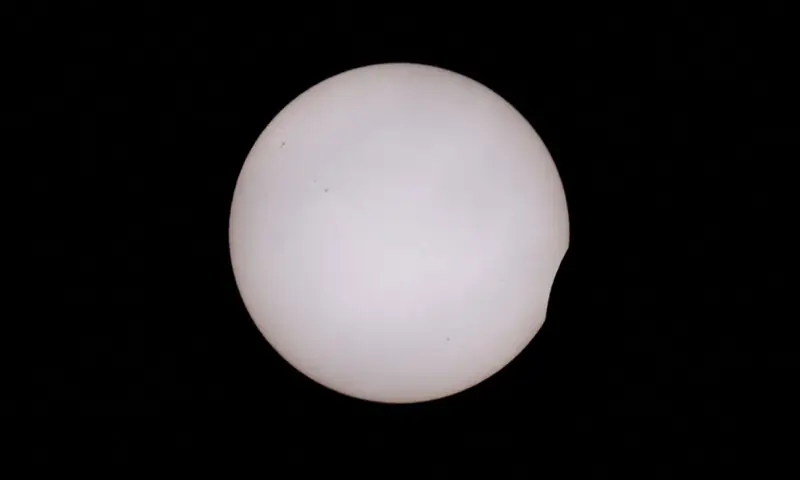


BURGOS: One of nature’s greatest spectacles — a rare total solar eclipse — began casting its shadow on Wednesday, briefly turning day into night in Russia’s remote Arctic north before heading towards mainland Europe.
The Moon first blotted out the Sun at the northernmost tip of mainland Russia at about 1700 GMT, leaving only the shimmering glow of its outer corona, and eerie darkness.
As it passes down through parts of Greenland and Iceland, excitement built in Spain, where the eclipse’s narrow path cuts diagonally from the northwestern Atlantic coast to the Mediterranean Sea, before being expected to fade at about 1830 GMT.
Tourists and enthusiasts thronged normally quiet Spanish villages, as mainland Europe has not experienced a total solar eclipse for 20 years while Spain has not witnessed one in more than a century.
Iceland’s capital, Reykjavik, however, has not seen a total solar eclipse since 1433.
“It’s the first time and it’s the last time, the only time I’m going to see an eclipse,” Yenny Guevera, a 50-year-old Peruvian living in France, said excitedly in Burgos, northwest Spain.
“I like painting and I really like light,” said Mercedes Bua, a 51-year-old engineer awaiting the eclipse’s passage in a park in Colmenar Viejo, some 30 kilometres (19 miles) north of Madrid.
“So I find it interesting to see how it’s going to look.” Supplies of special viewing glasses were in high demand as a partial eclipse will be visible for millions more in most of Europe, Canada, the northern United States and northwest Africa.
Throughout human history, eclipses have stirred amazement, fear and reverence, as they appear to momentarily halt the normal course of nature. The shadow or “umbra” cast by the alignment of Sun and Moon creates a strange twilight during which temperatures drop, shadows appear at strange angles and some animals go to sleep.
But the phenomenon is fleeting, lasting just minutes. The partial eclipse — which occurs as the Moon starts and finishes crossing the Sun’s path, dimming its light — will last around one hour and 45 minutes.
Lucie Green, a British solar physicist who has travelled the world to witness eclipses, called it “a moving experience”. She will watch from a boat off the island of Mallorca.
The event, to be livestreamed by both Nasa and the European Space Agency, presents scientists with a rare opportunity to study the Sun’s atmosphere and its outermost layer, as they seek to uncover secrets about solar winds and our star’s magnetic field.
Published in Dawn, August 13th, 2026